Imaging and Controlling Emergent States in Quantum Materials Peter - - PowerPoint PPT Presentation

imaging and controlling emergent states
SMART_READER_LITE
LIVE PREVIEW

Imaging and Controlling Emergent States in Quantum Materials Peter - - PowerPoint PPT Presentation

Imaging and Controlling Emergent States in Quantum Materials Peter Wahl University of St Andrews Acknowledgements Experiments: Christopher Trainer, Chi Ming Yim, Ram Aluru, Haibiao Zhou, Antoine Essig, Jean-Philippe Reid (St Andrews) Mostafa


slide-1
SLIDE 1

Peter Wahl

University of St Andrews
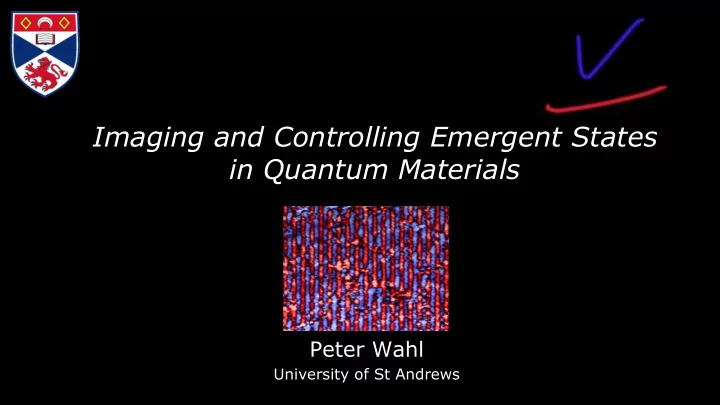
Imaging and Controlling Emergent States in Quantum Materials

slide-2
SLIDE 2

Acknowledgements

Experiments:

Christopher Trainer, Chi Ming Yim, Ram Aluru, Haibiao Zhou, Antoine Essig, Jean-Philippe Reid (St Andrews) Mostafa Enayat, Zhi-Xiang Sun, Udai Raj Singh, Stefan Schmaus (Stuttgart)

Samples:

  • Y. Liu, C.T. Lin, MPI Stuttgart
  • V. Tsurkan, J. Deisenhofer, A. Loidl, Universität Augsburg

Shun Chi, Doug Bonn, UBC Vancouver Chris Stock, University of Edinburgh Theory:

  • A. Yaresko, MPI Stuttgart
  • C. Heil and F

. Giustino, Oxford University

Funding: Scottish Universities Physics Alliance Netherlands Organization for Scientific Research (Rubicon Grant) EPSRC

slide-3
SLIDE 3

Quantum Materials - High Tc Superconductivity

K.A. Müller and J.G. Bednorz, Science 237, 1133 (1987) May 11, 1987

slide-4
SLIDE 4

Phase Diagrams of Quantum Materials

  • Nat. Phys. 8, 514
  • C. Lester et al., Nat. Mat. 14, 373 (2015)
  • S. Grigera et al., Science 294, 329 (2001)
slide-5
SLIDE 5

Instrumentation

STM head

  • Rev. Sci. Instr. 82, 113708 (2011); Rev. Sci. Instr. 84, 013708 (2013);
  • Rev. Sci. Instrum. 88, 093705 (2017)

Magnet dewar

  • 1.6K (to ~20K) 16T SI STM
  • 7mK(MXC), 14T SI-STM, hold

time up to ~140h

  • 1.6K, 9/5T vector magnet

All with sample exchange and in-situ sample cleavage.

slide-6
SLIDE 6

Spectroscopic Mapping

Spatial map of local excitations:

  • Local gap size
  • Effect of defects
  • Inelastic excitations
  • Local ordering

Periodic effects:

  • Quasiparticles
  • CDWs
  • Lattice distortions

FFT

slide-7
SLIDE 7

Tip LDOS Sample LDOS

Spin-polarized STM

 

  E

T E f T eV E f z V E Τ eV E E eV E E V I

s t t s t s

d ) , ( ) , ( ) , , ( ) ( ) ( ) ( ) ( ) (       

      

   

With a magnetic tip on a magnetic sample:

  • R. Wiesendanger, Rev. Mod. Phys. 81, 1495
slide-8
SLIDE 8

Tip LDOS Sample LDOS

Spin-polarized STM

 

  E

T E f T eV E f z V E Τ eV E E eV E E V I

s t t s t s

d ) , ( ) , ( ) , , ( ) ( ) ( ) ( ) ( ) (       

      

   

With a magnetic tip on a magnetic sample:

  • R. Wiesendanger, Rev. Mod. Phys. 81, 1495

In constant current mode: tip will approach

slide-9
SLIDE 9

What is the Smoking Gun

  • f Magnetic Imaging with

STM ?

  • 1. Change the

magnetization of the tip

  • 2. image the same

place with the same tip

slide-10
SLIDE 10

Iron-based Superconductors

Paglione&Greene, Nat. Phys. 6, 645 (2010)

slide-11
SLIDE 11

Phase Diagram

0.0 0.2 0.4 0.6 0.8 1.0 20 40 60 80 100

Temperature [K] x [Fe1+ySexTe 1-x]

tetragonal monoclinic

  • rthorhombic

superconductivity

  • N. Katayama et al., J. Phys. Soc. Jpn. 79, 113702 (2010);
  • Y. Mizuguchi and Y. Takano, J. Phys. Soc. Jpn. 79, 102001 (2010)
slide-12
SLIDE 12

Phase Diagram

E.E. Rodriguez et al., Phys. Rev. B84, 064403 (2011)

Origin of complex magnetic order:

  • Doping due to excess iron ? (e.g. Ducatman, Fernandes, Perkins, Phys. Rev. B 90, 165123)
  • Quantum fluctuations ? (e.g. Ducatman, Perkins, Chubukov, Phys. Rev. Lett. 109, 157206)
  • Structural distortion driving double-stripe order (Glasbrenner et al., Nat. Phys. 11, 954)

Plaquette Order Diagonal Double Stripe Order

slide-13
SLIDE 13

Fe1+δTe

Fe Te

Cleavage plane

3.77Å

slide-14
SLIDE 14

Stripes in FeTe

Te Fe

a b

Te Fe

a b

Magnetic structure deduced from Neutron Scattering

qTe

a

qFe qAFM 1

  • 1
  • 1

1

qx qy

qTe

b

Expected Pattern in Fourier Space

qTe

a

qFe 1

  • 1
  • 1

1

qx q

y

qTe

b

slide-15
SLIDE 15

Stripes in FeTe

Non-magnetic tip Magnetic tip Some Fe defects gone …

slide-16
SLIDE 16

Magnetic Field

B=5T B=-5T

30 Height (pm)

slide-17
SLIDE 17

Magnetic Field

zt P

  • 10

10 Spin pol. (%)

Largest spin polarization between Te atoms ! Science 345, 653 (2014)

  • Phys. Rev. B 91, 161111 (2015)
slide-18
SLIDE 18

STM in a Vectormagnet

  • Rev. Sci. Instr. 88, 093705 (2017)

Full 3D rotation of 5T

slide-19
SLIDE 19

1.8nm

Results: Low excess Fe – Fe1.06Te X Y Z

C.Trainer et al. arxiv/1802.05978

slide-20
SLIDE 20

Reconstructing the magnetic structure

Out of plane angle (degrees)

  • ut of plane component of 31°
  • Same periodicity, but different

magnetization direction than neutron scattering

see also Hänke et al, Nat. Commun. 8, 13939

slide-21
SLIDE 21

Incommensurate order with q=0.4.

Magnetic order at high excess Fe concentations x>0.12

slide-22
SLIDE 22

Spin spiral!

  • spin spiral rotating in the

bc plane

  • full agreement with

neutron scattering

Magnetic order at high excess Fe concentations x>0.12

slide-23
SLIDE 23

Effect of removing surface Fe

Fe1+dTe Fe1+d/2Te

slide-24
SLIDE 24

Phase Diagram

E.E. Rodriguez et al., Phys. Rev. B84, 064403 (2011)

Origin of complex magnetic order:

  • Doping due to excess iron ? (e.g. Ducatman, Fernandes, Perkins, Phys. Rev. B 90, 165123)
  • Quantum fluctuations ? (e.g. Ducatman, Perkins, Chubukov, Phys. Rev. Lett. 109, 157206)
  • Structural distortion driving double-stripe order (Glasbrenner et al., Nat. Phys. 11, 954)

Plaquette Order Diagonal Double Stripe Order

slide-25
SLIDE 25

Magnetic structure of Fe1.1Te/Fe1.2Te

qa qb

slide-26
SLIDE 26

Relationship with field angle

qa qb

slide-27
SLIDE 27

Resulting structure

Spins order in a complex staggered structure forming two different spin spirals along both Fe-Fe directions.

slide-28
SLIDE 28

Construcing a magnetic phase diagram

qa qb

slide-29
SLIDE 29

qa qb

Magnetic Phase Diagram

x=0.06 x=0.12 x=0.20

slide-30
SLIDE 30

Phase Diagram

E.E. Rodriguez et al., Phys. Rev. B84, 064403 (2011)

Origin of complex magnetic order:

  • Doping due to excess iron ? (e.g. Ducatman, Fernandes, Perkins, Phys. Rev. B 90, 165123)
  • Quantum fluctuations ? (e.g. Ducatman, Perkins, Chubukov, Phys. Rev. Lett. 109, 157206)
  • Structural distortion driving double-q order (Glasbrenner et al., Nat. Phys. 11, 954)
slide-31
SLIDE 31

0.0 0.2 0.4 0.6 0.8 1.0 20 40 60 80 100

Temperature [K] x [Fe1+ySexTe 1-x]

tetragonal monoclinic

  • rthorhombic

superconductivity

Phase Diagram

  • N. Katayama et al., J. Phys. Soc. Jpn. 79, 113702 (2010);
  • Y. Mizuguchi and Y. Takano, J. Phys. Soc. Jpn. 79, 102001 (2010)

Selenium

0 % 10 % 15 % see Aluru et al., arxiv/1711.10389

slide-32
SLIDE 32

Controlling Symmetry Breaking Electronic States

slide-33
SLIDE 33

Symmetry Breaking Electronic States in Iron Pnictides

T.-M. Chuang et al., Science 327, 181 (2010) Ca(Fe0.97Co0.03)2As2

slide-34
SLIDE 34

Symmetry breaking QPI

  • Sci. Adv. 1, e1500206 (2015)

0.0 0.2 0.4 0.6 0.8 1.0 20 40 60 80 100

Temperature [K] x [Fe1+ySexTe 1-x]

tetragonal monoclinic

  • rthorhombic

superconductivity

slide-35
SLIDE 35

Strain-tuning in quantum materials

Susceptibility

Steppke A et al., Science, 355, eaaf9398 (2017)

Strain-induced enhancement of Superconductivity

Chu JH et al., Science, 337, 710 (2012)

Divergent nematic response in BaFe2As2

slide-36
SLIDE 36

STM Strain-device

brass body Voltage leads piezo-electric actuator

  • Strain due to anisotropic thermal

contraction (300 -> 4 K) ~ ≤0.3%

  • Strain levels achieved by voltage

tuning were ≤0.01%

  • Rev. Sci. Instr. 88, 093705 (2017)
slide-37
SLIDE 37

STM Strain-device

brass body Voltage leads piezo-electric actuator

  • Strain due to anisotropic thermal

contraction (300 -> 4 K) ~ ≤0.3%

  • Strain levels achieved by voltage

tuning were ≤0.01%

[010] [100] strain FOV displacement demonstrates strain tuning

LiFeAs

slide-38
SLIDE 38

Structure of LiFeAs

slide-39
SLIDE 39

Strain along [100]

black dashed - unstrained (±5.8 mV) red-dashed - V = -300 V

slide-40
SLIDE 40

4 3 2 1 Normalized dI/dV

  • 10

10 Bias (mV)

Strain along [110]

ε||[110]

[100] [010]

slide-41
SLIDE 41

4 3 2 1 Normalized dI/dV

  • 10

10 Bias (mV)

Strain along [110]

ε||[110]

[100] [010]

slide-42
SLIDE 42

4 3 2 1 Normalized dI/dV

  • 10

10 Bias (mV)

Strain along [110]

ε||[110]

[100] [010]

slide-43
SLIDE 43

4 3 2 1 Normalized dI/dV

  • 10

10 Bias (mV)

Strain along [110]

ε||[110]

[100] [010]

slide-44
SLIDE 44

4 3 2 1 Normalized dI/dV

  • 10

10 Bias (mV)

Strain along [110]

ε||[110]

[100] [010]

slide-45
SLIDE 45

4 3 2 1 Normalized dI/dV

  • 10

10 Bias (mV)

Strain along [110]

ε||[110]

[100] [010]

slide-46
SLIDE 46

4 3 2 1 Normalized dI/dV

  • 10

10 Bias (mV)

Strain along [110]

ε||[110]

[100] [010]

slide-47
SLIDE 47

[100] [010]

Modulated Phase in strained LiFeAs

Unstrained LiFeAs 15 mV, 0.25 nA Inset: -50 mV, 0.3nA 5nm

1nm

Modulated phase (periodicity ~2.7 nm) 15 mV, 50pA [100] [010]

strain

5nm

slide-48
SLIDE 48

Origin of the modulation

Setpoints: 20 mV, 50 pA

2 1 Normalized dI/dV

  • 10
  • 5

5 10 Bias (mV)

2 K 7.8 K 12.6 K 16.1 K

Superconductivity forms on top of modulated state

slide-49
SLIDE 49

Modulated superconductivity

120 80 40 Distance (Å)

  • 20
  • 10

10 20 Bias (mV) 0.4 0.2 0.0

g (a.u.)

1.0 0.5 0.0 Normalized dI/dV

  • 20
  • 10

10 20 Bias (mV) On stripes Off stripes Unstrained

slide-50
SLIDE 50

Modulated superconductivity

20x10

  • 6

10 σ

2(l(x,V))

  • 16 mV

+10 mV

0.15 0.14 q/q0 20 10

  • 10
  • 20

Bias (mV)

120 80 40 Distance (Å)

  • 20
  • 10

10 20 Bias (mV) 0.4 0.2 0.0

g (a.u.)

slide-51
SLIDE 51

Modulated superconductivity

120 80 40 Distance (Å)

  • 20
  • 10

10 20 Bias (mV) 0.4 0.2 0.0

g (a.u.)

[100] [010]

positive bias negative bias

slide-52
SLIDE 52

strain

Vortex cores in modulated phase

B=9T

1 Normalized dI/dV

  • 10

10 Bias (mV) 0.6 mV

  • 0.6 mV

Vortex (Stripe) Vortex (Unstrained) 0 T (Unstrained)

strained unstrained

slide-53
SLIDE 53

Phase diagram

Nature Communications 9, 2602 (2018)

I II III IV V VI VII

5 10

SC1 SC2 CM

ε   Energy (meV)

slide-54
SLIDE 54

4 3 2 1 Normalized dI/dV

  • 10

10 Bias (mV)

Reconstruction of the Fermi surface?

ε||[110] Umezawa et al., Phys. Rev. Lett. 108, 037002 (2012), also Allan et

  • al. Science 336, 563 (2012)

1 Normalized dI/dV

  • 10

10 Bias (mV) 0.6 mV

  • 0.6 mV

Vortex (Stripe) Vortex (Unstrained) 0 T (Unstrained)

slide-55
SLIDE 55

Dip-hump features – coupling to the spin resonance

Replica features due to inelastic tunneling

  • Nat. Commun. 8, 15996 (2017)
slide-56
SLIDE 56

Dip-hump features – coupling to the spin resonance

1.0 0.5 0.0 Normalized dI/dV

  • 20
  • 10

10 20 Bias (mV) On stripes Off stripes Unstrained

  • Nat. Commun. 8, 15996 (2017)
slide-57
SLIDE 57

Spin Resonance

  • N. Qureshi et al., Phys. Rev. Lett. 108, 117001 (2012)

see also A.E. Taylor et al., Phys. Rev. B 83, 220514 (2011) δ~±0.07

slide-58
SLIDE 58
  • Magnetic imaging of emergent orders
  • Manipulation of surface magnetic order
  • Strain-tuning of emergent phases

Summary

slide-59
SLIDE 59

The End