Illumination and Shading In order to produce realistic images, we - - PDF document

illumination and shading
SMART_READER_LITE
LIVE PREVIEW

Illumination and Shading In order to produce realistic images, we - - PDF document

Illumination and Shading In order to produce realistic images, we must simulate the appearance of surfaces under various lighting conditions. Illumination models : given the illumination incident at a point on a surface, what is


slide-1
SLIDE 1

1

Illumination and Shading

In order to produce realistic images, we must

simulate the appearance of surfaces under various lighting conditions.

Illumination models: given the illumination incident

at a point on a surface, what is reflected?

Shading algorithms: determine when and how to

apply the illumination model, in order to provide a color for every visible surface point.

2

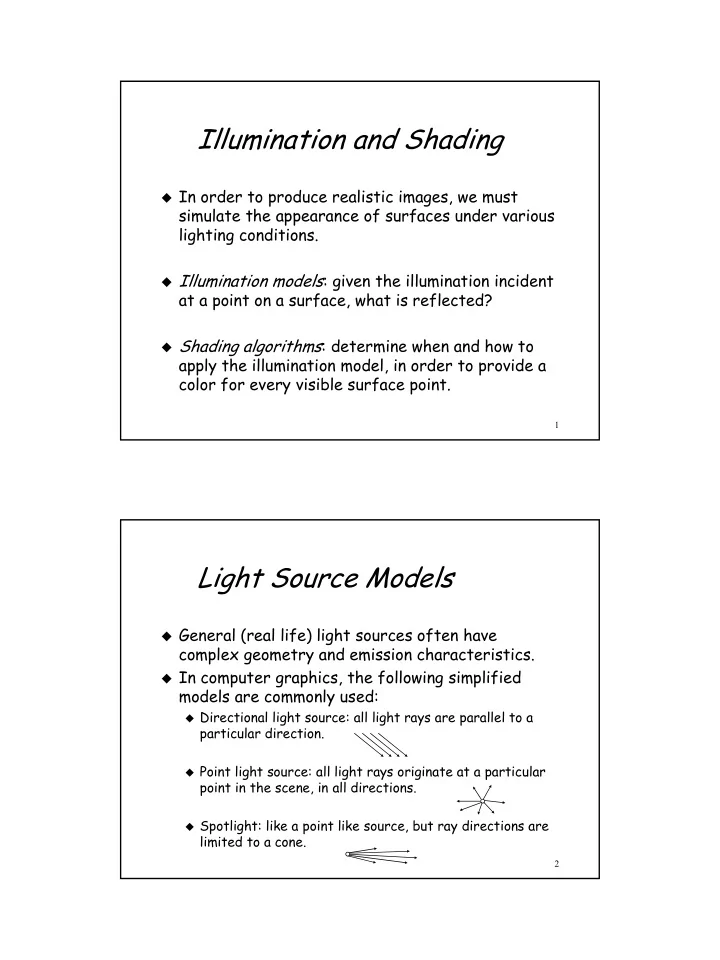
Light Source Models

General (real life) light sources often have

complex geometry and emission characteristics.

In computer graphics, the following simplified

models are commonly used:

Directional light source: all light rays are parallel to a

particular direction.

Point light source: all light rays originate at a particular

point in the scene, in all directions.

Spotlight: like a point like source, but ray directions are

limited to a cone.

slide-2
SLIDE 2

3

The BRDF

Bidirectional Reflection Distribution Function - describes

the ratio of light intensity leaving a point in some outgoing direction to the differential irradiance from some incoming direction:

4

Diffuse Reflection

Diffuse (Lambertian) surfaces appear equally

bright from all directions.

The intensity of light reflected by a point x on a

diffuse reflector is

( )

L N k I k I I

d p d p r

⋅ = = θ cos

N L

θ

slide-3
SLIDE 3

5

The Ambient Term

In the real world, objects receive light both from

light sources and from other surfaces in the scene.

This indirect illumination is very coarsely modeled

by adding an ambient term into the shading model:

( )

L N k I k I I

d p a a r

⋅ + =

6

Examples: Lambertian model

Diffuse term only: Diffuse + Ambient:

slide-4
SLIDE 4

7

Light-source attenuation

The irradiance due to physical light source falls

  • ff proportionally to the square of the distance.

This is accounted for by introducing a light-source

attenuation factor into the shading equation:

Typically,

( )

L N k I f k I I

d p att a a r

⋅ + =         + + = 1 , 1 min

2 L L att

cd bd a f

8

Specular Reflection

Phong Bui-Tuong introduced a term for simulating

specular highlights on non-ideal (glossy) reflectors:

N L

θ θ

R V

( ) ( )

[ ]

n s d p att a a r

V R k L N k I f k I I ⋅ + ⋅ + =

slide-5
SLIDE 5

9

The Specular Exponent

The Phong exponent n determines how

concentrated the specular peak is:

10

Example: Phong model

slide-6
SLIDE 6

11

The Reflected Vector

The Phong model makes use of the reflected

vector R, which is computed as follows:

( )

L L N N R − ⋅ = 2 L N R S S

( ) ( ) ( )

L N L N S L R L N L N S N L N S L S L R − ⋅ = + = − ⋅ = ⋅ = + + = 2 2 2

( ) ( ) ( )

L N L N S L R L N L N S N L N S L S L R − ⋅ = + = − ⋅ = ⋅ = + + = 2 2 2

12

Multiple light sources

( ) ( )

[ ]

=

⋅ + ⋅ + =

  • 1

i n i s i d p att a a r

V R k L N k I f k I I

i i

The shading model easily extends to the case of

multiple light sources:

slide-7
SLIDE 7

13

Polygon Shading

Flat (constant) shading

Evaluate the shading model once per polygon, use

resulting color for all of its pixels.

Gouraud shading

Evaluate the shading model at each vertex, and linearly

interpolate resulting values inside the polygon

Phong shading

Evaluate the normal at each vertex, and linearly

interpolate it inside the polygon. Having the interpolated normal at each point inside the polygon, we can use it to calculate the shading model in each point.

14

Gouraud shading

Smooth surfaces are commonly represented as a collection

  • f polygonal facets for the purposes of interactive display.

If each facet is shaded individually, it is easy to see the

shading discontinuities, which result in faceted appearance

slide-8
SLIDE 8

15

Gouraud shading

To eliminate faceted appearance we can use Gouraud shading

(linearly interpolated shading). For the resulting shading to be continuous we need each vertex in the polygon mesh to have the same normal for all faces incident on it.

16

Gouraud shading

Calculate normals on each vertex of the polygon

slide-9
SLIDE 9

17

Gouraud shading

Caculate shading model on each vertex and interpolate it along the edges.

18

Gouraud shading

Interpolate shading model along the scanlines

slide-10
SLIDE 10

19

Gouraud shading

Result, smooth shading with slow (linear) specular effect

20

Phong Shading

Better results can be obtained by linearly interpolating the

normals between the vertices, and recomputing the shading at every pixel: Gouraud shading Phong shading

slide-11
SLIDE 11

21

Phong Shading

Evaluate the normals at each vertex

22

Phong Shading

Interpolate normals on the polygon’s edges

slide-12
SLIDE 12

23

Phong Shading

Interpolate normals on each pixel on the scanline

24

Phong Shading

Calculate shading model on each pixel of the scanline

slide-13
SLIDE 13

25

Phong Shading

Result, shows specular highlight clearly.

26

slide-14
SLIDE 14

27

Comparisons

Specular highlights are different, linear and exponential

28

Comparisons

Specular highlight completely missing since it didn’t occur close enough to any of the vertices

slide-15
SLIDE 15

29

Comparisons

Normals estimation, should not be based only on the polygon’s plane. Neighboring polygons should be taken in to account.