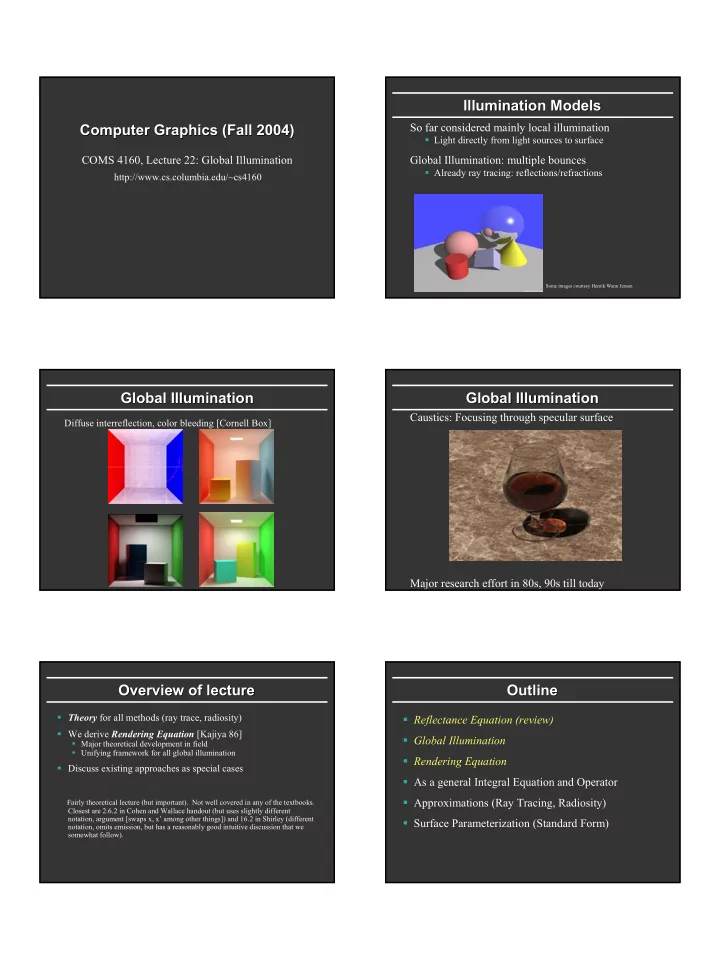
Illumination Models Illumination Models So far considered mainly - - PDF document

illumination models illumination models
SMART_READER_LITE
LIVE PREVIEW

Illumination Models Illumination Models So far considered mainly - - PDF document

Illumination Models Illumination Models So far considered mainly local illumination Computer Graphics (Fall 2004) Computer Graphics (Fall 2004) Light directly from light sources to surface COMS 4160, Lecture 22: Global Illumination Global


slide-1
SLIDE 1

Computer Graphics (Fall 2004) Computer Graphics (Fall 2004)

COMS 4160, Lecture 22: Global Illumination

http://www.cs.columbia.edu/~cs4160

Illumination Models Illumination Models

So far considered mainly local illumination

Light directly from light sources to surface

Global Illumination: multiple bounces

Already ray tracing: reflections/refractions

Some images courtesy Henrik Wann Jensen

Global Illumination Global Illumination

Diffuse interreflection, color bleeding [Cornell Box]

Global Illumination Global Illumination

Caustics: Focusing through specular surface Major research effort in 80s, 90s till today

Overview of lecture Overview of lecture

Theory for all methods (ray trace, radiosity) We derive Rendering Equation [Kajiya 86]

Major theoretical development in field Unifying framework for all global illumination

Discuss existing approaches as special cases

Fairly theoretical lecture (but important). Not well covered in any of the textbooks. Closest are 2.6.2 in Cohen and Wallace handout (but uses slightly different notation, argument [swaps x, x’ among other things]) and 16.2 in Shirley (different notation, omits emission, but has a reasonably good intuitive discussion that we somewhat follow).

Outline Outline

Reflectance Equation (review) Global Illumination Rendering Equation As a general Integral Equation and Operator Approximations (Ray Tracing, Radiosity) Surface Parameterization (Standard Form)

slide-2
SLIDE 2

Reflectance Equation (review)

i

ω

r

ω

x

( , ) ( , ) ( , ) ( , , )( )

r r e r i i i r i

L x L x L x f x n ω ω ω ω ω ω = + i

Reflected Light (Output Image) Emission Incident Light (from light source) BRDF Cosine of Incident angle

Reflectance Equation (review)

i

ω

r

ω

x

( , ) ( , ) ( , ) ( , , )( )

r r e r i i i r i

L x L x L x f x n ω ω ω ω ω ω = +∑ i

Reflected Light (Output Image) Emission Incident Light (from light source) BRDF Cosine of Incident angle Sum over all light sources

Reflectance Equation (review)

i

ω

r

ω

x

( , ) ( , ) ( , ) ( , , ) cos

r r e r i i i r i i

L x L x L x d f x ω ω ω ω ω ω θ

= +∫

Reflected Light (Output Image) Emission Incident Light (from light source) BRDF Cosine of Incident angle Replace sum with integral i

Global Illumination

i

ω

r

ω

x

( , ) ( , ) ( , , ) cos ( , )

r r e r i r i r i i

L x d L x L x f x ω ω ω ω θ ω ω

= + ′ −

Reflected Light (Output Image) Emission Reflected Light (from surface) BRDF Cosine of Incident angle i

Surfaces (interreflection)

dA x′

i

x x ω ′− ∼

Rendering Equation

i

ω

r

ω

x

( , ) ( , , ) c ( , ) ( , )

  • s

e r i r r r i i r i

L x L x L x f x d ω ω ω ω θ ω ω

= + ′ −

Reflected Light (Output Image) Emission Reflected Light BRDF Cosine of Incident angle i

Surfaces (interreflection)

dA x′

UNKNOWN UNKNOWN KNOWN KNOWN KNOWN

Rendering Equation ( Rendering Equation (Kajiya Kajiya 86) 86)

slide-3
SLIDE 3

Outline Outline

Reflectance Equation (review) Global Illumination Rendering Equation As a general Integral Equation and Operator Approximations (Ray Tracing, Radiosity) Surface Parameterization (Standard Form)

The material in this part of the lecture is fairly advanced and not covered in any of the texts. The slides should be fairly

  • complete. This section is fairly short, and I hope some of you

will get some insight into solutions for general global illumination

Rendering Equation as Integral Equation

Reflected Light (Output Image) Emission Reflected Light BRDF Cosine of Incident angle UNKNOWN UNKNOWN KNOWN KNOWN KNOWN

( ) ( ) ( ) ( , ) l u e u K u dv l v v = +∫

Is a Fredholm Integral Equation of second kind [extensively studied numerically] with canonical form

( , ) ( , , ) c ( , ) ( , )

  • s

e r i r r r i i r i

L x L x L x f x d ω ω ω ω θ ω ω

= + ′ −

Kernel of equation

Linear Operator Equation ( ) ( ) ( ) ( , ) l u e u K u dv l v v = +∫

Kernel of equation Light Transport Operator

L E KL = +

Can be discretized to a simple matrix equation [or system of simultaneous linear equations] (L, E are vectors, K is the light transport matrix)

Solution Techniques

All global illumination methods try to solve (approximations of) the rendering equation

– Too hard for analytic solution: numerical methods – General theory of solving integral equations

Radiosity (next lecture; usually diffuse surfaces)

– General class numerical finite element methods (divide surfaces in scene into a finite set elements or patches) – Set up linear system (matrix) of simultaneous equations – Solve iteratively

Ray Tracing and extensions

– General class numerical Monte Carlo methods – Approximate set of all paths of light in scene

L E KL = + IL K E L − = ( ) I K E L − =

1

( ) I K L E

= −

Binomial Theorem

2 3

( ...) I K L K K E = + + + +

2 3

... E KE K E K E L = + + + + Ray Tracing

2 3

... E KE K E K E L = + + + +

Emission directly From light sources Direct Illumination

  • n surfaces

Global Illumination (One bounce indirect) [Mirrors, Refraction] (Two bounce indirect) [Caustics etc]

slide-4
SLIDE 4

Ray Tracing

2 3

... K E E K K E E L + + + + =

Emission directly From light sources Direct Illumination

  • n surfaces

Global Illumination (One bounce indirect) [Mirrors, Refraction] (Two bounce indirect) [Caustics etc]

OpenGL Shading

Outline Outline

Reflectance Equation (review) Global Illumination Rendering Equation As a general Integral Equation and Operator Approximations (Ray Tracing, Radiosity) Surface Parameterization (Standard Form)

Page 289 of Shirley is reasonably close to this part of lecture, although it uses different notation. See also pages 38 and 39 in handout, which may have a clearer explanation of the ideas.

Rendering Equation

i

ω

r

ω

x

( , ) ( , , ) c ( , ) ( , )

  • s

e r i r r r i i r i

L x L x L x f x d ω ω ω ω θ ω ω

= + ′ −

Reflected Light (Output Image) Emission Reflected Light BRDF Cosine of Incident angle i

Surfaces (interreflection)

dA x′

UNKNOWN UNKNOWN KNOWN KNOWN KNOWN

i

x x ω ′− ∼

Change of Variables

Integral over angles sometimes insufficient. Write integral in terms of surface radiance only (change of variables) ( , ) ( , ) ( , ) ( , , ) cos

r r e r r i i r i i

L x L x L x d f x ω ω ω ω ω ω θ

′ = + −

x x′

dA′

i

ω

i

ω −

i

θ

  • θ

i

2

cos | |

  • i

dA d x x θ ω ′ = ′ −

Change of Variables

Integral over angles sometimes insufficient. Write integral in terms of surface radiance only (change of variables) ( , ) ( , ) ( , ) ( , , ) cos

r r e r r i i r i i

L x L x L x d f x ω ω ω ω ω ω θ

′ = + −

2

cos | |

  • i

dA d x x θ ω ′ = ′ −

all visible 2 to

cos cos ( , ) ( , ) ( , ) ( , , ) | |

i

  • r

r e r r i i r x x

L x L x L x f x x d x A θ θ ω ω ω ω ω

′ = + − ′ − ′

2

cos cos ( , ) ( , ) | |

i

  • G x x

G x x x x θ θ ′ ′ = = ′ −

Rendering Equation: Standard Form

Integral over angles sometimes insufficient. Write integral in terms of surface radiance only (change of variables) Domain integral awkward. Introduce binary visibility fn V ( , ) ( , ) ( , ) ( , , ) cos

r r e r r i i r i i

L x L x L x d f x ω ω ω ω ω ω θ

′ = + −

2

cos | |

  • i

dA d x x θ ω ′ = ′ −

all visible 2 to

cos cos ( , ) ( , ) ( , ) ( , , ) | |

i

  • r

r e r r i i r x x

L x L x L x f x x d x A θ θ ω ω ω ω ω

′ = + − ′ − ′

2

cos cos ( , ) ( , ) | |

i

  • G x x

G x x x x θ θ ′ ′ = = ′ −

all surfaces

( , ) ( , ) ( , ) ( , , ) ( , ) ( , )

r r e r r x i i r

L x L x L x f x G x dA x x V x ω ω ω ω ω

′ ′ ′ = + − ′

Same as equation 2.52 Cohen Wallace. It swaps primed And unprimed, omits angular args of BRDF, - sign. Same as equation above 16.3 in Shirley, except he has no emission, slightly diff. notation

slide-5
SLIDE 5

Overview Overview

Theory for all methods (ray trace, radiosity) We derive Rendering Equation [Kajiya 86]

Major theoretical development in field Unifying framework for all global illumination

Discuss existing approaches as special cases