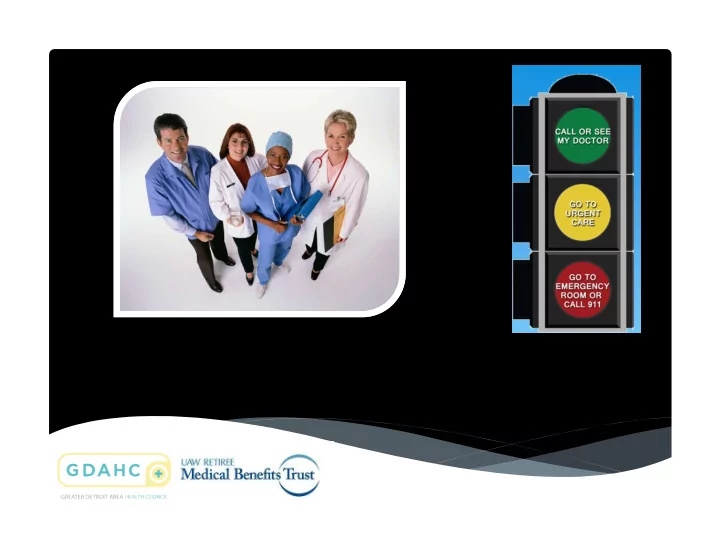
Im Sick or Hurt Where Do I Go? Getting the Right Care in the Right - - PowerPoint PPT Presentation

i m sick or hurt where do i go
SMART_READER_LITE
LIVE PREVIEW

Im Sick or Hurt Where Do I Go? Getting the Right Care in the Right - - PowerPoint PPT Presentation

Im Sick or Hurt Where Do I Go? Getting the Right Care in the Right Setting Primary Care Many Emergency and Urgent Care visits can be prevented with timely access to Primary Care Physician (PCP) PCPs specialize in General Practice,


slide-1
SLIDE 1

I’m Sick or Hurt … Where Do I Go?

Getting the Right Care in the Right Setting

slide-2
SLIDE 2
  • Many Emergency and Urgent Care visits can be

prevented with timely access to Primary Care Physician (PCP)

  • PCPs specialize in General Practice, Family Practice,

General Internal Medicine or pediatrics

  • Don’t have a PCP?
  • Call the number on the back of your medical ID

card…they can help you select a PCP

Primary Care

slide-3
SLIDE 3
  • Your PCP is your health care partner - together you work

as a team to take care of your health

  • Your PCP gets to know you and can provide:
  • A better understanding of you, your health conditions and

treatment options

  • Follow- up and continuity of care, which means one place and one

person who knows your medical issues

  • Ways to keep you healthy, help you manage chronic conditions

such as diabetes, asthma, arthritis or heart disease, along with managing your medications

  • Referrals to specialists, as needed and coordinate your overall

care

  • Annual physicals, immunizations, wellness and age-related

screenings

Primary Care Physician

slide-4
SLIDE 4
  • Your doctor’s name
  • Address
  • Phone number
  • Office hours
  • List of Medications, chronic

conditions and allergies

  • Local Urgent Care Center

Important Information to Keep Handy for Reference

slide-5
SLIDE 5

For an unexpected medical care need and feel safe to wait a day

Contact your primary care doctor when you need treatment for conditions you feel are not immediately dangerous. These are situations when your PCP can take care of you in his/her office. Examples include:

  • Treatment for:
  • Runny nose
  • Simple backache
  • Sore throat
  • Earache
slide-6
SLIDE 6

For an unexpected medical care need today and feel safe to wait a few hours

Go to an Urgent Care* when your condition is not life threatening, but needs attention promptly. Situations may include:

  • Doctor’s office is closed and you cannot wait
  • Doctor could not see you the same day or appointment time does not

meet your needs

  • Your Primary Care Doctor tells you to go to an Urgent Care Center
  • You do not have a Primary Care Doctor
  • Conditions may include issues such as minor injuries like:
  • Cuts needing stitches
  • Muscle strains
  • Sprains

*Note: Urgent Care facilities and services can vary. Some facilities may be similar to a doctor’s office, but others offer more extensive services. Look for facilities which are certified, accredited or approved by your health plan.

slide-7
SLIDE 7

For an unexpected medical care need now and do not feel safe to wait

When you need medical attention now and do not feel safe to wait, go to an Emergency Care location. An “emergency” means medical care may be needed immediately and waiting may be dangerous. Some examples are:

  • Trouble breathing
  • Chest pains
  • Fainting
  • Uncontrolled bleeding
  • Severe pain
  • Serious injury
  • Swallowing poisons or objects

Emergency care is always available 24 hours a day, 7 days a week at designated Emergency care locations. If you have an emergency, go to the nearest Emergency care location or call 911 for help.

slide-8
SLIDE 8
  • Follow up with your PCP in three to seven

days after an Emergency or Urgent Care visit, or sooner if told to do so

  • It’s important to update your PCP on the care

that you have received

Tests Treatments and plan Medications prescribed

You’ve been to Emergency or Urgent Care…now what?