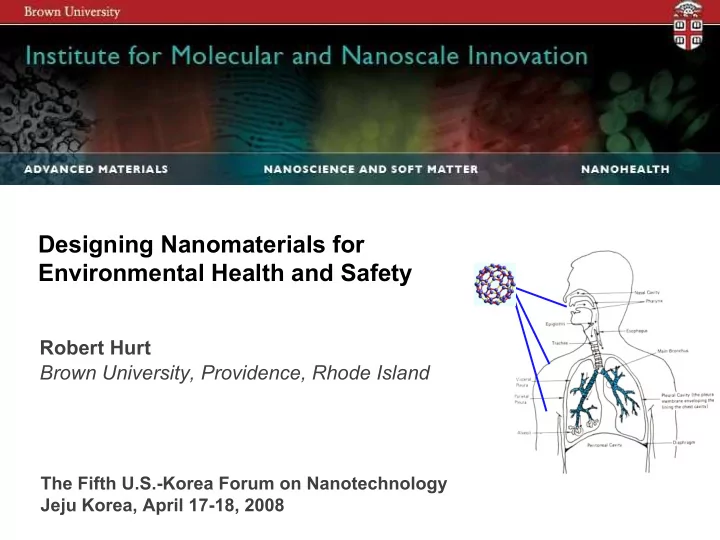
Designing Nanomaterials for Environmental Health and Safety Robert - - PowerPoint PPT Presentation

designing nanomaterials for environmental health and
SMART_READER_LITE
LIVE PREVIEW

Designing Nanomaterials for Environmental Health and Safety Robert - - PowerPoint PPT Presentation

Designing Nanomaterials for Environmental Health and Safety Robert Hurt Brown University, Providence, Rhode Island The Fifth U.S.-Korea Forum on Nanotechnology Jeju Korea, April 17-18, 2008 Nanomaterials are complex chemical systems that


slide-1
SLIDE 1

Robert Hurt Brown University, Providence, Rhode Island

The Fifth U.S.-Korea Forum on Nanotechnology Jeju Korea, April 17-18, 2008

Designing Nanomaterials for Environmental Health and Safety

slide-2
SLIDE 2

Nanomaterials are complex “chemical systems” that may include:

  • surface functional groups
  • adsorbed surface species, bound and free ligands
  • byproduct phases or structures
  • chemical toxicants imbedded within a passivating shell
  • unreacted precursors, residual catalysts

CdSe core ZnS shell Commercial single-wall nanotube sample

slide-3
SLIDE 3

Cellular uptake DNA damage Membrane damage Developmental effects Persistent inflammation

Nanotechnology Toxicology

Point of contact between nanomaterial / living receptor Synthesis Purification Surface modification Formulation (surfactants, solvents, imbedding matrices) Environmental

  • fate. transport,

transformation and exposure

Causes …………> Effects

Attachment Epigenetic effects Disease

R&D; Technical decision-making

Translocation metabolism excretion Consumer use, disposal Processing stresses

What material feature(s) triggers the biological response?

feedback

Free radical production Bioaccumulation

Environmental science

slide-4
SLIDE 4

What material feature is the trigger for the biological response? Example: Effect of carbon nanotubes on electrically active cells

(Lorin Jakubek w/ Prof. Diane Lipscombe, Neuroscience, Brown)

Current nA

Time, ms

Current in cells transfected with voltage-gated calcium channel

increasing nanotube dose

20 40 60 80 100 20 40 60 80 100

%inhibition conc ( /ml) 킽 swnt AP

SWNT dose ug/ml

% Inhibition

slide-5
SLIDE 5

Yttrium ion concentration (ɥM )

How do SWNTs inhibit neuronal calcium channels?

SWNT dose ug/ml

% Inhibition SWNT Supernatant

SWNT dose, ug/ml

no inhibition from purified SWNTs or soluble Ni

slide-6
SLIDE 6

General channel structure

EEEE (glutamate) peptide sequence is highly preserved in Ca channels

% of inhibition

20 10 40 30 50 20 40 80 60 Yttrium ion concentration (ɥM )

Calcium Ion Channel Inhibition is due to Mobilized Yttrium!

slide-7
SLIDE 7

Bioavailability of Nickel in Single-Wall Carbon Nanotubes

Liu, Gurel, Morris, Murray, Zhitkovich, Kane, Hurt Advanced Materials, 19 2790 (2007)

Synthesis:

biological activity of C-imbedded metal is not obvious

slide-8
SLIDE 8

Cellular Response to CNT Nickel

Effect of fluid media Effect of CNT source / type

PSF: Phagolysosomal Simulant Fluid

Soluble Ni dose-response in human lung epithelial cells (48 hrs) Control 3 ppm (ug/g) 6 ppm (ug/g) SWNTs inside lung epithelial cell vesicle by thin-section TEM

slide-9
SLIDE 9

Surface modification Effect of CNT hydrophobicity

[Guo, Von Dem Busche, Buechner, Kane, Hurt ; Small, in press]

Simple Experiment SWNTs + Cell culture medium SWNT removal by centrifugal ultrafiltration solute profiling and cell culture in “exposed” media Viability of HepG2 liver cells

slide-10
SLIDE 10

Amino acid profiling after dose-dependent SWNT exposure

0.02 0.04 0.06 0.08 0.1 0.12 0.14 0.16 0.18 ASP MET TYR GLU HIS PHE concentration mM

control 1 ug/ml 100ug/ml 1mg/ml 10 mg/ml

c)

Hydrophobicity index

  • f Black and Mould, 1991
slide-11
SLIDE 11

control 0.01mg CNT/ml 0.1mg CNT/ml 1mg CNT/ml 10mg CNT/ml 0.0005 0.001 0.0015 0.002 0.0025

Riboflavin Biotin Pantothenic Acid Folic Acid

concentration mM

a)

Some vitamins are depleted at CNT doses as low as 10 ug/ml !

slide-12
SLIDE 12

Effect of folate replenishment

Competitive Folate Pathways and Biological Implications

slide-13
SLIDE 13

Folate monoglutamate top view side view

Folate / SWNT Adsorption Isotherm

Result: A new “starvation mechanism” driven by hydrophobic depletion of essential micronutrients

Adsorption of Essential Micronutrients by Carbon Nanotubes and Its Implications for Nanotoxicity Testing, Guo, Von Dem Bussche, Buechner, Kane, Hurt , SMALL in press

slide-14
SLIDE 14

Purification

Question 1: What is origin of bioavailable metal in “purified” CNTs ? (and why does “purification” sometimes increase it? ) Question 2: How can we target the bioactive portion of the metal for removal (and detoxification) purification increases bioavailable metal !

Example: targeted removal of bioavailable metal as a detoxification strategy for nanotubes

slide-15
SLIDE 15

Last step wash with non-oxidizing acid (do) Oxidation during

  • r after acid wash (don’t)

Metal ion re-deposition

  • n functional groups (don’t)

Purification do’s and don’ts

slide-16
SLIDE 16

Single-wall carbon nanotubes can inhibit cell growth by adsorbing folic acid

and other micronutrients (even without contacting cells!)

Carbon nanotubes can block neuronal calcium ion channels

through release of trace amounts of yttrium!

Carbon nanotubes can also release toxicologically significant amounts

  • f nickel – a known carcinogen that acts through epigenetic modification

The mechanisms above can be suppressed by proper purification

(purification designed for detoxification) and by surface modification for hydrophilicity

There are many other opportunities to make nanomaterials safer by

understanding biomolecular mechanisms and modifying the nanomaterial features that trigger those mechanisms.

Summary

slide-17
SLIDE 17

Contributors

Materials Chemistry Pathobiology

  • Prof. Robert Hurt
  • Prof. Agnes Kane

Indrek Kulaots, Charles A. Vaslet Lorin Jakubek Annette Von Dem Bussche Lin Guo Kevin McNeil Xinyuan Liu Michelle Buechner Daniel Morris Jodie Pietruska Aihui Yan Ashley Smith Neuroscience

  • Prof. Diane Lipscombe

Jesica Raingo

slide-18
SLIDE 18

RD-83171901-0

Financial support at Brown:

  • US EPA (STAR Grant RD83171901)
  • NSF NIRT grant (DMI-050661)
  • SBRP grant at Brown (NIEHS P42 ES013660)
  • NIEHS R01 on Nanotoxicology