
SLIDE 1
10/28/2016 1
Is this too much bleeding?
Evaluating post-pregnancy bleeding
Sara Whetstone, MD, MHS
I have no disclosures
–Barack Obama
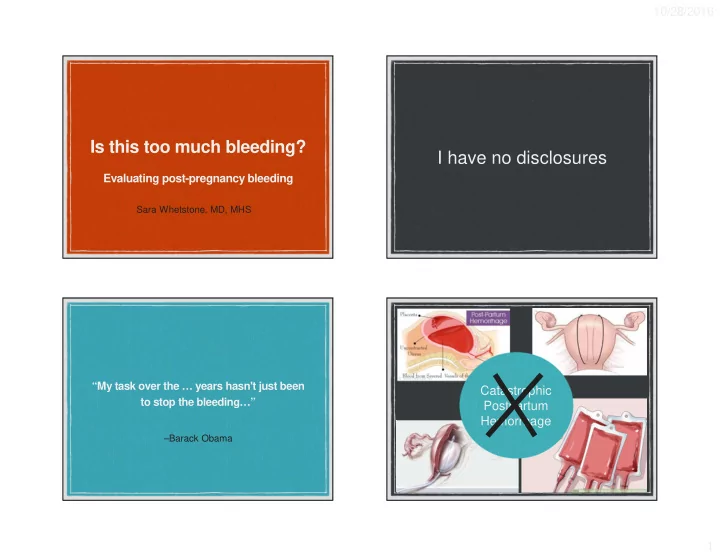
I have no disclosures Evaluating post-pregnancy bleeding Sara - - PowerPoint PPT Presentation
10/28/2016 Is this too much bleeding? I have no disclosures Evaluating post-pregnancy bleeding Sara Whetstone, MD, MHS My task over the years hasn't just been Catastrophic to stop the bleeding Postpartum Hemorrhage Barack
Sara Whetstone, MD, MHS
–Barack Obama
To describe bleeding patterns following delivery and early pregnancy loss To state 3 diagnostic possibilities for abnormal post-pregnancy bleeding To develop an algorithm for evaluating abnormal post-pregnancy bleeding
Case #1
Naya calls your office. She is now 7.5 weeks postpartum and she continues to have light
this is normal.
C.losing part of oneself D.relating to childbirth
0% 0% 50% 50% 0%
Lochia: postpartum vaginal discharge that contains blood, mucus, and uterine tissue
http://singaporeschild.com.sg/postpartum-care-for-new-mums
28% 35% 16% 21%
Average duration ranges from 24 to 36 days Caution: several studies did not follow bleeding until cessation Very little can be said about quantity of blood loss >10% of women experienced bleeding beyond 40 days Common for women to stop bleeding for 1+ days and then resume bleeding
Fletcher et al, 2012; WHO, 1999.
Case #1
Naya calls your office. She is now 7.5 weeks postpartum and she continues to have light
this is normal.
Case #1 - revised
Naya calls your office. She is 2 weeks postpartum and she is bleeding more heavily. She is filling a pad every 1-2 hours.
18% 18% 7% 58%
Primary
Secondary
after delivery
Vaginal bleeding Stable Obtain H&P and labs (CBC, coags) Obtain pelvic ultrasound with Doppler Consider differential diagnosis Unstable Manage blood loss Transfer to OR Surgical management
Retained products of conception Uterine atony Placental site sub- involution Endomyometritis Abnormal placentation
Coagulopathy Arterial-venous malformation (AVM) Pseudoaneurysm Gestational trophoblastic disease
Large patent uteroplacental arteries that failed to undergo normal process of involution Delayed or inadequate remodeling of vessels during 3rd trimester Persistence of low- resistance dilated vessels with increased flow Occurs most often in second week postpartum
Weydert et al 2006; Petrovich et al 2009
Can be congenital or acquired Usually follows a history of previous uterine trauma Abnormal communication between artery & vein occurs during healing process U/S: multiple tubular or “spongy” anechoic or hypoechoic areas within the myometrium of a normal endometrium; use of spectral Doppler very helpful
Vijayakumar et al 2013
Pseudoaneurysm does not have all 3 layers of the arterial wall Extraluminal collection of blood with turbulent flow that communicates with parent vessel through defect in arterial wall Can be asymptomatic, may thrombose or rupture or cause hemorrhage Reported after pelvic surgery, vascular trauma, and uterine curettage
Baba et al 2014; Nanjundan et al 2011.
Case #1 - revised
Naya calls your office. She is 2 weeks postpartum and she is bleeding more heavily. She is filling a pad every 1-2 hours.
History: Uncomplicated NSVD 2 weeks ago, started bleeding heavily this morning, no infectious symptoms Exam: Vital signs wnl, perineal laceration well-reapproximated, active bleeding from the cervix, 8 week sized uterus (non-tender) CBC & coags wnl Pelvic ultrasound
47% 23% 10% 11% 9%
Case #2
Sonia calls your office. She was just diagnosed with a miscarriage and started
how long to expect bleeding. What do you tell her?
1% 22% 20% 35% 22%
Median duration
(days)
Expectant Medical Surgical Early pregnancy failure 12 (7-15) 11 (7-15) 8 (4-14) Embryonic demise 12 (7-16) 11 (7-15) 9 (4.8-14) Incomplete abortion 10 (7-13.3) 9 (6-14) 7 (4-12)
Trinder et al 2006 (MIST trial)
Management of EPF trial reports that a substantial number of women continued to bleed at 2 weeks 43% of women who had medical treatment 30% of women in the surgical treatment For women with a pregnancy loss prior to 6 wks GA: Length of bleeding with loss was similar to usual menstrual length Bleeding associated with loss slightly longer (0.4 days)
Davis et al, 2007; Promislow et al 2007.
0% 57% 24% 18%
Initially a steep decline Less steep decline if initial value < 500 mIU/mL
Barnhart K et al Obstet Gynecol 2004
Barnhart K et al Obstet Gynecol 2004
Case #2
Sonia calls your office. She was just diagnosed with a miscarriage and started
how long to expect bleeding. What do you tell her?
Case #2 - revised
Sonia calls your office. She was diagnosed with a miscarriage; she opted for medical management. She is now bleeding heavily. How do you manage her?
Retained products of conception Endomyometritis Abnormal placentation Trauma Coagulopathy Arterial-venous malformation Pseudoaneurysm Gestational trophoblastic disease
Vaginal bleeding Stable Obtain H&P and labs (CBC, coags) Obtain pelvic ultrasound with Doppler Consider differential diagnosis Unstable Manage blood loss Transfer to OR Surgical management
Endometrial thickness alone does not predict who will require D&C
Even when EMS > 30mm
Endometrial thickness is greater in women who require D&C after medical abortion or medical management
Poor test for predicting need for D&C
Reeve et al, 2008; Reeves et al, 2009.
Normal appearance of cavity after spontaneous abortion is variable and poorly described Ultrasound associated with high false positive rate of retained POCs Endometrial thickness is poor predictor of need for surgical intervention
Hyperechoic endometrial mass or solid component in endometrium
Heavy or prolonged bleeding
Case #2 - revised
Sonia calls your office. She was diagnosed with a miscarriage; she opted for medical management. She is now bleeding heavily. How do you manage her?
To describe bleeding patterns following delivery and early pregnancy loss To state 3 diagnostic possibilities for abnormal post-pregnancy bleeding To develop an algorithm for evaluating abnormal post-pregnancy bleeding
How soon does the next menses occur after early pregnancy failure?
C.5 weeks D.6 weeks
0% 0% 0% 0% 0%
10