Avian Influenza H5N1 Emerging Infectious Diseases Endemic in - - PDF document

avian influenza h5n1 emerging infectious diseases
SMART_READER_LITE
LIVE PREVIEW

Avian Influenza H5N1 Emerging Infectious Diseases Endemic in - - PDF document

Avian Influenza H5N1 Emerging Infectious Diseases Endemic in domestic poultry in certain areas 2008 Sporadic human infection from direct contact with infected poultry and/or wild birds Person-to-person spread of H5N1 virus from has


slide-1
SLIDE 1

1

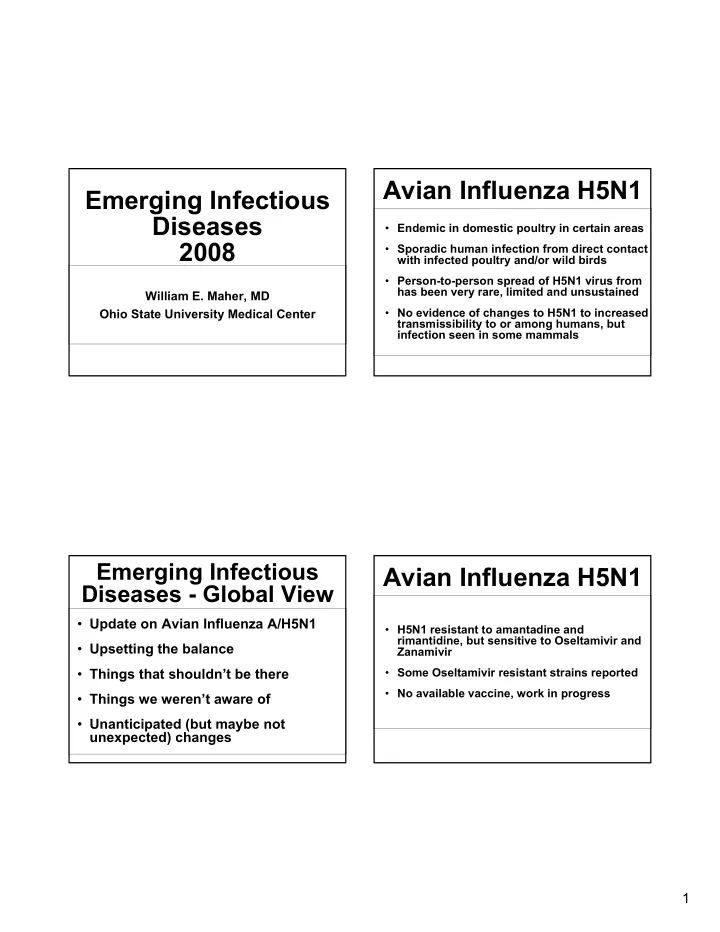
Emerging Infectious Diseases 2008

William E. Maher, MD Ohio State University Medical Center

Emerging Infectious Diseases - Global View

  • Update on Avian Influenza A/H5N1
  • Upsetting the balance
  • Things that shouldn’t be there
  • Things we weren’t aware of
  • Unanticipated (but maybe not

unexpected) changes

Avian Influenza H5N1

  • Endemic in domestic poultry in certain areas
  • Sporadic human infection from direct contact

with infected poultry and/or wild birds

  • Person-to-person spread of H5N1 virus from

has been very rare, limited and unsustained

  • No evidence of changes to H5N1 to increased

transmissibility to or among humans, but infection seen in some mammals

Avian Influenza H5N1

  • H5N1 resistant to amantadine and

rimantidine, but sensitive to Oseltamivir and Zanamivir

  • Some Oseltamivir resistant strains reported
  • No available vaccine, work in progress
slide-2
SLIDE 2

2

  • Thailand, 2004: limited spread in a family from prolonged and

very close contact. No transmission beyond one person.

  • Vietnam, 2004: fatal case presented with fever, diarrhea and

seizures, and was initially diagnosed as encephalitis.

  • Vietnam, 2005: Infection via ingestion of raw duck blood.
  • Azerbaijan, 2006: teenagers infected by contact with wild dead

birds (swans) removing feathers from the birds.

  • Indonesia, 2006: 8 people in one family were affected, with 7
  • deaths. No further spread outside of the exposed family was

documented or suspected.

  • Vietnam, 2006: high viral concentration and elevated

inflammatory cytokine levels in fatal cases. Inflammatory response appears to be implicated in the pathogenesis

Epidemiologic Findings in Human H5N1 Cases

Country 2003 2004 2005 2006 2007 2008 Total cases deaths cases deaths cases death s cases death s cases deaths cases death s cases death s Azerbaijan 8 5 8 5 Cambodia 4 4 2 2 1 1 7 7 China 1 1 8 5 13 8 5 3 3 3 30 20 Djibouti 1 1 Egypt 18 10 25 9 7 3 50 22 Indonesia 20 13 55 45 42 37 16 13 133 108 Iraq 3 2 3 2 Lao People's Democratic Republic 2 2 2 2 Myanmar 1 1 Nigeria 1 1 1 1 Pakistan 3 1 3 1 Thailand 17 12 5 2 3 3 25 17 Turkey 12 4 12 4 Viet Nam 3 3 29 20 61 19 8 5 5 5 106 52 Total 4 4 46 32 98 43 115 79 88 59 31 24 382 241

Cumulative Number of Confirmed Human Cases of Avian Influenza A/(H5N1) Reported to WHO

  • 1999-2000 outbreak, Hurricanes Mitch and George
  • 2004, Hurricane Jeanne, Punta Cana
  • Heavy rains and flooding, increased mosquitoes
  • Malaria-infected migrant workers
  • 3,000 malaria cases reported in 1999
  • 1,500-2,500 malaria cases now reported annually
  • Europeans in Punta Cana All inclusive resorts,

never left the grounds

  • CDC recommend chloroquine prophylaxis for

travelers to La Altagracia and Duarte provinces.

Malaria Dominican Republic

Malaria risk area in Dominican Republic: Rural, with highest risk in provinces bordering

  • Haiti. In addition, risk in

all areas of La Altagracia Province, including resort areas.

slide-3
SLIDE 3

3

Malaria in Kingston, Jamaica

  • Fall 2006, confirmed malaria cases,

Kingston, Jamaica where Malaria transmission does not normally occur

  • Ant malarial drugs recommended.
  • February 29, 2008 CDC removed

temporary recommendation for malaria preventive medication (prophylaxis) for travel to Kingston Jamaica.

  • Kingston continues to experience rare

cases of malaria, but the risk to travelers appears to be minimal.

Recommendations for Travelers to Great Exuma

  • Repeated instances of chloroquine-sensitive

Plasmodium falciparum malaria occurring in travelers to the island of Great Exuma

  • Ongoing, low-level risk of malaria for people

traveling to the island.

  • CDC recommends that travelers to Great Exuma,

Bahamas take chloroquine malaria preventive medication (prophylaxis)

  • There is currently no known risk of malaria on
  • ther islands of the Bahamas; therefore,

prophylaxis is not necessary for those islands

Great Exuma

Celebrities Who Own Islands in the Exumas

  • Nicolas Cage
  • Faith Hill and Tim McGraw
  • David Copperfield
  • Johnny Depp
slide-4
SLIDE 4

4

Chikungunya Fever in Italy

  • In Swahili Chikungunya: illness of the

bended walker

  • Fever, arthralgia, myalgia, headache and

diffuse maculopapular rash.

  • Symptoms 4–7 days after bite
  • Arthralgia is often severe, persistent
  • 12% of patients have chronic arthralgia 3

years after onset of illness

  • Chikungunya is transmitted by Aedes aegypti
  • r A. albopictus
  • Lancet. 2007 Dec 1;370(9602):1805-6

Chikungunya Fever in Italy

  • CHIKV 1st Isolated in Tanzania in 1953
  • African countries, Indian subcontinent, SE Asia.
  • Outbreaks: India, Comoros and La Réunion

islands in the SW Indian Ocean in early 2005

  • During these outbreaks, travelers from

industrialized countries became infected with CHIKV and were still infected on returning home.

  • Aedes albopictus—a vector of CHIKV—was

introduced a number of years ago and is now widespread in Italy

85% of the cases were confirmed by either serology or PCR.

  • Lancet. 2007 Dec 1;370(9602):1805-6
slide-5
SLIDE 5

5

  • Outbreak of a tropical disease in a non-

tropical area

  • Index case had recently traveled to an

endemic area (India) to visit relatives

  • Vector infestation traced to imported tires

from a tire retreading company that had imported used tires infested with mosquito eggs from Georgia, USA.

  • Other Diseases: Malaria, Yellow Fever,

Dengue, ?

Chikungunya Fever in Italy

  • Dengue noted in 5 Texas border counties

since 1980.

  • Survey in Brownsville, Texas, and

Matamoros, Tamaulipas, Mexico (n = 600), in 2004 to assess dengue seroprevalence.

  • Recent dengue infection was detected in

2% and 7.3% of residents in Brownsville and Matamoros, respectively.

  • Past infection was detected in 40% of

Brownsville residents and 78% of Matamoros residents.

Dengue in Texas

MMWR August 10, 2007 / Vol. 56 / No. 31

Autochthonous Malaria

  • Inadvertent carriage of infective

Anopheles mosquitoes by airplane, ship, baggage, or bilge water may be responsible for these occurrences.

  • Also, large populations of migrants from

areas highly endemic for malaria may act as human reservoirs for potential gametocyte carriers.

  • Outbreaks of mosquito borne malaria in

areas of New Jersey, New York, and Texas

slide-6
SLIDE 6

6

EID Vol 2, No. 1—January-March 1996:37-43

Outbreaks of Acute Gastroenteritis: Settings 2006

Setting Number of Outbreaks Cruise ships 37 Long-term care facilities 37 Restaurants 13 Hospitals 7 Colleges 3 Parties 3 Other 26 Total 126

Norovirus

  • Most common cause of infectious gastroenteritis

among persons of all ages

  • Responsible for 50% of all food-borne gastroenteritis
  • utbreaks in the United States
  • Major problem cruise ships, nursing homes and

hospitals

  • Detected in 35% of persons with sporadic

gastroenteritis and in 14% of all children < 3 years

  • ld hospitalized for gastroenteritis.
  • Cause of chronic diarrhea among transplant patients
  • Diagnostic PCR available at CDC and State Health

Dept.

  • ? Emerging due to lifestyle changes vs. better tests

Norovirus

  • Short, self-limited illness
  • As few as 100 virus particles thought to

infectious

  • Stable in the environment and can survive

freezing and heating to 60°C (140°F).

  • Transmission to the oral mucosa via hand

contact with materials, fomites, and environmental surfaces contaminated with feces

  • r vomitus
  • May be food borne or waterborne
  • Susceptible to chlorination
slide-7
SLIDE 7

7

Prevention of Norovirus Transmission

  • Hand hygiene with alcohol-based

hand gels;

  • Disinfect surfaces: 1:10-50 dilution

chlorine bleach

  • Do not return to work or school for 24

to 72 hours after symptoms resolve

Prevention of Norovirus Transmission

  • During outbreaks

Use contact precautions Avoid sharing staff members between units or facilities with affected patients cluster symptomatic patients instruct visitors on hand hygiene close affected units to new admissions and transfers

Chagas Disease Trypanosoma cruzi in The USA

  • American trypanosomiasis
  • Endemic to Central and South America

Romaña’s Sign Megacolon Megaesophagus Cardiomegaly. Reduvid Bug Vector

  • Rare Transmission

IVDA Transfusion

Photo courtesy of CDC

Chagas Disease Range and Vector

Triatoma sanguisuga

Photo courtesy of CDC

slide-8
SLIDE 8

8

  • Cases of Chagas disease reported in the

United States 3 in infants in Texas 1 in an infant in Tennessee 1 in a 56-year-old woman in California 1 in Louisiana 2006

  • Vector in the USA is Triatoma sanguisuga,

Chagas Disease

  • T. cruzi has been identified in

>18 species of mammals raccoons, opossums, armadillos, foxes, skunks, dogs, wood rats, squirrels, and nonhuman primates

  • Lack of human cases in USA

Lack of habitat for the bugs in most US homes a preference for animal hosts delayed defecation of triatomines found in the US compared with those found in Latin America.

Chagas Disease

Photograph courtesy South Florida NRC ►May 22 – Child hospitalized because of festering lesions,

fever, sweats, ocular discharge, and new skin lesions.

Wildlife, Exotic Pets, and Emerging Zoonoses

Photos courtesy of CDC

slide-9
SLIDE 9

9

Photos courtesy of CDC

Monkeypox

  • In 1958, monkeypox was noted as a viral disease that

is found mostly in the rainforest countries of central and west Africa. Laboratory studies showed that the virus could also infect rats, mice, and rabbits.

  • In 1970, monkeypox was identified as the cause of a

rash illness in humans in remote African locations.

  • In early June 2003, monkeypox was reported among

several residents in the United States who became ill after having contact with sick pet prairie dogs. This is the first evidence of community-acquired monkeypox in the United States.

53 rope squirrels 510 Dormice 47 tree squirrels 50 Gambian giant rats 2 brush-tailed porcupines 100 striped mice

April, 2003 800 rodents from Ghana

200 Native Prairie Dogs

Illinois Distributor

Photos courtesy of CDC

Wildlife, Exotic Pets and Emerging Zoonoses

  • Petting zoos linked to Escherichia coli

O157:H7, salmonellae, and Coxiella burnetii

  • Salmonellosis from a Komodo dragon

exhibit

  • Twelve elephant handlers infected with M.

tuberculosis, and 1 with active disease after 3 elephants died of tuberculosis.

  • Human monkeypox related to pet prairie

dogs

slide-10
SLIDE 10

10

Wildlife, Exotic Pets and Emerging Zoonoses

  • Lyssaviruses in pet bats
  • Ringworm from African pygmy hedgehogs
  • r chinchillas.
  • Tularemia in commercially traded prairie

dogs;

  • ≈7% of human infections with salmonella in

US are associated with having handled a reptile.

  • Democratic Republic of the Congo
  • A mine associated with a protracted outbreak of

Marburg hemorrhagic fever during 1998–2000

  • MARV nucleic acid found in 12 bats, 3.0%–3.6%
  • f 2 species of insectivorous bat and 1 species
  • f fruit bat
  • Antibody to the virus found in the serum of 9.7%
  • f 1 of the insectivorous species and in 20.5% of

the fruit bat species

  • Attempts to isolate virus unsuccessful.

Attempt to Determine Reservoir of Marburg Virus (MARV)

  • Close contacts of persons with

meningococcal disease have a higher risk for carriage and therefore invasive disease.

  • Contacts should receive antibiotic

chemoprophylaxis to eliminate nasopharyngeal carriage of N. meningitidis ASAP.

  • Risk of secondary cases is highest

immediately after onset of disease

  • Secondary cases rarely occur after 14 days.
  • Oral Ciprofloxacin is an effective single dose

chemoprophylactic agent.

Meningococcemia

Quinolone-Resistant Neisseria meningitidis Minnesota and North Dakota, 2007–2008

  • In August 2006, a worker in a day care center

in eastern North Dakota died of Group B Meningococcemia

  • Children received rifampin, staff ciprofloxacin
  • Secondary case, January 20071

Ciprofloxacin-resistant

  • 2 unrelated cases, 2008

Ciprofloxacin-resistant

slide-11
SLIDE 11

11

SinglePO dose 500 mg >15 yrs Single PO dose 10 mg/kg body weight <15 yrs Azithromycin Single IM dose 250 mg >15 yrs Single IM dose 125 mg <15 yrs Ceftriaxone 2 days PO 600 mg every 12 hrs >15 yrs 2 days PO 10 mg/kg q 12 hrs 1 mo to <15 yrs 2 days PO 5 mg/kg q 12 hrs <1 mo Rifampin Duration/Route Dosage Age group Drug

Chemoprophylaxis for Meningococcal Disease with Possible Fluoroquinolone-resistance

Plasmodium falciparum Malaria and Atovaquone-Proguanil Treatment Failure

  • Atovaquone/proguanil (Malarone)

Effective Rx: chloroquine-resistant P. falciparum malaria Convenient route of administration (oral) Short treatment course (three days-12 pills) Attractive adverse-effect profile

  • Atovaquone Resistance

Single point mutation in plasmodial cytochrome b

  • Therapeutic Concerns

Narrow margin for dosing errors with a large parasite load Stress completion of course in a non-immune host ? Lower drug levels if >100 kg at standard dose.

  • Recrudescent malaria 3-4 weeks after ATQ/PRO Rx

Failure likely due to drug resistance Quinine plus doxycycline, or artemether/lumefantrine (if available) should be used to treat relapse

Plasmodium falciparum Malaria and Atovaquone- Proguanil Treatment Failure

Emerging Infectious Diseases 2008 Challenges in Diagnosis and Management of Invasive Fungal Infections

Julie E. Mangino, MD Ohio State University Medical Center

slide-12
SLIDE 12

12

Trends in Mortality: Invasive Mycoses

aCrude mortality rate (US) due to candidiasis and aspergillosis.

Pfaller, Diekema. Clin Microbiol Rev. 2007;20:133-163.

a

0.2 0.4 0.6 0.8

1991 1992 1993 1994 1995 1996 1997 1998 1999 2000 2001 2002 2003 Year

Rate per 100,000 Population Candidiasis Aspergillosis

Candida - A High Priority in the ICU: Bloodstream Infection Pathogens

25.7 34.4 47.1 43.0 47.9 35.9 (1)a 16.8 (2)a 10.1 (3) 9.8 (4) 4.7 (5) Coagulase-negative Staph Staphylococcus aureus Candida species Enterococcus species Pseudomonas aeruginosa Crude Mortality, % % BSI (n=10,515) Pathogen

aP<.05 for patients in ICU vs non-ICU settings.

SCOPE data. Wisplinghoff et al. Clin Infect Dis. 2004;39:309-317.

Excess Mortality, Length of Stay (LOS), and Associated Costs

Invasive Candidemia in the United States

  • Excess mortality rates: 10%-49%
  • Excess LOS in hospital: 3.4-30 days
  • Excess costs: $6200-$92,000
  • Average total cost of candidemia: $44,536a

a1997 dollars.

Rentz et al. Clin Infect Dis. 1998;27:781-788.

Increased Hospital Costs for Candidemia

Total Cost of Candidemia: $44,536a

` `

Adverse Drug Reactions $610 (1.4%) Diagnostic Procedures $1513 (3.4%)

Hospital Stay $37,681 (84.6%)

Antifungal Therapy $4710 (10.5%)

a1997 dollars.

Rentz et al. Clin Infect Dis. 1998;27:781-788.

slide-13
SLIDE 13

13

Risk Factors for Candidemia

  • Central venous catheters
  • Systemic antibiotic exposure
  • Length of stay in ICU >72 hours
  • Major surgery, especially abdominal
  • Pancreatitis
  • Dialysis
  • Neutropenia
  • Immunosuppressive agents (steroids, etc)
  • Colonization with Candida species
  • Total parenteral nutrition, hyperalimentation

3% 20% 36% 1% 3% 22% 15% C albicans C glabrata C parapsilosis C tropicalis C krusei C lusitaniae Other 3% 20% 36% 1% 3% 22% 15% C albicans C glabrata C parapsilosis C tropicalis C krusei C lusitaniae Other

Distribution of Common Candida Species

Various sources, predominantly IDSA Guidelines: Pappas et al. Clin Infect Dis. 2004;38:161-189.

Frequency

1Pfaller, Diekema. J Clin Microbiol. 2004;42:4419-4431. 2Lin et al. Antimicrob Agents Chemother. 2005;49:4555-4560.

  • Emergence of C glabrata as an important

bloodstream pathogen may not be just a matter of selection with drug pressure

Nosocomial transmission pattern Patient age (increases with age)

  • Changes in mucosal defenses with age
  • Colonization by C glabrata (40%, >70 years)

Factors Associated With C glabrata Infection1

1Pfaller, Diekema. J Clin Microbiol. 2004;42:4419-4431. 2Lin et al. Antimicrob Agents Chemother. 2005;49:4555-4560.

Underlying diseases Geographic location (United States > worldwide) Previous exposure to specific antimicrobials2

  • Azoles
  • Piperacillin-tazobactam, Vancomycin,
  • Anti-anaerobic agents

Factors Associated With C glabrata Infection1

slide-14
SLIDE 14

14

3 5 3 5 13 2 13 9 10 5 2 7 6 9 5 6 4 6 5 9 8 18 4 13 3 8 7 2 4 6 8 10 12 14 16 18 20 MICU SICU MICU SICU MICU SICU MICU SICU MICU SICU MICU SICU MICU SICU 2001 2002 2003 2004 2005 2006 2007 Year and Type of ICU Number of Cases

  • C. albicans

Non-albicans

Number of cases C. albicans vs. Non- albicans in the MICU & SICU 2001-2007

3 5 5 2 9 5 7 6 5 6 6 13 9 4 1 1 2 3 1 1 2 2 1 1 2 1 1 1 2 4 6 8 10 12 14 2001 2002 2003 2004 2005 2006 2007 Year N u m b e r o f C a s e s

  • C. albicans
  • C. glabrata
  • C. tropicalis
  • C. parapsilosis
  • C. dubliniensis
  • C. krusei
  • C. lusitaniae

Candidemia Cases - MICU - 2001-2007

Traditional Diagnosis

  • Blood cultures

Negative: 50% sensitivity by autopsy data Intense research to improve techniques

  • Biopsies and other cultures

Not always feasible Contaminant vs real?

LIMITED BY BIOLOGY OF THE DISEASE

Candidemia Management: Who and When to Treat?

Sequelae No disease Full-blown disease Markers Signs and symptoms Prophylaxis Preemptive Empirical Therapy Asymptomatic, high-risk patient (chemo, ICU?)

Asymptomatic, positive

superficial cultures or beta-D- glucan Symptomatic, high-risk febrile patient receiving antibiotics

slide-15
SLIDE 15

15

Use of Beta-D-Glucan Assay to Diagnose Candidemia

  • 1. Obayashi et al. Lancet. 1995;345:17-20.
  • 2. Odabasi et al. Clin Infect Dis. 2004;39:199-205.
  • 3. Ostrosky-Zeichner et al. Clin Infect Dis. 2005;41:654-659.
  • 4. Mohr et al. Presented at: 45th ICAAC; Washington, DC. 2005. Abstract M-168.

– 89 57 59

PPV, %

– 63 100 Multiple, 2+ ICU patients, surveillance Mohr4 73 92 64 Single Hospitalized patients Ostrosky- Zeichner3 97 96 65 Multiple, 2+ AML / MDS Odabasi2 97 100 90 Single Febrile patients Obayashi1

NPV, % Specificity, % Sensitivity, % Sampling Population Author

Clinical Manifestations

  • f Candidiasis

– Candidemia (most common) – CNS (neonates) – Respiratory tract (rare) – Cardiac (surgery) – Urinary (management issue) – Arthritis, osteomyelitis, myositis (long-term treatment) – Peritoneum, liver, spleen, gallbladder (hepatosplenic candidiasis to postsurgical collections) – Ocular – Disseminated candidiasis (liver/spleen in neutropenics with candidemia)

  • Superficial disease: mucous membranes

– Thrush, esophagitis, vaginitis, cutaneous syndromes in neutropenic patients, or IV drug users

  • Deep organ involvement
  • Dilated eye exam

All with candidemia Particularly in prolonged fungemia

  • Endophthalmitis

Consider intravitreal treatment / vitrectomy

An Eye for an Eye…

Piek et al. Intensive Care Med. 1988;14:173-175.

  • Barza. Clin Infect Dis. 1998;27:1134-1136.

Essman et al. Ophthalmic Surg Lasers. 1997;28:185-194.

Lifelines

  • Lines and foreign bodies

Remove if possible—better outcomes Tunneled catheters are lower risk Neutropenic patients

  • Gut vs line?

Biofilms are important

  • Polyenes and echinocandins

Anaissie et al. Am J Med. 1998;104:238-245. Cole et al. Clin Infect Dis. 1996;22(suppl 2):S73-S88. Nucci et al. Clin Infect Dis. 2002;34:591-599. Schinabeck et al. Antimicrob Agents Chemother. 2004;48:1727-1732.

L-AMB FLUC

slide-16
SLIDE 16

16

Antıfungal Drugs By Mechanism of Action

  • Membrane disrupting agents:

Amphotericin B, Ampho B lipid formulations

  • Ergosterol synthesis inhibitors:

Azoles: fluconazole, itraconazole, voriconazole

  • Nucleic acid inhibitor: Flucytosine
  • Glucan synthesis inhibitors: Echinocandins:

caspofungin, anidulafungin and micafungin

  • Consider the source of infection:

Local epidemiology

  • Establish the diagnosis

Repeat cultures, pursue imaging

  • Consider the type of patient

Colonized? Trauma? Neutropenic? Future chemo?

Principles of Managing Invasive Candidiasis

  • Evaluate the bug

Consider species-specific features Consider susceptibility testing

  • Remove prosthetic devices, if possible
  • Consider options for antifungal therapy

Principles of Managing Invasive Candidiasis

Revised IDSA Guidelines for Candidemia

  • Choice of therapy depends on clinical status of the patient

and knowledge of species Remove all lines, if feasible

  • Therapy

Fluconazole ≥6 mg/kg/d (400 mg), or Caspofungin 50 mg/d, anidulafungin 100 mg/d, or micafungin 100 mg/d, * or AMB (0.6-1.0 mg/kg/d for AMB or 3 mg/kg/d for liposomal formulations of AMB) in selected circumstances* Treat 2 weeks after last positive blood culture and resolution of signs and symptoms of infection

*Transition to fluconazole, when appropriate, is encouraged once the Candida sp is known and the patient

is stable. Pappas et al, guideline revisions in progress.

slide-17
SLIDE 17

17

Proposed Approach: Immunocompromised Patients

Ostrosky-Zeichner, Pappas. Crit Care Med. 2006;34:857-863.

Candida Endemic mycosis

Start (lipid) polyene and wait for identification (ID)

Continue (lipid) polyene until stable; consider fluconazole or itraconazole as appropriate

Immunocompromised (transplant, BMT, AIDS) Yeast in blood culture Nonimmunocompromised

Proposed Approach: Non-immunocompromised Patients

Ostrosky-Zeichner, Pappas. Crit Care Med. 2006;34:857-863.

Candida Endemic mycosis Start lipid polyene and wait for identification (ID) Continue lipid polyene until stable, then consider fluconazole or itraconazole

Immunocompromis ed (transplant, BMT, AIDS) Yeast in blood culture

Hemodynamically stable, no previous azoles

Non-immunocompromised

No response

  • r clearly

resistant isolate

If good response complete 14 days from first negative culture, may switch to fluconazole or voriconazole if stable and susceptible If no response, switch to another agent from the above classes

If good response treat 14 days from first negative culture

Start echinocandin or lipid polyene, wait for ID and monitor response Hemodynamically unstable, previous azoles Start fluconazole, wait for ID and monitor response

The Bottom Line: Candidemia in the ICU

  • Epidemiology supports importance of

candidemia, particularly in ICU settings

  • Need better diagnostics
  • Need practical rules to assess risk
  • Antifungals for:

Prophylaxis Preemptive and empirical therapy Traditional therapy

Do not treat asymptomatic candiduria unless risk factors are present

Treatment of Candiduria

  • Treat

Symptomatic patients Neutropenic patients Low birth-weight infants Patients with urological manipulations/

  • bstructions
  • Treatments

Remove “hardware” (stents and/or Foley) Fluconazole (200-400 mg/dl) Flucytosine (100mg/kg/d) Lower urinary tract infections: AMB bladder irrigations (rarely useful) Upper urinary tract infections (pyelonephritis): can use azoles and echinocandins

  • 1. Drew et al. Clin Infect Dis. 2005;40:1465-1470.
  • 2. Sobel et al. Clin Infect Dis. 2007;44:e46-e49.

1

1 2