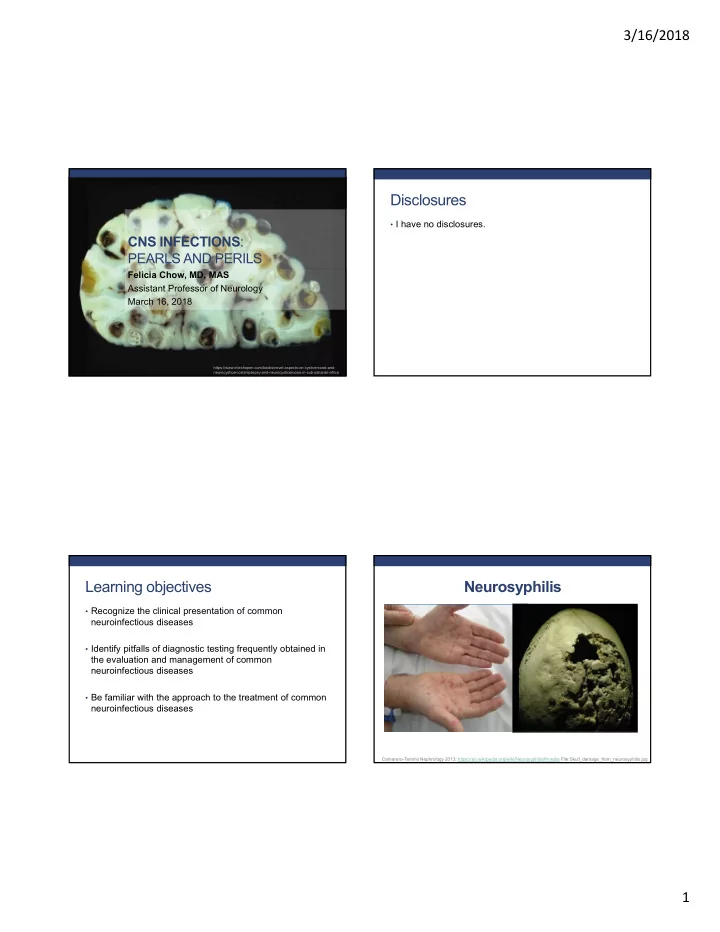
Disclosures I have no disclosures. CNS INFECTIONS : PEARLS AND - - PDF document

disclosures
SMART_READER_LITE
LIVE PREVIEW

Disclosures I have no disclosures. CNS INFECTIONS : PEARLS AND - - PDF document

3/16/2018 Disclosures I have no disclosures. CNS INFECTIONS : PEARLS AND PERILS Felicia Chow, MD, MAS Assistant Professor of Neurology March 16, 2018 https://www.intechopen.com/books/novel-aspects-on-cysticercosis-and-


slide-1
SLIDE 1

3/16/2018 1

Felicia Chow, MD, MAS Assistant Professor of Neurology March 16, 2018

CNS INFECTIONS: PEARLS AND PERILS

https://www.intechopen.com/books/novel-aspects-on-cysticercosis-and- neurocysticercosis/epilepsy-and-neurocysticercosis-in-sub-saharan-africa

Disclosures

  • I have no disclosures.

Learning objectives

  • Recognize the clinical presentation of common

neuroinfectious diseases

  • Identify pitfalls of diagnostic testing frequently obtained in

the evaluation and management of common neuroinfectious diseases

  • Be familiar with the approach to the treatment of common

neuroinfectious diseases

Neurosyphilis

Camarero-Temino Nephrology 2013; https://en.wikipedia.org/wiki/Neurosyphilis#/media File:Skull_damage_from_neurosyphilis.jpg

slide-2
SLIDE 2

3/16/2018 2

Question: My patient has neurosyphilis. Does that automatically mean they have late, or like later, or latent syphilis?

Stages of syphilis

Lafond et al. Clin Microbiol Rev 2006

Answer: Neurosyphilis can occur at any stage of infection.

Question: I have a patient whose MRI demonstrated a small acute infarct in the internal capsule. He has hypertension and uncontrolled diabetes, and urine tox screen was positive for cocaine. His RPR was 1:64 and was negative 6 months ago. Since strokes in syphilis usually occur as a late presentation and he has many other vascular risk factors, I don’t have to LP him, do I?

slide-3
SLIDE 3

3/16/2018 3

Ghanem CNS Neurosci Ther 2010

Think meninges, CSF and blood vessels in early syphilis and parenchymal disease in late syphilis

Answer: I would recommend an LP for any patient with a newly positive RPR (or positive RPR of unknown duration) and clinical/radiologic evidence of strokes. Question: My clinic patient has uveitis and an RPR of 1:128. Ophtho sent him to clinic for neurological evaluation, but he has no neurological symptoms. I don’t have to LP him, do I?

Which syphilis patients need an LP?

  • Any stage of syphilis + neurological signs/symptoms
  • Any stage of syphilis + ocular or otologic disease
  • Tertiary syphilis w/ or w/o neurological signs/symptoms
  • Inappropriate serologic response after treatment
  • HIV-infected patients PLUS:
  • Consider for HIV-infected patients with CD4 <350 cells/mm3 and/or

RPR ≥ 1:32

Ghanem Clin Infect Dis 2009

slide-4
SLIDE 4

3/16/2018 4 Which syphilis patients need an LP?

  • Any stage of syphilis + neurological signs/symptoms
  • Any stage of syphilis + ocular or otologic disease
  • Tertiary syphilis w/ or w/o neurological signs/symptoms
  • Inappropriate serologic response after treatment
  • HIV-infected patients PLUS:
  • Consider for HIV-infected patients with CD4 <350 cells/mm3 and/or

RPR ≥ 1:32  Thorough neurologic history and exam

Ghanem Clin Infect Dis 2009

Answer: I would recommend an LP for all patients with ocular syphilis. Question: My HIV+ patient, intermittently non-adherent to his ARVs, presented to clinic with headaches that are more severe than his usual migraines. Serum RPR was 1:64. CSF had 20 WBC and a mildly elevated protein, but CSF VDRL was negative. Could this still be neurosyphilis?

No one test has high sensitivity/specificity for neurosyphilis

SERUM Treponemal tests (TPPA, FTA-Abs) False positives with other spirochetal infections, malaria, leprosy False negative in HIV *Titers do not correspond to disease activity *Most positive for life despite treatment Test characteristics Notes SERUM RPR (non- treponemal tests) Sensitivity: 1°: 78-86% 2°: Near 100% 3°/Latent: Varies, ~85% False positives 1-2%, usually titer <1:8 (autoimmune disease, IVDU, TB, pregnancy, endocarditis) False negatives in HIV, prozone effect

*Titers correspond to disease activity *Used to assess treatment response  4-fold decline considered to be clinically significant

CSF VDRL CSF Treponemal tests CSF VDRL Sensitivity: 30-80%, Specificity 99% FTA-Abs/TPPA high sensitivity but low specificity *CSF VDRL considered “gold standard” for neurosyphilis Positive CSF VDRL at any titer = neurosyphilis

slide-5
SLIDE 5

3/16/2018 5

Answer: Yes, CSF VDRL can be insensitive for neurosyphilis. This absolutely could still be neurosyphilis, and based on the clinical data, I would recommend treating him for neurosyphilis with 2 weeks of Penicillin G (4 million units IV q4 hours). Herpes simplex virus CNS infections

Question: We have an inpatient who presented with 2 days of fever, headache and confusion. CSF with 11 WBC (85%L), protein 75 and glucose 53. CSF HSV 1 PCR negative. Could this still be HSV-1 encephalitis?

HSV encephalitis

  • HSV is the most frequently identified viral

etiology of sporadic encephalitis in the US

  • Bimodal distribution: 1/3 cases <20 y, 2/3

>40 y

  • Case fatality rate >70% if untreated; 1/3 of

patients may be significantly disabled despite treatment

  • CSF: 5-500 WBC/mm3, normal to moderately

elevated protein, glucose typically normal

  • Involvement on imaging of the medial

temporal lobes, insula, and/or inferolateral frontal lobes

slide-6
SLIDE 6

3/16/2018 6

What is the utility of HSV-1 PCR in the CSF?

  • 54 patients with biopsy-

proven HSE underwent HSV-1 PCR from CSF

  • Sensitivity 98%
  • Specificity 94%

Lakeman J Infect Dis 1995

Sensitivity of CSF HSV-1 PCR is lower early in the course of HSV encephalitis

Weil Clin Infect Dis 2002

Answer: Yes, this could definitely still be HSV-1 encephalitis. I recommend you repeat the lumbar puncture, resend an HSV-1 PCR from the CSF and start IV acyclovir 10 mg/kg every 8 hours as you await the results. Question: The repeat CSF HSV-1 PCR was positive. She received 3 weeks of IV acyclovir but is still quite impaired, far from her baseline. Should we discharge her on

  • ral antiviral therapy?
slide-7
SLIDE 7

3/16/2018 7

No significant cognitive benefit of oral therapy after IV acyclovir

  • 87 HSE patients

randomized to valacyclovir 2 g TID versus placebo x 90 days

  • Excluded individuals with

life expectancy <90 d and those who couldn’t take PO

  • Primary outcome was

survival with no/mild impairment at 12 months

Gnann Clin Infect Dis 2015

Answer: No, unfortunately there is no evidence that a longer course of oral antiviral therapy after completing IV acyclovir is beneficial.

Question: We have a 55-year-old man on the inpatient service with no past medical history other than “possible meningitis” over 5 years ago, who presented with 5 days of fever, chills, malaise and severe headache. One day prior to presentation, he developed bilateral hip and buttocks pain and paresthesias along with urinary retention. On exam, his temperature is 101, and there is

  • meningismus. Neurologic exam is notable for

decreased sensation in an S3-S5 distribution.

Question: CSF demonstrated normal

  • pening pressure with 310 WBC (84%

lymphocytes), glucose 40, and protein 91. CSF HSV-2 PCR returned positive. What route and duration of acyclovir would you recommend, and should he be discharged on suppressive oral antiviral therapy?

slide-8
SLIDE 8

3/16/2018 8

  • Lumbosacral myeloradiculitis associated most commonly

with HSV-2 reactivation

  • Typically present with lower back/buttocks pain,

paresthesias in lumbosacral distribution and bowel/bladder symptoms

  • CSF profile consistent with viral meningitis
  • MRI may be normal or may show root/lower spinal cord

edema with enlargement, T2/FLAIR hyperintensity and contrast enhancement

  • Treatment: IV acyclovir 10 mg/kg q8h x 2 weeks

Eberhardt et al. Neurology 2004

  • 101 patients with HSV-2 meningitis randomized to

valacyclovir 500 mg BID or placebo x 1 year after completing treatment for acute meningitis

Aurelius et al. CID 2012

  • In Year 1, 14 cases of

recurrent meningitis in valacyclovir group (29%)

  • vs. 8 cases in placebo

group (16%), p=0.12

  • In Year 2, 12 cases in

valacyclovir group (24%)

  • vs. 4 in placebo (8%),

p=0.03

Aurelius et al. CID 2012

Answer: Although there are no data to guide therapy for HSV or VZV meningitis, I generally treat severe or complicated cases (e.g., meningo- encephalitis, myelitis, meningoradiculitis), even in immunocompetent patients, with a full 2-week course of IV acyclovir. From the perspective of preventing recurrent HSV-2 meningitis, there are no data to support use of long-term suppressive valacyclovir.

slide-9
SLIDE 9

3/16/2018 9 Toxoplasmosis

https://www.urmc.rochester.edu/libraries/courses/neuroslides/lab3b/slide137.cfm

Question: Our patient with newly diagnosed HIV infection (CD4 count 90 cells/mm3, viral load 75K) presented with progressive right sided weakness and

  • confusion. Brain MRI demonstrates

several ring-enhancing lesions with surrounding edema and mass effect.

I know the serum toxoplasma antibody status of an HIV+ patient with focal brain lesions is

  • important. The

patient’s serum toxo IgM ELISA is negative, so does this rule out toxoplasmosis?

CNS toxoplasmosis

  • Most common focal brain

lesion in HIV+ w/ CD4 < 200 in US

  • Presentation usually evolves
  • ver weeks to months
  • TMP/SMX prophylaxis

reduces risk of toxoplasmosis

  • Ddx: CNS lymphoma,

pyogenic abscess, tuberculoma, cryptococcoma

Tan et al. Lancet Neurology 2012, Laing et al. Int J STD AIDS 1996

slide-10
SLIDE 10

3/16/2018 10 Utility of toxoplasma serology

  • Toxoplasmosis seropositivity in general population in the

US is estimated to be 10-40%

  • Toxoplasmosis in HIV is typically reactivation of prior

infection (i.e., IgM antibodies less helpful)

  • Serum IgG is positive in most HIV patients with CNS

toxoplasmosis

  • CSF toxoplasma PCR is very specific but sensitivity

varies

Laing Int J STD AIDS 1996, Correira Trans R Soc Trop Med Hyg 2010, Vidal J Clin Microbiol 2004, Sakamoto Parasitol Int 2014

Answer: The serum toxoplasma IgG is more informative in an HIV patient in whom you are worried about CNS

  • toxoplasmosis. Send the IgG and, if safe,

do a lumbar puncture and send the CSF for toxoplasma PCR. Question: Serum toxo IgG was positive. CSF demonstrated 23 WBC (80%L), 27 RBC, glucose 47 and protein 58. CSF toxoplasma and EBV PCR are pending. What else can help us to distinguish between toxo and CNS lymphoma?

Toxoplasmosis versus CNS lymphoma in HIV

Radiologic findings Basal ganglia, thalamus, grey-white junction Usually multiple lesions (75%) with ring or nodular enhancement +Mass effect and edema Periventricular, deep white matter Can be solitary/few lesions with solid/homogeneous enhancement; in patients with HIV, can ring-enhance +Mass effect and edema Toxoplasmosis Primary CNS Lymphoma Clinical presentation Focal s/sx (~75%), HA (~50%), fever (~50%); sx evolve faster than CNSL At risk with CD4 count <200 Focal s/sx including hemiparesis, aphasia, visual field deficit At risk with CD4 count <50

Raffi et al. AIDS 1997

slide-11
SLIDE 11

3/16/2018 11

Toxoplasmosis versus CNS lymphoma in HIV

Radiologic findings Basal ganglia, thalamus, grey-white junction Usually multiple lesions (75%) with ring or nodular enhancement +Mass effect and edema Periventricular, deep white matter Can be solitary/few lesions with solid/homogeneous enhancement; in patients with HIV, can ring-enhance +Mass effect and edema Toxoplasmosis Primary CNS Lymphoma Clinical presentation Focal s/sx (~75%), HA (~50%), fever (~50%); sx evolve faster than CNSL At risk with CD4 count <200 Focal s/sx including hemiparesis, aphasia, visual field deficit At risk with CD4 count <50 Treatment Pyrimethamine (w/ leucovorin) and sulfadiazine AVOID steroids if possible! Corticosteroids, methotrexate, rituximab, XRT, ARVs

Raffi et al. AIDS 1997

Neurocysticercosis

Question: My patient, originally from Mexico, was referred for evaluation of a single ring-enhancing right frontal lesion. While in the ED with her husband who was being seen for chest pain, she had a witnessed convulsive spell and was confused for hours afterward. Blood cultures, HIV test, PPD and chest/abdomen/pelvis CT were negative. Serum cysticercal ELISA was also

  • negative. Could this still be cysticercosis?
slide-12
SLIDE 12

3/16/2018 12 Neurocysticercosis (NCC)

  • Infection of the nervous

system with larval stage of the helminth, Taenia solium

  • 50+ million people affected

worldwide

  • One of the most common

causes of acquired epilepsy in developing world

Stages of neurocysticercosis

Garcia et al. Curr Opin Infect Dis 2003;16:411-419. Courtesy of HH Garcia

Viable cyst Degenerating cyst Dead cyst

Location, location, location

  • Intraparenchymal (70%)
  • Cortical (>90%)
  • Deep gray matter (5%)
  • Brainstem/infratentorial

(Uncommon)

  • Extraparenchymal (30%)
  • Sylvian fissure
  • Basal cisterns
  • Spine
  • Intraventricular

Serological diagnosis of NCC

  • Enzyme-linked immunotransfer blot
  • Sensitivity near 100% for multiple

parenchymal, ventricular, or subarachnoid cysts; specificity 100%

  • Performs as well (or better) in serum as CSF
  • Sensitivity much lower in patients w/ single
  • r calcified lesions (<50%)
  • ELISA
  • Sensitivity and specificity lower than EITB
  • Sensitivity even lower for single or calcified

lesions (<50%)

  • Neither can be used to distinguish prior from

active infection

Tsang VC et al. J Infect Dis 1989

slide-13
SLIDE 13

3/16/2018 13

“We recommend serologic testing with enzyme-linked immunotransfer blot as a confirmatory test in patients with suspected neurocysticercosis. Enzyme-linked immunosorbent assays (ELISAs) using crude antigen should be avoided due to poor sensitivity and specificity.”

White et al. Clin Infect Dis 2018

Answer: The epidemiology, clinical presentation and radiology findings are all highly suggestive of NCC. The ELISA has lower sensitivity, I would send a serum enzyme immunotransfer blot (EITB) for cysticercosis, keeping in mind, though, that this patient may still have a false negative EITB. Question: I saw a patient in clinic,

  • riginally from Mexico, currently working

as a construction foreman, who complained of 1 month of worsening headaches and several episodes of left arm/leg shaking followed confusion. Serum cysticercal ELISA was positive. My practice is to treat with albendazole + steroids, but dual antihelminthic therapy seems to be all the rage. Is that a good idea for this patient?

slide-14
SLIDE 14

3/16/2018 14 Extraparenchymal NCC

  • Less common form of infection w/

proliferating, invasive membranous structures

  • Associated with more protracted

course and worse prognosis

  • Complications, particularly of basal

subarachnoid disease, include:

  • Hydrocephalus and elevated ICP
  • Vasculitis +/- infarcts and hemorrhages

Should I treat with dual therapy?

  • Double-blind, placebo-controlled randomized controlled trial
  • Inclusion: 1-20 viable cysts
  • Exclusion: Subarachnoid NCC at base of brain, most intraventricular

cysts, cysts in brainstem, larger cysts (>30 mm), ocular cysts

  • Three arms, all 10 days of therapy:

1.

Albendazole alone (15 mg/kg/day)

2.

Albendazole + praziquantel

3.

High-dose albendazole (22.5 mg/kg/day)

  • Primary outcome: Cyst resolution at 6 months

Garcia et al. Lancet Infect Dis August 2014

Answer: A recent RCT showing benefit of dual anti-helminthic therapy for NCC patients excluded most patients with subarachnoid disease. Dual anti- helminthic therapy is still reasonable in this patient, but steroids should be initiated before starting treatment, and he should be observed carefully for complications (e.g. ICP , seizures).

slide-15
SLIDE 15

3/16/2018 15

Treatment summary

CALCIFIED CYSTS No antiparasitic therapy VIABLE CYSTS 1-2 lesions: albendazole x 10-14 d +/- steroids >2 lesions: albendazole + praziquantel x 10-14 d + steroids

DEGENERATING

CYSTS

Single lesion: albendazole x 7- 14 d +/- steroids Multiple lesions: albendazole + praziquantel x 10-14 d + steroids

SUBARACHNOID CYSTS

ABZ +/- PZQ + steroids +/- resection 

  • ften requires

prolonged and multiple courses of therapy OCULAR CYSTS Surgical resection

Antihelminthic therapy may result in loss

  • f vision

secondary to inflammation

White et al. Clin Infect Dis 2018

Coccidioidal meningitis

https://microbewiki.kenyon.edu/index.php/Coccidioides_immitis

Question: I am seeing a middle-aged African American man from Modesto with a 6 week history of progressive headache, confusion and lethargy. CSF demonstrates 290 cells/mm3, protein is 100 and glucose 36. CSF gram stain and fungal stains are negative. Question: Cocci meningitis is high

  • n my differential
  • diagnosis. What

testing on the CSF is most sensitive to make the diagnosis?

slide-16
SLIDE 16

3/16/2018 16 Coccidioidomycosis

  • Most primary infections (pulmonary) are asymptomatic (~2/3)
  • CNS dissemination (1%) occurs weeks to months after 1o infection
  • Risk factors for extrapulmonary/disseminated disease:
  • African or Filipino ancestry
  • Immune compromise (HIV, malignancy, DM, SOT, steroids)
  • Pregnancy

Drake Neurology 2009, Galgiani Clin Infect Dis 2005, Johnson Clin Infect Dis 2006

~66% 50-60% 33% (focal)

Imaging:

  • Meningeal

enhancement

  • Hydrocephalus
  • Focal lesion (e.g,

infarct, abscess)

  • Spinal arachnoiditis

also common

Performance of Cocci testing in CSF

CSF Parameter Sens (%) Specificity (%) Fungal culture 7 100 Immunodiffusion (ID) 67 99 Complement fixation (CF) 70 100 Antigen 93 100 Antigen, ID, CF 98 99

Kassis Clin Infect Dis 2015, Table adapted from Brian Schwartz Galgiani Clin Infect Dis 2016

Answer: If you suspect Cocci meningitis, in addition to checking an opening pressure, cell count, glucose, protein and fungal culture, send a CSF Cocci immunodiffusion, complement fixation and antigen.

slide-17
SLIDE 17

3/16/2018 17 Treatment for Cocci meningitis

  • 1st line: Lifelong fluconazole 400 to 1200 mg/day
  • If disease progression on 1st line therapy:
  • 1. Increase dose of fluconazole as tolerated
  • 2. Consider another azole (e.g., voriconazole, posaconazole,

isavuconazonium)

  • 3. Consider IT amphotericin B
  • Hydrocephalus is a common complication 

neurosurgery evaluation for shunt

  • Consider adjunctive steroids in patients with vasculitis and

infarcts

Galgiani Clin Infect Dis 2005, Johnson Clin Infect Dis 2006

Useful references

  • Marra CM. Update on neurosyphilis. Curr Infect Dis Rep 2009;11:127-134.
  • Weil AA, Glaser CA, Amad Z, Forghani B. Patients with herpes simple encephalitis: rethinking an initial negative polymerase

chain reaction result. Clin Infect Dis 2002;34:1154-57.

  • Gnann JW, Skoldenberg B, Hart J et al. Herpes simplex encephalitis: lack of clinical benefit of long-term valacyclovir
  • therapy. Clin Infect Dis 2015;61;683-91.
  • Aurelius E, Franzen-Rohl E, Glimaker M, et al. Long-term valacyclovir suppressive treatment after HSV-2 meningitis: a

double-blind randomized controlled trial. Clin Infect Dis 2012;54:1304-13.

  • Guidelines for the prevention and treatment of opportunistic infections in HIV-infected adults and adolescent:

https://aidsinfo.nih.gov/guidelines/html/4/adult-and-adolescent-oi-prevention-and-treatment-guidelines/0.

  • Garcia HH, Gonzales I, Lescano AG et al. Efficacy of combined antiparasitic therapy with praziquantel and albendazole for

neurocystiercosis: a double-blind randomized controlled trial. Lancet Infect Dis 2014;14:687-95.

  • Garcia HH, Nash TE, del Brutto OH. Clinical symptoms, diagnosis and treatment of neurocysticercosis. Lancet Neurol.

2014;13:1202-15.

  • Galgiani JN, Ampel NM, Blair JE et al. Clinical practice guideline for the treatment of coccidioidomycosis. Clin Infect Dis

2016;63:e112-46.

  • Kassis C, Zaidi S, Kuberski T et al. Role of Coccidioides antigen testing in the CSF for the diagnosis of Coccidioidal
  • meningitis. Clin Infect Dis 2015;61:1521-26.
  • White AC, Coyle C, Rajshekhar V, et al. Diagnosis and treatment of neurocysticercosis: 2017 clinical practice guidelines by

the Infectious Diseases Society of America and the American Society of Tropical Medicine and Hygiene. Clin Infect Dis 2018 Feb 22. Epub ahead of print.

THANK YOU

felicia.chow@ucsf.edu