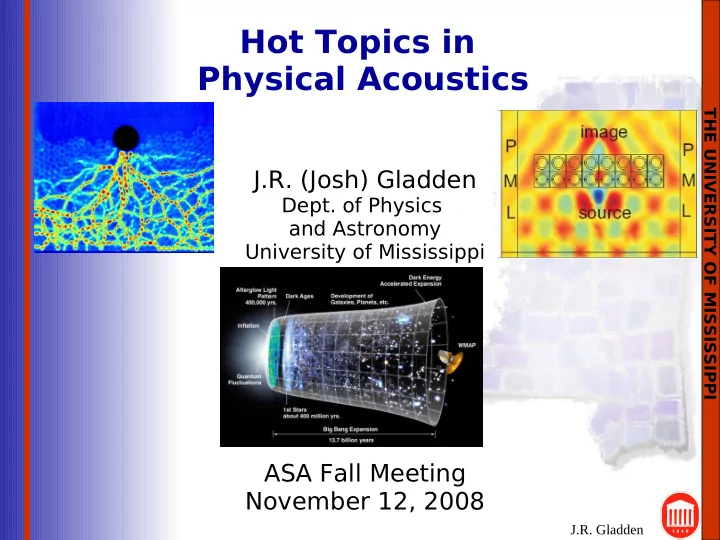
Hot Topics in Physical Acoustics THE UNIVERSITY OF MISSISSIPPI - - PowerPoint PPT Presentation

hot topics in physical acoustics
SMART_READER_LITE
LIVE PREVIEW

Hot Topics in Physical Acoustics THE UNIVERSITY OF MISSISSIPPI - - PowerPoint PPT Presentation

Hot Topics in Physical Acoustics THE UNIVERSITY OF MISSISSIPPI J.R. (Josh) Gladden Dept. of Physics and Astronomy University of Mississippi ASA Fall Meeting The University of November 12, 2008 Mississippi Institute for Advanced Education


slide-1
SLIDE 1

J.R. Gladden

THE UNIVERSITY OF MISSISSIPPI

The University of Mississippi Institute for Advanced Education in Geospatial Science

Hot Topics in Physical Acoustics

J.R. (Josh) Gladden

  • Dept. of Physics

and Astronomy University of Mississippi

ASA Fall Meeting November 12, 2008

slide-2
SLIDE 2

J.R. Gladden

THE UNIVERSITY OF MISSISSIPPI

The University of Mississippi Institute for Advanced Education in Geospatial Science

Outline

  • Sound waves in the early universe
  • Nature of sound in a hot plasma
  • Acoustic imprint in the microwave background
  • Connections to dark energy and matter
  • Acoustics and slip-stick friction
  • A table top model fault zone
  • The role of transient elastic waves
  • Connections to earthquake triggering
  • Acoustic Metamaterials
  • Generalized wave phenomenon
  • Coherent scattering effects:

negative index of refraction, band gaps

  • Applications: acoustic lenses, filters, cloaking
slide-3
SLIDE 3

J.R. Gladden

THE UNIVERSITY OF MISSISSIPPI

The University of Mississippi Institute for Advanced Education in Geospatial Science

Sound waves in the early universe

  • After Inflation phase (0 – 380k yrs)
  • Baryonic (n,p) matter was fully ionized
  • Acoustic waves driven by radiation pressure

Reference: Eisenstein and Bennett, Physics Today, p. 44-50,April 2008

  • Momentum transfer

between photons and free electrons

  • Source: small, early

(quantum?) fluctuations in photon density ⇉ radiation pressure gradients ⇉ propagating sound waves.

Courtesy of NASA/WMAP Science Team

slide-4
SLIDE 4

J.R. Gladden

THE UNIVERSITY OF MISSISSIPPI

The University of Mississippi Institute for Advanced Education in Geospatial Science

Radiation Pressure

  • Compton scattering
  • Analogous to

molecular collisions, BUT inertia is much lower

  • Speed of sound

v= restoring potential inertial property = 1

3 c

p= h 

slide-5
SLIDE 5

J.R. Gladden

THE UNIVERSITY OF MISSISSIPPI

The University of Mississippi Institute for Advanced Education in Geospatial Science

The end of the acoustic era

  • At Recombination (~380k years), free electrons

dropped by 104

  • As the restoring potential vanished, the

pressure distribution was frozen in time.

  • Pattern is still reflected by anisotropies in the

cosmic microwave background.

Eisenstein and Bennett, Physics Today, April 2008

slide-6
SLIDE 6

J.R. Gladden

THE UNIVERSITY OF MISSISSIPPI

The University of Mississippi Institute for Advanced Education in Geospatial Science

Wilkinson Microwave Anisotropy Probe

Eisenstein and Bennett, Physics Today, April 2008

  • Pressure map of sound

field at Recombination

  • Average microwave

background: T~2.725K with small variations.

  • Power spectrum versus

angular size in the sky shows harmonic peaks.

  • First peak (480 Mly -

acoustic scale) corresponds to distance a sound wave traveled during inflation.

  • Predicted by Andrei

Sakharov (1965)

slide-7
SLIDE 7

J.R. Gladden

THE UNIVERSITY OF MISSISSIPPI

The University of Mississippi Institute for Advanced Education in Geospatial Science

Wilkinson Microwave Anisotropy Probe

  • Video from NASA WMAP Science Team
  • Illustrates relation of primordial

acoustic waves to anisotropy map.

  • Animation Link

[ map.gsfc.nasa.gov/media/030658/index.html ]

slide-8
SLIDE 8

J.R. Gladden

THE UNIVERSITY OF MISSISSIPPI

The University of Mississippi Institute for Advanced Education in Geospatial Science

Sound waves and dark matter

  • Anisotropy lead to

clustering of matter (galaxy clusters)

  • Baryon acoustic
  • scillation peak
  • Cosmological

model fits help determine ratio of baryonic to dark matter Ω ~ 1:5

Eisenstein and Bennett, Physics Today, April 2008

Dark matter:

unknown structure, immune to light, but has mass.

slide-9
SLIDE 9

J.R. Gladden

THE UNIVERSITY OF MISSISSIPPI

The University of Mississippi Institute for Advanced Education in Geospatial Science

Outline

  • Sound waves in the early universe
  • Nature of sound in a hot plasma
  • Acoustic imprint in the microwave background
  • Connections to dark energy and matter
  • Acoustics and slip-stick friction
  • A table top model fault zone
  • The role of transient elastic waves
  • Connections to earthquake triggering
  • Acoustic Metamaterials
  • Generalized wave phenomenon
  • Coherent scattering effects:

negative index of refreaction, band gaps

  • Applications: acoustic lenses, filters, cloaking
slide-10
SLIDE 10

J.R. Gladden

THE UNIVERSITY OF MISSISSIPPI

The University of Mississippi Institute for Advanced Education in Geospatial Science

Acoustics and slip-stick friction

  • Slip-stick friction plays a

vital role in earthquake fault dynamics

  • Granular interface

produces unexpected dynamics. “Friction is a very complicated matter ... and in view of all the work that has been done on it, it is surprising that more understanding of this phenomenon has not come about.”

  • -Richard Feynman, ~1965

Force chains in granular media

courtesy of Behringer, Duke Univ.

slide-11
SLIDE 11

J.R. Gladden

THE UNIVERSITY OF MISSISSIPPI

The University of Mississippi Institute for Advanced Education in Geospatial Science

The importance of earthquake science

Sichuan Province, China 2008

courtesy of Time.com

San Andreas Fault

courtesy of USGS

Sichuan Province, China 2008

courtesy of Time.com

San Francisco 1906

courtesy of Library of Congress

slide-12
SLIDE 12

J.R. Gladden

THE UNIVERSITY OF MISSISSIPPI

The University of Mississippi Institute for Advanced Education in Geospatial Science

Fault on a table top

  • Laboratory models allow

for precise control and repetition

  • Shear model with glass

bead interface (125μm)

  • Transducer introduces

transient acoustic pulses (1 – 20 kHz)

  • Acoustic stress ~1% of

static transverse stress

  • Block displacement rate

~ 5μm/s

P.A. Johnson, et al.,Nature Letters 451 (3), 57-61, Jan 2008 courtesy of Nature Letters, 2008

slide-13
SLIDE 13

J.R. Gladden

THE UNIVERSITY OF MISSISSIPPI

The University of Mississippi Institute for Advanced Education in Geospatial Science

Behavior without vibration

courtesy of Nature Letters, 2008

  • Stress patterns very

regular with period ~250 seconds

  • Stress drops of 30%
  • Thickness of bead

layer varies with slips

  • Periodic smaller

events

slide-14
SLIDE 14

J.R. Gladden

THE UNIVERSITY OF MISSISSIPPI

The University of Mississippi Institute for Advanced Education in Geospatial Science

Three observations with vibrations

courtesy of Nature Letters, 2008

  • Acoustic waves disrupt

the slip-stick period

  • Acoustic waves trigger

immediate and delayed small magnitude events

  • Strain memory is

maintained through successive large magnitude slip-sticks

  • No effects for acoustic

stresses < 1% of static stress.

Shaded regions are locations and durations of introduced vibrations

slide-15
SLIDE 15

J.R. Gladden

THE UNIVERSITY OF MISSISSIPPI

The University of Mississippi Institute for Advanced Education in Geospatial Science

Outline

  • Sound waves in the early universe
  • Nature of sound in a hot plasma
  • Acoustic imprint in the microwave background
  • Connections to dark energy and matter
  • Acoustics and slip-stick friction
  • A table top model fault zone
  • The role of transient elastic waves
  • Connections to earthquake triggering
  • Acoustic Metamaterials
  • Generalized wave phenomenon
  • Coherent scattering effects:

negative index of refreaction, band gaps

  • Applications: acoustic lenses, filters, cloaking
slide-16
SLIDE 16

J.R. Gladden

THE UNIVERSITY OF MISSISSIPPI

The University of Mississippi Institute for Advanced Education in Geospatial Science

Acoustic Metamaterials

  • A new world for acoustic

engineers is opening up!

  • Dispersion relations can be

tuned and enriched by embedding arrays of geometric objects.

Guenneau, et al.,New Journal of Physics 11 399 (2007)

  • Novel effects: negative index of refraction and

band gaps ⇉ acoustic trapping, flat acoustic lenses, filters

Torrent, et al., New Journal of Physics 9 323 (2007)

slide-17
SLIDE 17

J.R. Gladden

THE UNIVERSITY OF MISSISSIPPI

The University of Mississippi Institute for Advanced Education in Geospatial Science

Negative index of refraction

  • Parallel component of

incident wave vector reverses direction

  • NRAM: negative

refraction acoustic material.

  • Applications:

superlens, open resonator.

Guenneau, et al.

slide-18
SLIDE 18

J.R. Gladden

THE UNIVERSITY OF MISSISSIPPI

The University of Mississippi Institute for Advanced Education in Geospatial Science

Band gaps

  • First experimentally observed

by Martínez-Sala, et al. in a periodic array to steel tubes. Strong attenuation ~1670 Hz.

  • Due to resonances of

scattered waves between structures.

  • R. Martínez-Sala, Nature 378, 241 (1995)

Artist: Eusebio Sempere band gap

  • Parameters: geometry,

periodicity, symmetry, defects

  • Applications: filters and

isolators, acoustic traps and waveguides.

Guenneau, et al. (2007)

slide-19
SLIDE 19

J.R. Gladden

THE UNIVERSITY OF MISSISSIPPI

The University of Mississippi Institute for Advanced Education in Geospatial Science

Conclusions

  • Physical acoustics continues to

increasingly contribute to a wide variety of fundamental science and technology fields.

  • The topics presented here represent a

small portion of ground breaking and far reaching acoustics research.

  • Further advances in cross-disciplinary

fields will require wider collaborations for physical acousticians. ⇉ New opportunities!

slide-20
SLIDE 20

J.R. Gladden

THE UNIVERSITY OF MISSISSIPPI

The University of Mississippi Institute for Advanced Education in Geospatial Science

A few references

  • Acoustics of the early universe
  • Acoustics peaks first predicted: Andrei Sakharov, JETP 49, 345 (1965)
  • Eisenstein and Bennett, Physics Today, p. 44-50,April 2008
  • W. Hu and S. Donaldson, Annu. Rev. Astron. Astrophys. 40, 171 (2002)
  • P. Corasaniti and A. Melchiorri, Phys. Rev. D 77, 103507 (2008)
  • G. Hinshaw, et al., Astrophys. J. Suppl. Serv. 170, 288 (2007)
  • Acoustics of slip-stick friction systems
  • P.A. Johnson, et al., Nature Letters 451 (3), 57-61, Jan 2008
  • Johansen and Sornette, Phys. Rev. Lett. 82 (25) 5152 (1999)
  • Gomberg, et al., Science 319 (11) 173 (2008)
  • Acoustic Metamaterials
  • Guenneau, et al.,New Journal of Physics 11 399 (2007)
  • Torrent, et al., New Journal of Physics 9 323 (2007)
  • Zhang and Liu, Appl. Phy. Lett. 85 (2) 341 (2004)
  • R. Martínez-Sala, et al., Nature 378, 241 (1995)