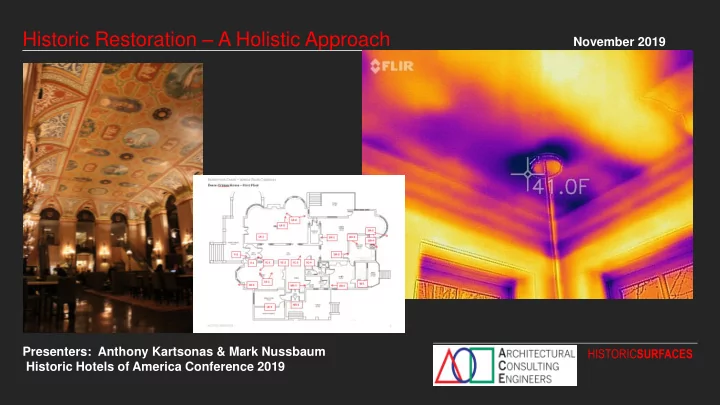
SLIDE 1
Historic Restoration – A Holistic Approach
Presenters: Anthony Kartsonas & Mark Nussbaum Historic Hotels of America Conference 2019 November 2019 HISTORICSURFACES
SLIDE 2
What we will discuss Common types of historic surface issues Common environmental and infrastructure issues that can effect historic surfaces Typical assessment strategies used to inform the restoration of historic surfaces
SLIDE 3 Historic Surfaces & Materials Commonly found materials in historic buildings include:
- Plaster
- Paint
- Wood Finishes
- Metal
- Marble & other stones
SLIDE 4 Causes of Deterioration
SLIDE 5 Causes of Deterioration
SLIDE 6 Causes of Deterioration
SLIDE 7 Causes of Deterioration
- Water
- Water
- Water
- Did I say Water?
SLIDE 8 Causes of Deterioration Other Causes
- Structural Issues
- Mechanical Wear
- Natural Aging
- Incompatibility of Materials, Workmanship,
& Alterations
SLIDE 9 Causes of Deterioration - Water Typical Causes
- Infiltration from the building exterior
- Infiltration from mechanical
systems Effects
deterioration
- Flaking and Peeling paint
- Water staining on finishes
SLIDE 10 Causes of Deterioration – Structural Issues Typical Causes
- Building Movement
- Natural Aging
- Environmental Issues
Effects
- Cracks and unstable elements
SLIDE 11 Causes of Deterioration – Mechanical Wear Typical Causes
- Manual Touch by public
- Moving of Furniture & Furnishing
Effects
- Nicks, Scrapes, & Abrasions
- Losses
SLIDE 12 Causes of Deterioration – Natural Aging Typical Causes
- Normal ‘Shelf Life’
- Exposure (Environment)
Effects
- Material Breakdown
- Finish Discoloration or Degradation
SLIDE 13 Causes of Deterioration – Incompatibility Typical Causes
- Wrong Material
- Wrong / Poor Repair
- Poor Decision
Effects
- Material Breakdown
- Poor adhesion on finishes
SLIDE 14 Causes of Deterioration – Environmental Issues Typical Causes
- Mechanical System Operations / Failure
- Control of Exterior Environment
Effects
SLIDE 15 Finding Solutions First Step
- Document & Evaluate the Condition Issues
- Look for the Causes
Methods
- Material Assessments
- Lab Analysis
- Environmental Assessment & Monitoring
SLIDE 16 Finding Solutions Material Assessment
- Cursory Survey
- Comprehensive Examination
SLIDE 17 Finding Solutions Lab Analysis
- Determine components
- f original material
- Find elements that could
be contributing to the problem
SLIDE 18 Finding Solutions Environmental Assessment & Monitoring
- Monitor Relative Temperature & Humidity
- Review of Mechanical Systems
SLIDE 19 Environmental Assessment & Monitoring
Temperature & Relative Humidity data collection
- This can be done at any point to create a
baseline of data.
- If setting a survey before an issue arises
then this data can be an early indicator of an issue.
- OR it can be started once an issue is
discovered
- Looking for understanding of how the T&RH
fluctuates in the space of concern.
SLIDE 20
Environmental Assessment & Monitoring
Tools for Measurement
SLIDE 21
Environmental Assessment & Monitoring
SLIDE 22 Environmental Assessment & Monitoring
Detailed survey of the space, building and building systems
- Building envelope deficiencies could be directly contributing to issues
through bulk water leaks or excessive air infiltration.
- Building systems could be directly contributing to the issue through
leaks – water, steam, conditioned air, sanitary, storm water, etc..
- Building systems could be indirectly contributing due to poor
performance in removing excess humidity or poor temperature control.
- IR survey to see hot/cold spots behind walls and ceilings.
- Blower door testing.
SLIDE 23
Environmental Assessment & Monitoring Infrared Imaging
SLIDE 24
Environmental Assessment & Monitoring
SLIDE 25 Environmental Assessment & Monitoring
Sometimes the results are indeterminate / inconclusive In that case, if there is no smoking gun?
- Expanded T & RH Data collection is needed.
- May Require Destructive testing with the use of a
Boroscope
SLIDE 26
Case Study – Palmer House At first glance – Everything Looks Great
SLIDE 27 Case Study – Palmer House At first glance – Everything Looks Great
attention
SLIDE 28
Case Study – Palmer House Upon closer examination - Significant Flaking Paint
SLIDE 29
Case Study – Palmer House Cursory examination to possibly identify source of the problem
SLIDE 30
Case Study – Palmer House Main Project was to correct the most defective areas.
SLIDE 31
Case Study – Palmer House Before & After
SLIDE 32
Conclusion Best Tool for Preservation
SLIDE 33 Conclusion Best Tool for Preservation
SLIDE 34 Conclusion Best Tool for Preservation
- Inform Yourself
- Inform Yourself
SLIDE 35 Conclusion Best Tool for Preservation
- Inform Yourself
- Inform Yourself
- Inform Yourself
SLIDE 36 Conclusion Best Tool for Preservation
- Inform Yourself
- Inform Yourself
- Inform Yourself
Create a Plan
SLIDE 37 Conclusion Best Tool for Preservation (Very Best) Call specialists like Anthony Kartsonas of Historic Surfaces LLC & Mark Nussbaum of Architectural Consulting Engineers. Will work for:
- Monetary Funding
- On Occasion - Well Cooked Meals and Beverages
- And now – Stays at fabulous Historic Properties
SLIDE 38
Conclusion In general, call a specialist. Feel free to contact us: Anthony Kartsonas historicsurfaces@gmail.com 708-205-7164 / Cell Mark Nussbaum mark@ace-oakpark.com 708-524-0272