
SLIDE 1
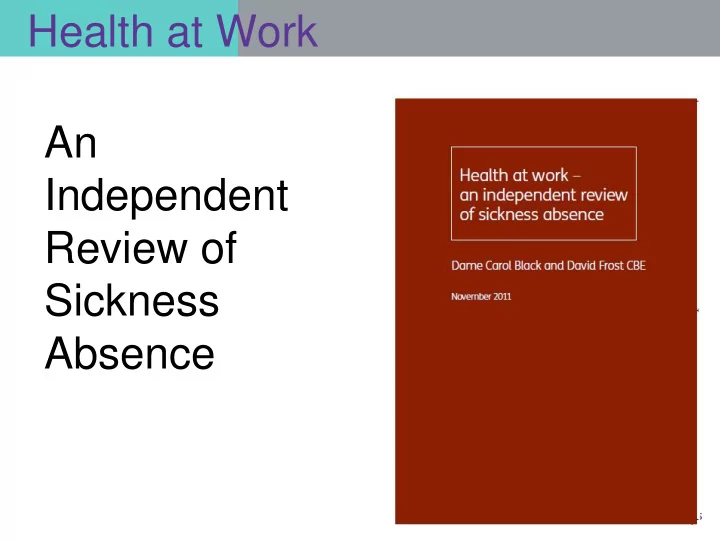
Health at Work An Independent Review of Sickness Absence Terms - - PowerPoint PPT Presentation
Health at Work An Independent Review of Sickness Absence Terms of Reference to explore how the current sickness absence system could be changed to help people stay in work, reduce costs and contribute to economic growth to examine
State
(Worklessness benefits; foregone taxes; extra healthcare)
Employers
(SSP/OSP; costs of staff turnover; time spend managing absence; OH where offered)
Individuals
(Loss of income; emotional and physical costs of ill-health)
Cost of sickness absence to economy c £15bn
Management of sickness absence by employers is
and those from smaller firms have less support. 85% of fit notes sign people off completely unfit.
Work Sickness absence
Claim to Employment Support Allowance (ESA) Work Capability Assessment
ESA
benefit and support
JSA
benefit and support
Work Inactivity 28 weeks 39 weeks
140,000 ESA claimants come straight from work without a period of support from their employer.
Claim to Employment Support Allowance (ESA) Work Capability Assessment
The State’s main interventions are focused on the after job-loss period. Huge delays in assessing benefit claimants’ work capability.
There are too few drivers in the journey keeping people in work.
WORK 24m Short-term absence 11m Long-term absence 1m 0 8 days 4 wks 8wks 28 wks
IAS - reducing flows into long-term sickness (2.9m off sick with GP’s certificate) Tax relief, public sector recommendations – managing absence in employment Job Brokering - helping people move jobs
1.9m 0.5m 0.5m
Our recommendations address problems throughout the sickness absence journey
ESA reforms - reducing flows on to ESA from work (140k) ESA reforms - reducing flows on to ESA from sickness (110k)
ESA
Employees 24.0m Self- employed 3.5m Out of work/ inactive 11.4m Claim to Employment Support Allowance (ESA)
350,000
(650,000) Short time sickness absence Long-term sickness absence
140,000 (320,000) 60,000 (80,000) 120,000 (140,000) 30,000 (110,000)
12-15 months after ESA claim Economically inactive 210,000 (310,000)
Figures may not sum due to rounding.
Economically active 140,000 (340,000)
Flows between work, absence and ESA before and after our recommendations
Government Employers Economy Independent Assessment Service
+100 +150 Job brokering Up to +300 Up to +50 Up to +800 ESA system +100 +300 Tax incentives
+250 +100 Percentage Threshold Scheme +50 Up to -50* Total Up to +300 Up to +400 Up to +1,400 * this offset comes from the associated reduction in admin burdens