Happy 103rd birthday, Richard Guy Karl Dilcher Infinite products - - PowerPoint PPT Presentation

happy 103rd birthday richard guy
SMART_READER_LITE
LIVE PREVIEW

Happy 103rd birthday, Richard Guy Karl Dilcher Infinite products - - PowerPoint PPT Presentation

Happy 103rd birthday, Richard Guy Karl Dilcher Infinite products Infinite products involving Dirichlet characters and cyclotomic polynomials Karl Dilcher Dalhousie Number Theory Seminar, Sept. 30, 2019 Karl Dilcher Infinite products Joint


slide-1
SLIDE 1
slide-2
SLIDE 2
slide-3
SLIDE 3

Happy 103rd birthday, Richard Guy

Karl Dilcher Infinite products

slide-4
SLIDE 4

Infinite products involving Dirichlet characters and cyclotomic polynomials

Karl Dilcher Dalhousie Number Theory Seminar, Sept. 30, 2019

Karl Dilcher Infinite products

slide-5
SLIDE 5

Joint work with Christophe Vignat (Université d’Orsay and Tulane University)

Karl Dilcher Infinite products

slide-6
SLIDE 6
  • 1. Introduction

Well-known fact about infinite products:

  • k=2
  • 1 − 1

k

  • diverges.

Karl Dilcher Infinite products

slide-7
SLIDE 7
  • 1. Introduction

Well-known fact about infinite products:

  • k=2
  • 1 − 1

k

  • diverges. On the other hand, e.g.,

  • k=1
  • 1 − (−1)k

2k + 1

  • = π

4 √ 2.

Karl Dilcher Infinite products

slide-8
SLIDE 8
  • 1. Introduction

Well-known fact about infinite products:

  • k=2
  • 1 − 1

k

  • diverges. On the other hand, e.g.,

  • k=1
  • 1 − (−1)k

2k + 1

  • = π

4 √ 2. Related: Weierstrass factorization theorem which gives, e.g., zeγz

  • k=1
  • 1 + z

k

  • e−z/k =

1 Γ(z).

Karl Dilcher Infinite products

slide-9
SLIDE 9
  • 1. Introduction

Well-known fact about infinite products:

  • k=2
  • 1 − 1

k

  • diverges. On the other hand, e.g.,

  • k=1
  • 1 − (−1)k

2k + 1

  • = π

4 √ 2. Related: Weierstrass factorization theorem which gives, e.g., zeγz

  • k=1
  • 1 + z

k

  • e−z/k =

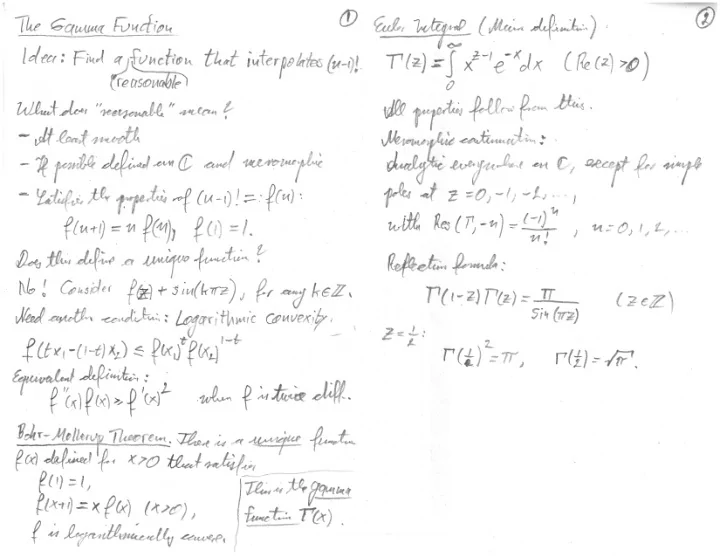
1 Γ(z). First indication that the gamma function may be involved.

Karl Dilcher Infinite products

slide-10
SLIDE 10

Source: Wikipedia, “Gamma Function".

Karl Dilcher Infinite products

slide-11
SLIDE 11

Source: Wikipedia, “Gamma Function".

Karl Dilcher Infinite products

slide-12
SLIDE 12

Karl Dilcher Infinite products

slide-13
SLIDE 13

A general result: A convergent infinite product of a rational function in the index k can always be written as a product or quotient of finitely many values of the gamma function. The last identity is an ingredient in the proof of this fact.

Karl Dilcher Infinite products

slide-14
SLIDE 14

A general result: A convergent infinite product of a rational function in the index k can always be written as a product or quotient of finitely many values of the gamma function. The last identity is an ingredient in the proof of this fact. Goal of this talk: To extend the identity

  • k=1
  • 1 − (−1)k

2k + 1

  • = π

4 √ 2 in a different direction.

Karl Dilcher Infinite products

slide-15
SLIDE 15
  • 2. Main Result

Let χ be the unique nontrivial Dirichlet character modulo 4, i.e., the periodic function of period 4 defined by χ(1) = 1, χ(3) = −1, and χ(0) = χ(2) = 0.

Karl Dilcher Infinite products

slide-16
SLIDE 16
  • 2. Main Result

Let χ be the unique nontrivial Dirichlet character modulo 4, i.e., the periodic function of period 4 defined by χ(1) = 1, χ(3) = −1, and χ(0) = χ(2) = 0. Then we can rewrite this last identity as

  • k=2
  • 1 − χ(k)

k

  • = π

4 √ 2, (1)

Karl Dilcher Infinite products

slide-17
SLIDE 17
  • 2. Main Result

Let χ be the unique nontrivial Dirichlet character modulo 4, i.e., the periodic function of period 4 defined by χ(1) = 1, χ(3) = −1, and χ(0) = χ(2) = 0. Then we can rewrite this last identity as

  • k=2
  • 1 − χ(k)

k

  • = π

4 √ 2, (1) and as a function of the complex variable z as

  • k=2
  • 1 − χ(k)z

k

  • =

√ 2 1 − z sin (1 − z)π 4 . (2)

Karl Dilcher Infinite products

slide-18
SLIDE 18
  • 2. Main Result

Let χ be the unique nontrivial Dirichlet character modulo 4, i.e., the periodic function of period 4 defined by χ(1) = 1, χ(3) = −1, and χ(0) = χ(2) = 0. Then we can rewrite this last identity as

  • k=2
  • 1 − χ(k)

k

  • = π

4 √ 2, (1) and as a function of the complex variable z as

  • k=2
  • 1 − χ(k)z

k

  • =

√ 2 1 − z sin (1 − z)π 4 . (2) Note: (2) implies (1) by letting z → 1.

Karl Dilcher Infinite products

slide-19
SLIDE 19
  • 2. Main Result

Let χ be the unique nontrivial Dirichlet character modulo 4, i.e., the periodic function of period 4 defined by χ(1) = 1, χ(3) = −1, and χ(0) = χ(2) = 0. Then we can rewrite this last identity as

  • k=2
  • 1 − χ(k)

k

  • = π

4 √ 2, (1) and as a function of the complex variable z as

  • k=2
  • 1 − χ(k)z

k

  • =

√ 2 1 − z sin (1 − z)π 4 . (2) Note: (2) implies (1) by letting z → 1. This is a special case of the following result.

Karl Dilcher Infinite products

slide-20
SLIDE 20

Theorem 1 Let χ be a primitive nonprincipal Dirichlet character with conductor q > 2. Then

  • k=2
  • 1 − χ(k)z

k

  • = (2π)ϕ(q)/2

(1 − z)ǫ(q) ·

q−1

  • j=1

(j,q)=1

1 Γ

  • j−χ(j)z

q

,

Karl Dilcher Infinite products

slide-21
SLIDE 21

Theorem 1 Let χ be a primitive nonprincipal Dirichlet character with conductor q > 2. Then

  • k=2
  • 1 − χ(k)z

k

  • = (2π)ϕ(q)/2

(1 − z)ǫ(q) ·

q−1

  • j=1

(j,q)=1

1 Γ

  • j−χ(j)z

q

, where ǫ(q) is defined by ǫ(q) = √p when q is a power of a prime p, 1

  • therwise.

Karl Dilcher Infinite products

slide-22
SLIDE 22

Main ingredients in proof:

  • 1. Infinite product expansion for 1/Γ(z) leads to

Γ(u) Γ(u + v) = eγv

  • k=0
  • 1 +

v u + k

  • e−v/(k+1),

Karl Dilcher Infinite products

slide-23
SLIDE 23

Main ingredients in proof:

  • 1. Infinite product expansion for 1/Γ(z) leads to

Γ(u) Γ(u + v) = eγv

  • k=0
  • 1 +

v u + k

  • e−v/(k+1),

and this, in turn, gives rise to Lemma 2 Let n ∈ N, a, z1, . . . , zn ∈ C with zj = 0 for j = 1, . . . , n, and let f : {1, 2, . . . , n} → C satisfy f(1) + · · · + f(n) = 0. Then

Karl Dilcher Infinite products

slide-24
SLIDE 24

Main ingredients in proof:

  • 1. Infinite product expansion for 1/Γ(z) leads to

Γ(u) Γ(u + v) = eγv

  • k=0
  • 1 +

v u + k

  • e−v/(k+1),

and this, in turn, gives rise to Lemma 2 Let n ∈ N, a, z1, . . . , zn ∈ C with zj = 0 for j = 1, . . . , n, and let f : {1, 2, . . . , n} → C satisfy f(1) + · · · + f(n) = 0. Then

  • k=0

n

  • j=1
  • 1 − f(j)

a zj + k

  • =

n

  • j=1

Γ(zj) Γ(zj − f(j)a).

Karl Dilcher Infinite products

slide-25
SLIDE 25
  • 2. Products of certain gamma function values:

Karl Dilcher Infinite products

slide-26
SLIDE 26
  • 2. Products of certain gamma function values:

Lemma 3 (Chamberland and Straub, 2013) For any integer n ≥ 2 and prime p we have

n−1

  • j=1

(j,n)=1

Γ j n

  • =
  • (2π)ϕ(n)/2

if n is not a prime power,

1 √p(2π)ϕ(n)/2

if n = pν, ν ≥ 1.

Karl Dilcher Infinite products

slide-27
SLIDE 27
  • 2. Products of certain gamma function values:

Lemma 3 (Chamberland and Straub, 2013) For any integer n ≥ 2 and prime p we have

n−1

  • j=1

(j,n)=1

Γ j n

  • =
  • (2π)ϕ(n)/2

if n is not a prime power,

1 √p(2π)ϕ(n)/2

if n = pν, ν ≥ 1. This extends the well-known identity

n−1

  • j=1

Γ j n

  • = (2π)(n−1)/2

√n .

Karl Dilcher Infinite products

slide-28
SLIDE 28

Marc (left) and Armin (middle) after being hit by a rogue wave in Peggy’s Cove, Nova Scotia.

Karl Dilcher Infinite products

slide-29
SLIDE 29

Using the reflection formula Γ(z)Γ(1 − z) = π sin(πz), z = 0, ±1, ±2, . . . :

Karl Dilcher Infinite products

slide-30
SLIDE 30

Using the reflection formula Γ(z)Γ(1 − z) = π sin(πz), z = 0, ±1, ±2, . . . : Corollary 4 Let χ be an odd primitive Dirichlet character with conductor q > 2. Then

  • k=2
  • 1 − χ(k)z

k

  • =

2ϕ(q)/2 (1 − z)ǫ(q) ·

⌊ q−1

2 ⌋

  • j=1

(j,q)=1

sin

  • πj − χ(j)z

q

  • ,

Karl Dilcher Infinite products

slide-31
SLIDE 31

Using the reflection formula Γ(z)Γ(1 − z) = π sin(πz), z = 0, ±1, ±2, . . . : Corollary 4 Let χ be an odd primitive Dirichlet character with conductor q > 2. Then

  • k=2
  • 1 − χ(k)z

k

  • =

2ϕ(q)/2 (1 − z)ǫ(q) ·

⌊ q−1

2 ⌋

  • j=1

(j,q)=1

sin

  • πj − χ(j)z

q

  • ,

and in particular,

  • k=2
  • 1 − χ(k)

k

  • = π2ϕ(q)/2

qǫ(q) ·

⌊ q−1

2 ⌋

  • j=2

(j,q)=1

sin

  • πj − χ(j)

q

  • .

Karl Dilcher Infinite products

slide-32
SLIDE 32

Example 1. Let q = 3. Then the only nonprincipal character is given by χ(1) = 1 and χ(2) = −1. Then

  • k=2
  • 1 − χ(k)z

k

  • =

2 (1 − z) √ 3 · sin( π

3(1 − z)),

Karl Dilcher Infinite products

slide-33
SLIDE 33

Example 1. Let q = 3. Then the only nonprincipal character is given by χ(1) = 1 and χ(2) = −1. Then

  • k=2
  • 1 − χ(k)z

k

  • =

2 (1 − z) √ 3 · sin( π

3(1 − z)),

and with z = 1 and z = 1

2 we get, respectively, ∞

  • k=2
  • 1 − χ(k)

k

  • = 2π

3 √ 3 ,

  • k=2
  • 1 − χ(k)

2k

  • =

2 √ 3 .

Karl Dilcher Infinite products

slide-34
SLIDE 34

Example 2. q = 5 is the smallest conductor that has nonreal

  • characters. We choose the one (of two) that is given by

χ(1) = 1, χ(2) = i, χ(3) = −i and χ(4) = −1. Then

Karl Dilcher Infinite products

slide-35
SLIDE 35

Example 2. q = 5 is the smallest conductor that has nonreal

  • characters. We choose the one (of two) that is given by

χ(1) = 1, χ(2) = i, χ(3) = −i and χ(4) = −1. Then

  • k=2
  • 1 − χ(k)z

k

  • =

4 (1 − z) √ 5 · sin( π

5(1 − z)) · sin( π 5(2 − iz)),

Karl Dilcher Infinite products

slide-36
SLIDE 36

Example 2. q = 5 is the smallest conductor that has nonreal

  • characters. We choose the one (of two) that is given by

χ(1) = 1, χ(2) = i, χ(3) = −i and χ(4) = −1. Then

  • k=2
  • 1 − χ(k)z

k

  • =

4 (1 − z) √ 5 · sin( π

5(1 − z)) · sin( π 5(2 − iz)),

and

  • k=2
  • 1 − χ(k)

k

  • = 4π

5 √ 5 · sin( π

5(2 − i))

= 4π 5 √ 5

  • sin( 2π

5 ) cosh( π 5) − i cos( 2π 5 ) sinh( π 5)

  • .

Karl Dilcher Infinite products

slide-37
SLIDE 37
  • 3. Some multiple L-series

Example: Let χ3 and χ−4 be the nonprincipal characters with q = 3 and q = 4, respectively. Well-known identities:

  • k=1

χ3 k = π 3 √ 3 ,

  • k=1

χ−4 k = π 4. On the right: The Gregory-Leibniz formula.

Karl Dilcher Infinite products

slide-38
SLIDE 38
  • 3. Some multiple L-series

Example: Let χ3 and χ−4 be the nonprincipal characters with q = 3 and q = 4, respectively. Well-known identities:

  • k=1

χ3 k = π 3 √ 3 ,

  • k=1

χ−4 k = π 4. On the right: The Gregory-Leibniz formula. More generally, let χ be a Dirichlet character with q ≥ 2. For n ≥ 1, consider Ln(χ) :=

  • 1≤k1<···<kn

χ(k1) k1 . . . χ(kn) kn .

Karl Dilcher Infinite products

slide-39
SLIDE 39
  • 3. Some multiple L-series

Example: Let χ3 and χ−4 be the nonprincipal characters with q = 3 and q = 4, respectively. Well-known identities:

  • k=1

χ3 k = π 3 √ 3 ,

  • k=1

χ−4 k = π 4. On the right: The Gregory-Leibniz formula. More generally, let χ be a Dirichlet character with q ≥ 2. For n ≥ 1, consider Ln(χ) :=

  • 1≤k1<···<kn

χ(k1) k1 . . . χ(kn) kn . Expanding the infinite product, we obtain

  • k=1
  • 1 − χ(k)z

k

  • = 1 +

  • n=1

(−1)nLn(χ)zn.

Karl Dilcher Infinite products

slide-40
SLIDE 40

Corollary 5 (a) If χ is the nonprincipal character with q = 3, then L2n(χ) = (−1)n (2n)! π 3 2n , L2n+1(χ) = (−1)n (2n + 1)! √ 3 π 3 2n+1 .

Karl Dilcher Infinite products

slide-41
SLIDE 41

Corollary 5 (a) If χ is the nonprincipal character with q = 3, then L2n(χ) = (−1)n (2n)! π 3 2n , L2n+1(χ) = (−1)n (2n + 1)! √ 3 π 3 2n+1 . (b) If χ is the nonprincipal character with q = 4, then L2n(χ) = (−1)n (2n)! π 4 2n , L2n+1(χ) = (−1)n (2n + 1)! π 4 2n+1 .

Karl Dilcher Infinite products

slide-42
SLIDE 42

Corollary 5 (a) If χ is the nonprincipal character with q = 3, then L2n(χ) = (−1)n (2n)! π 3 2n , L2n+1(χ) = (−1)n (2n + 1)! √ 3 π 3 2n+1 . (b) If χ is the nonprincipal character with q = 4, then L2n(χ) = (−1)n (2n)! π 4 2n , L2n+1(χ) = (−1)n (2n + 1)! π 4 2n+1 . (c) If χ is the nonprincipal character with q = 6, then L2n(χ) = (−1)n (2n)! π 6 2n , L2n+1(χ) = (−1)n√ 3 (2n + 1)! π 6 2n+1 .

Karl Dilcher Infinite products

slide-43
SLIDE 43

Corollary 5 (a) If χ is the nonprincipal character with q = 3, then L2n(χ) = (−1)n (2n)! π 3 2n , L2n+1(χ) = (−1)n (2n + 1)! √ 3 π 3 2n+1 . (b) If χ is the nonprincipal character with q = 4, then L2n(χ) = (−1)n (2n)! π 4 2n , L2n+1(χ) = (−1)n (2n + 1)! π 4 2n+1 . (c) If χ is the nonprincipal character with q = 6, then L2n(χ) = (−1)n (2n)! π 6 2n , L2n+1(χ) = (−1)n√ 3 (2n + 1)! π 6 2n+1 . In these cases: Only one factor on the right of our main result.

Karl Dilcher Infinite products

slide-44
SLIDE 44

Can this be generalized?

Karl Dilcher Infinite products

slide-45
SLIDE 45

Can this be generalized? Recall the partial (or incomplete) exponential Bell polynomial: Bn,k(x1, x2, . . . , xn−k+1) =

  • n!

j1! . . . jn−k+1! x1 1! j1 · · ·

  • xn−k+1

(n − k + 1)! jn−k+1 , where the summation is over all j1, j2, . . . , jn−k+1 ≥ 0 satisfying j1 + 2j2 + · · · + (n − k + 1)jn−k+1 = k, j1 + j2 + · · · + jn−k+1 = n;

Karl Dilcher Infinite products

slide-46
SLIDE 46

Can this be generalized? Recall the partial (or incomplete) exponential Bell polynomial: Bn,k(x1, x2, . . . , xn−k+1) =

  • n!

j1! . . . jn−k+1! x1 1! j1 · · ·

  • xn−k+1

(n − k + 1)! jn−k+1 , where the summation is over all j1, j2, . . . , jn−k+1 ≥ 0 satisfying j1 + 2j2 + · · · + (n − k + 1)jn−k+1 = k, j1 + j2 + · · · + jn−k+1 = n; Example: Bn,0(x1, x2, . . . , xn+1) = 0, Bn,1(x1, x2, . . . , xn) = xn, Bn,n(x1) = xn

1 .

Karl Dilcher Infinite products

slide-47
SLIDE 47

Can this be generalized? Recall the partial (or incomplete) exponential Bell polynomial: Bn,k(x1, x2, . . . , xn−k+1) =

  • n!

j1! . . . jn−k+1! x1 1! j1 · · ·

  • xn−k+1

(n − k + 1)! jn−k+1 , where the summation is over all j1, j2, . . . , jn−k+1 ≥ 0 satisfying j1 + 2j2 + · · · + (n − k + 1)jn−k+1 = k, j1 + j2 + · · · + jn−k+1 = n; Example: Bn,0(x1, x2, . . . , xn+1) = 0, Bn,1(x1, x2, . . . , xn) = xn, Bn,n(x1) = xn

1 .

The smallest case not belonging to these sequences is B3,2(x1, x2) = 3x1x2.

Karl Dilcher Infinite products

slide-48
SLIDE 48

Important use: Faà di Bruno’s formula: dn dxn f(g(x)) =

n

  • k=1

f (k)(g(x))·Bn,k(g′(x), g′′(x), . . . , g(n−k+1)(x)).

Karl Dilcher Infinite products

slide-49
SLIDE 49

Important use: Faà di Bruno’s formula: dn dxn f(g(x)) =

n

  • k=1

f (k)(g(x))·Bn,k(g′(x), g′′(x), . . . , g(n−k+1)(x)). Applying this to the digamma function ψ(z) = Γ′(z)/Γ(z), z = 0, −1, −2, . . . :

Karl Dilcher Infinite products

slide-50
SLIDE 50

Important use: Faà di Bruno’s formula: dn dxn f(g(x)) =

n

  • k=1

f (k)(g(x))·Bn,k(g′(x), g′′(x), . . . , g(n−k+1)(x)). Applying this to the digamma function ψ(z) = Γ′(z)/Γ(z), z = 0, −1, −2, . . . : Lemma 6 For n ∈ N we have dn dxn Γ(y) = Γ(y)

n

  • k=1

Bn,k(ψ(y), ψ1(y), . . . , ψn−k(y)), dn dxn 1 Γ(y) = 1 Γ(y)

n

  • k=1

(−1)kBn,k(ψ(y), ψ1(y), . . . , ψn−k(y)), where ψj(y) = ψ(j)(y) and ψ0(y) = ψ(y).

Karl Dilcher Infinite products

slide-51
SLIDE 51

Theorem 7 Let χ be a primitive nonprincipal Dirichlet character with q > 2. Then for n ∈ N, Ln(χ) = 1 qn ∗

j∈Φ

χ(j)kj kj!

kj

  • k=1

(−1)kBkj,k

  • ψ( j

q), ψ1( j q), . . . , ψkj−k( j q)

  • ,

with index set Φ := {j | 1 ≤ j ≤ q − 1, gcd(j, q) = 1}, where the summation ∗ is over all kj(j ∈ Φ) that sum to n.

Karl Dilcher Infinite products

slide-52
SLIDE 52

Theorem 7 Let χ be a primitive nonprincipal Dirichlet character with q > 2. Then for n ∈ N, Ln(χ) = 1 qn ∗

j∈Φ

χ(j)kj kj!

kj

  • k=1

(−1)kBkj,k

  • ψ( j

q), ψ1( j q), . . . , ψkj−k( j q)

  • ,

with index set Φ := {j | 1 ≤ j ≤ q − 1, gcd(j, q) = 1}, where the summation ∗ is over all kj(j ∈ Φ) that sum to n. Example 1: For n = 1, the product reduces to a single factor. Since B1,1(x1) = x1, we get the well-known identity L1(χ) = 1 q

  • j∈Φ

χ(j)(−1)ψ( j

q).

Karl Dilcher Infinite products

slide-53
SLIDE 53

Corollary 8 Let χ be a primitive nonprincipal odd character with q > 2. Then

  • 1≤k<ℓ

χ(k) k χ(ℓ) ℓ = π2 2q2       

⌊ q−1

2 ⌋

  • j=1

χ(j) cot( πj

q )

  

2

⌊ q−1

2 ⌋

  • j=1
  • χ(j)

sin( πj

q )

2     .

Karl Dilcher Infinite products

slide-54
SLIDE 54
  • 4. Some multiple L-star series

Consider the “star analog" of Ln(χ): L∗

n(χ) :=

  • 1≤k1≤···≤kn

χ(k1) k1 . . . χ(kn) kn . Note: ≤ instead of < between subscripts.

Karl Dilcher Infinite products

slide-55
SLIDE 55
  • 4. Some multiple L-star series

Consider the “star analog" of Ln(χ): L∗

n(χ) :=

  • 1≤k1≤···≤kn

χ(k1) k1 . . . χ(kn) kn . Note: ≤ instead of < between subscripts. Lemma 9 Let χ be a primitive nonprincipal Dirichlet character. Then

  • k=1
  • 1 − χ(k)z

k −1 = 1 +

  • n=1

L∗

n(χ)zn.

Karl Dilcher Infinite products

slide-56
SLIDE 56

Corollary 10 Let χ be a primitive nonprincipal Dirichlet character. Then for all n ≥ 1, L∗

n(χ) + n−1

  • j=1

(−1)jLj(χ)L∗

n−j(χ) + (−1)nLn(χ) = 0.

Karl Dilcher Infinite products

slide-57
SLIDE 57

Corollary 10 Let χ be a primitive nonprincipal Dirichlet character. Then for all n ≥ 1, L∗

n(χ) + n−1

  • j=1

(−1)jLj(χ)L∗

n−j(χ) + (−1)nLn(χ) = 0.

For the “easy cases", we need Bernoulli and Euler polynomials: xezx ex − 1 =

  • n=0

Bn(z)xn n! (|x| < 2π), 2ezx ex + 1 =

  • n=0

En(z)xn n! (|x| < π), and Bernoulli and Euler numbers defined by Bn := Bn(0), En := 2nEn( 1

2),

n = 0, 1, 2, . . . .

Karl Dilcher Infinite products

slide-58
SLIDE 58

Corollary 11 (a) If χ is the nonprincipal character with q = 3, then L∗

2n(χ) = (−1)n+13(22n + 1)B2n+1( 1 3)

(2n + 1)!π2n, L∗

2n+1(χ) = (−1)n

√ 3 2 (22n+1 − 1)(32n+2 − 1) B2n+2 (2n + 2)! π 3 2n+1 . (b) If χ is the nonprincipal character with q = 4, then L∗

n(χ) = (−1)⌊ n+1

2 ⌋ En( 1

4)

n! πn. (c) If χ is the nonprincipal character with q = 6, then L∗

2n(χ) = (−1)n 1

4(32n+1 + 1) E2n (2n)! π 6 2n , L∗

2n+1(χ) = (−1)n+1

√ 3 2 E2n+1( 1

6)

(2n + 1)!π2n+1.

Karl Dilcher Infinite products

slide-59
SLIDE 59

n B2n+1( 1

3)

B2n+2 En( 1

4)

E2n E2n+1( 1

6)

− 1

6 1 6

1 1 − 1

3

1

1 27

− 1

30

− 1

4

−1

23 108

2 − 5

243 1 42

− 3

16

5 − 1681

3888

3

49 2187

− 1

30 11 64

−61

257543 139968

4 − 809

19683 5 66 57 256

1385 − 67637281

5038848

5

20317 177147

− 691

2730

− 361

1024

−50521

27138236663 181398528

Karl Dilcher Infinite products

slide-60
SLIDE 60

The general case: Theorem 12 Let χ be a primitive nonprincipal Dirichlet character with q > 2. Then for all n ≥ 1, L∗

n(χ)

= (−1)n qn ∗

j∈Φ

χ(j)kj kj!

kj

  • k=1

Bkj,k

  • ψ( j

q), ψ1( j q), . . . , ψkj−k( j q)

  • ,

with index set Φ := {j | 1 ≤ j ≤ q − 1, gcd(j, q) = 1}, and summation ∗ over all kj(j ∈ Φ) that sum to n.

Karl Dilcher Infinite products

slide-61
SLIDE 61

With n = 2 and using the relation L∗

2(χ) + L2(χ) = L1(χ)L∗ 1(χ) = L1(χ)2 :

Karl Dilcher Infinite products

slide-62
SLIDE 62

With n = 2 and using the relation L∗

2(χ) + L2(χ) = L1(χ)L∗ 1(χ) = L1(χ)2 :

Corollary 13 Let χ be a primitive nonprincipal character with q > 2. Then

  • k=1

χ(k)2 k2 = π2 q2

⌊ q−1

2 ⌋

  • j=1
  • χ(j)

sin( πj

q )

2 .

Karl Dilcher Infinite products

slide-63
SLIDE 63

With n = 2 and using the relation L∗

2(χ) + L2(χ) = L1(χ)L∗ 1(χ) = L1(χ)2 :

Corollary 13 Let χ be a primitive nonprincipal character with q > 2. Then

  • k=1

χ(k)2 k2 = π2 q2

⌊ q−1

2 ⌋

  • j=1
  • χ(j)

sin( πj

q )

2 . In particular,

  • k=1

(k,q)=1

1 k2 = π2 q2

⌊ q−1

2 ⌋

  • j=1

(j,q)=1

csc2( πj

q ).

Karl Dilcher Infinite products

slide-64
SLIDE 64

Example: If q is an odd prime, then the LHS becomes ζ(2) − ζ(2)/q2, and with ζ(2) = π2/6, we get

q−1 2

  • j=1

csc2( πj

q ) = q2 − 1

6 . (This is a well-known identity).

Karl Dilcher Infinite products

slide-65
SLIDE 65
  • 5. Products involving cyclotomic polynomials

Theorem 14 If m ≥ 3 is an integer that contains a square, then

  • k=1

Φm( z

k ) = m−1

  • j=1

(j,m)=1

1 Γ(1 − ze2πij/m).

Karl Dilcher Infinite products

slide-66
SLIDE 66
  • 5. Products involving cyclotomic polynomials

Theorem 14 If m ≥ 3 is an integer that contains a square, then

  • k=1

Φm( z

k ) = m−1

  • j=1

(j,m)=1

1 Γ(1 − ze2πij/m). Example 1: Let m = 4. Then Φ4( z

k ) = 1 + ( z k )2, and ∞

  • k=1
  • 1 + ( z

k )2

= i −πz sin(πiz) = sinh(πz) πz , a well-known identity.

Karl Dilcher Infinite products

slide-67
SLIDE 67

Example 2: Let m = 12. Then Φ12(x) = 1 − x2 + x4, and thus

  • k=1
  • 1 − ( z

k )2 + ( z k )4

= −1 π2z2 sin(πzeπi/6) sin(πze5πi/6) = sin2( 1

2

√ 3πz) + sinh2( 1

2πz)

π2z2 .

Karl Dilcher Infinite products

slide-68
SLIDE 68

Example 2: Let m = 12. Then Φ12(x) = 1 − x2 + x4, and thus

  • k=1
  • 1 − ( z

k )2 + ( z k )4

= −1 π2z2 sin(πzeπi/6) sin(πze5πi/6) = sin2( 1

2

√ 3πz) + sinh2( 1

2πz)

π2z2 . With z = 1/(2 √ 3), we get

  • k=1
  • 1 −

1 12k2 + 1 144k4

  • = 6

π2 · cosh π 2 √ 3

  • .

Karl Dilcher Infinite products

slide-69
SLIDE 69

Thank you

Karl Dilcher Infinite products