Definition. For x > 0 we define the Gamma function ( x ) by the - - PDF document

definition for x 0 we define the gamma function x by the
SMART_READER_LITE
LIVE PREVIEW

Definition. For x > 0 we define the Gamma function ( x ) by the - - PDF document

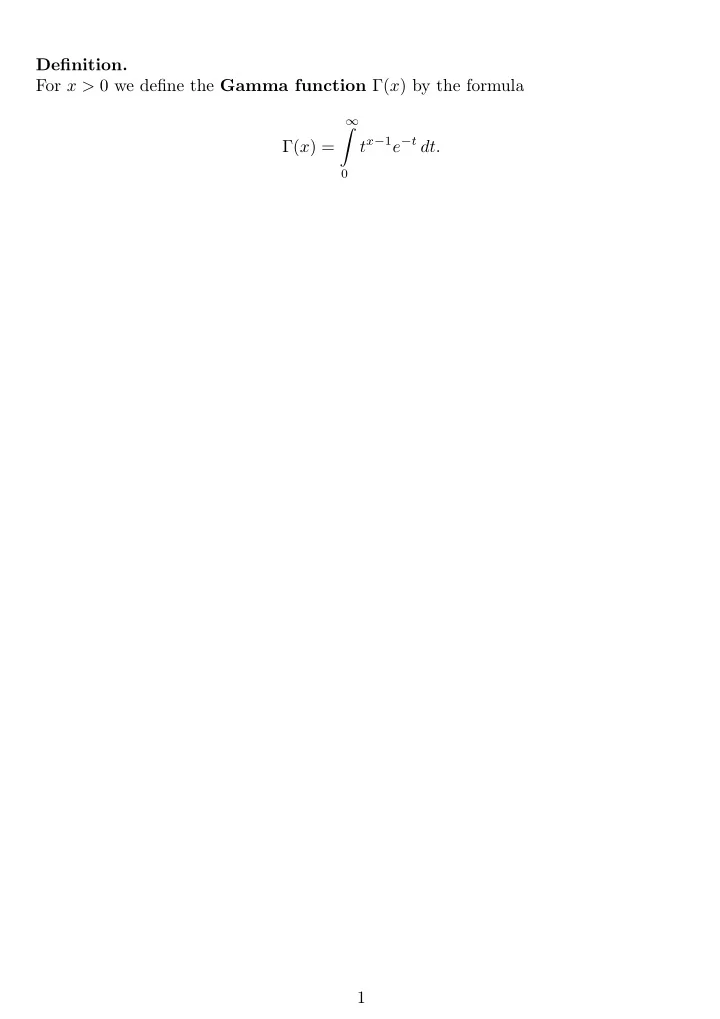
Definition. For x > 0 we define the Gamma function ( x ) by the formula t x 1 e t dt. ( x ) = 0 1 Theorem. The Gamma function satisfies ( x + 1) = x ( x ) for all x 0. 2 Theorem. (i) ( x ) = ( x 1)! for


slide-1
SLIDE 1

Definition. For x > 0 we define the Gamma function Γ(x) by the formula Γ(x) =

  • tx−1e−t dt.

1

slide-2
SLIDE 2

Theorem. The Gamma function satisfies Γ(x + 1) = xΓ(x) for all x ≥ 0. 2

slide-3
SLIDE 3

Theorem. (i) Γ(x) = (x − 1)! for all x ∈ I N. (ii) Γ 1

2

  • = √π.

3

slide-4
SLIDE 4

Theorem. Let m ∈ I

  • N0. Then

lim

z→−m

  • 1

Γ(z)

  • converges.

If we define the function g(z) as

1 Γ(z) for −z /

∈ I N0 and g(z) = lim

w→z

  • 1

Γ(w)

  • for −z ∈ I

N0, then g is an entire function on the complex plane. 4

slide-5
SLIDE 5

Definition. By a Bessel equation of order m we mean the equation x2y′′ + xy′ + (x2 − m2)y = 0, x > 0. 5

slide-6
SLIDE 6

Definition. Let m ∈ I R satisfy −m / ∈ I

  • N. We define the Bessel function (of the first kind) of
  • rder m by the formula

Jm(x) =

  • k=0

(−1)k k!Γ(m + k + 1) x 2 2k+m , x > 0. For m ∈ I N we define J−m(x) = lim

µ→−m

  • Jµ(x)
  • .

6

slide-7
SLIDE 7

Theorem. For all m the function Jm solves the Bessel equation of order |m|. If m is not an integer, then the set {Jm, J−m} is linearly independent and hence a basis

  • f solutions of the Bessel equation of order m.

7

slide-8
SLIDE 8

Theorem. If m is an integer, then J−m(x) = (−1)mJm(x) for all x > 0. 8

slide-9
SLIDE 9

Theorem. (i) J1/2(x) =

  • 2

πx sin(x)

and J−1/2(x) =

  • 2

πx cos(x)

for x ≥ 0. (ii) If x is small and positive, 0 < x < √x + 1, then Jm(x) ∼ 1 Γ(m + 1) x

2

m. (iii) If x is large, then Jm(x) ∼

  • 2

πx cos

  • x − π

4 (2m + 1)

  • .

9

slide-10
SLIDE 10

Definition. We define Bessel functions of the second kind of order m as follows: If m is not an integer, we set Nm(x) = Jm(x) cos(mπ) − J−m(x) sin(mπ) . If m is an integer, we set Nm(x) = lim

µ→m(Nµ(x)) for x > 0.

10

slide-11
SLIDE 11

Theorem. For all m ∈ I R, the set {Jm, Nm} is a fundamental system of the Bessel equation of

  • rder m.

11

slide-12
SLIDE 12

Theorem. Let m ≥ 0. (i) If x is small and positive, 0 < x < √x + 1, then N0(x) ∼ 2

π

  • ln

x

2

  • + 0.5772...
  • and

Nm(x) ∼ −Γ(m) π 2 x m pro m > 0. (ii) If x is large, then Nm(x) ∼

  • 2

πx sin

  • x − π

4 (2m + 1)

  • .

12