SLIDE 1
PRINCIPLES OF TAXATION
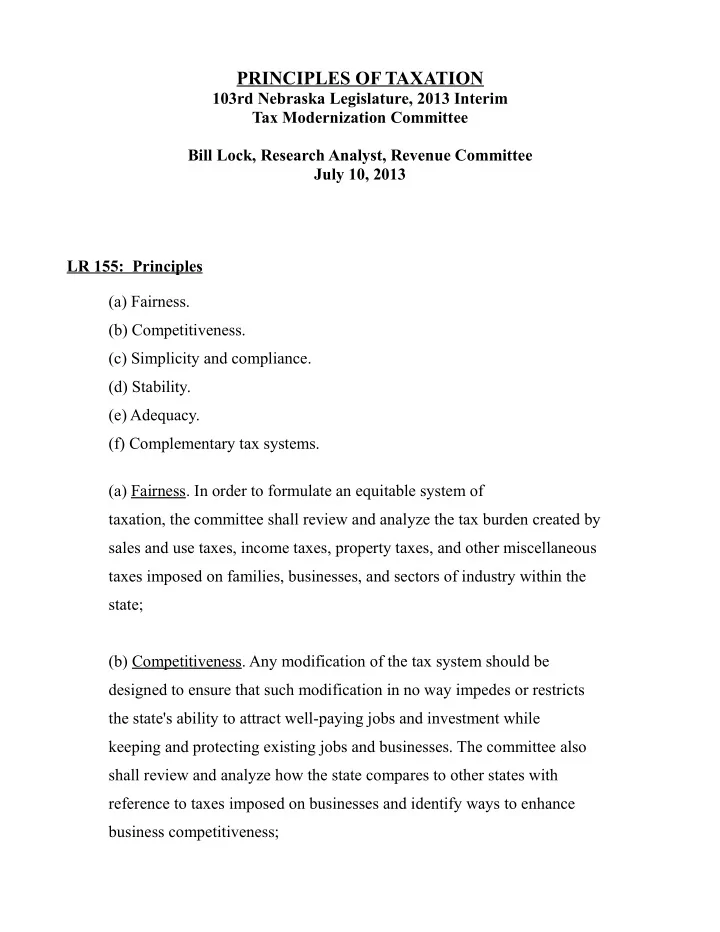
103rd Nebraska Legislature, 2013 Interim Tax Modernization Committee Bill Lock, Research Analyst, Revenue Committee July 10, 2013 LR 155: P rinciples (a) Fairness. (b) Competitiveness. (c) Simplicity and compliance. (d) Stability. (e) Adequacy. (f) Complementary tax systems. (a) Fairness. In order to formulate an equitable system of taxation, the committee shall review and analyze the tax burden created by sales and use taxes, income taxes, property taxes, and other miscellaneous taxes imposed on families, businesses, and sectors of industry within the state; (b) Competitiveness. Any modification of the tax system should be designed to ensure that such modification in no way impedes or restricts the state's ability to attract well-paying jobs and investment while keeping and protecting existing jobs and businesses. The committee also shall review and analyze how the state compares to other states with reference to taxes imposed on businesses and identify ways to enhance business competitiveness;
SLIDE 2 (c) Simplicity and compliance. The tax system should be easy to understand and comply with. The committee shall formulate recommendations designed to ensure ease of compliance for individuals and businesses and efficient administration by the state; (d) Stability. A stable tax system generates revenue that is relatively dependable and not prone to unpredictable fluctuations. The committee shall ensure that any recommended changes will maintain or improve stability; (e) Adequacy. The tax modernization process should create a tax system that generates adequate revenue to fund essential state services and
- bligations. The tax structure should ensure that revenue will meet
spending needs; and (f) Complementary tax systems. Updating of the tax system should address the interrelationships among tax systems within the state revenue system as a whole. National Conference of State Legislatures: Principles of a High-Quality Revenue System
- 1. A high-quality revenue system comprises elements that are complementary,
including the finances of both state and local governments.
Page 2
SLIDE 3
- 2. A high-quality revenue system produces revenue in a reliable manner.
Reliability involves stability, certainty and sufficiency.
- 3. A high-quality revenue system relies on a balanced variety of revenue sources.
- 4. A high-quality revenue system treats individuals equitably. Minimum
requirements of an equitable system are that it imposes similar tax burdens on people in similar circumstances, that it minimizes regressivity, and that it minimizes taxes on low-income individuals.
- 5. A high-quality revenue system facilitates taxpayer compliance. It is easy to
understand and minimizes compliance costs.
- 6. A high-quality revenue system promotes fair, efficient and effective
- administration. It is as simple as possible to administer, raises revenue efficiently,
is administered professionally, and is applied uniformly.
- 7. A high-quality revenue system is responsive to interstate and international
economic competition.
- 8. A high-quality revenue system minimizes its involvement in spending decisions
and makes any such involvement explicit.
- 9. A high-quality revenue system is accountable to taxpayers.
Page 3
SLIDE 4 Nebraska Constitution: Select Provisions or Principles Article III - 18 The Legislature shall not pass special laws. Article III - 24 Limitation on games of chance; authorization of parimutuel wagering on horse racing. Article IV - 28 Appointment and jurisdiction of Tax Commissioner; creation of State Board of Equalization and Assessment with power to review and equalize assessments of property for taxation within this state. (Amended in 1996 to provide for creating a Tax Equalization and Review Commission. ) Article VII - 1 The Legislature shall provide for the free instruction in the common schools of the state. Article VIII - 1 Authorization of taxation. Taxes shall be levied by valuation uniformly and proportionately upon all tangible property and franchises; permissive exceptions for motor vehicles, agricultural land, and livestock; authorization for taxation of intangible property; and authorization for taxation
- ther than property taxation.
Article VIII - 1 A. Prohibition against the state levying a property tax for state purposes. Article VIII - 1 B. Authorization of an income tax based upon law of the United
Page 4
SLIDE 5
States. Article VIII - 2 Mandatory exemption from taxation of property owned by the state or its governmental subdivisions; permissive exemptions of certain enumerated property from taxation. The Legislature may classify personal property, and may exempt any class or all personal property from taxation. No property shall be exempt from taxation except as provided by Constitution. Article VIII -2A Permissive exemption of goods held in freeport warehouse. Article VIII - 3 Prohibition against the release, discharge, or commutation of the proportionate share of taxes levied for state purposes or due any municipal corporation. Article VIII -5 Limitation of county levy to no greater than 50 cents per 100 dollars of value Article VIII-10 Authorization to substitute valuation taxation on grain and seed produced or handled in this state, notwithstanding the other provisions of Article VIII. Article VIII -11 Requirement for in lieu of tax payment by public corporations or political subdivisions providing electricity or irrigation and electricity. Article XIII-1 State may contract debts; limitation; exceptions.
Page 5
SLIDE 6 Text of select provisions: Nebraska State Constitution Article VIII-1 Uniformity Clause
VIII-1. Revenue; raised by taxation; legislative powers. The necessary revenue of the state and its governmental subdivisions shall be raised by taxation in such manner as the Legislature may direct. Notwithstanding Article I, section 16, Article III, section 18, or Article VIII, section 4, of this Constitution or any other provision of this Constitution to the contrary: (1) Taxes shall be levied by valuation uniformly and proportionately upon all real property and franchises as defined by the Legislature except as otherwise provided in or permitted by this Constitution; (2) tangible personal property, as defined by the Legislature, not exempted by this Constitution or by legislation, shall all be taxed at depreciated cost using the same depreciation method with reasonable class lives, as determined by the Legislature, or shall all be taxed by valuation uniformly and proportionately; (3) the Legislature may provide for a different method of taxing motor vehicles and may also establish a separate class of motor vehicles consisting of those owned and held for resale by motor vehicle dealers which shall be taxed in the manner and to the extent provided by the Legislature and may also establish a separate class for trucks, trailers, semitrailers, truck-tractors, or combinations thereof, consisting of those owned by residents and nonresidents
- f this state, and operating in interstate commerce, and may provide reciprocal and proportionate taxation of
such vehicles. The tax proceeds from motor vehicles taxed in each county shall be allocated to the county and the cities, villages, and school districts of such county; (4) the Legislature may provide that agricultural land and horticultural land, as defined by the Legislature, shall constitute a separate and distinct class of property for purposes of taxation and may provide for a different method of taxing agricultural land and horticultural land which results in values that are not uniform and proportionate with all other real property and franchises but which results in values that are uniform and proportionate upon all property within the class of agricultural land and horticultural land; (5) the Legislature may enact laws to provide that the value of land actively devoted to agricultural or horticultural use shall for property tax purposes be that value which such land has for agricultural or horticultural use without regard to any value which such land might have for other purposes or uses; (6) the Legislature may prescribe standards and methods for the determination of the value
- f real property at uniform and proportionate values; (7) in furtherance of the purposes for which such a law
- f the United States has been adopted, whenever there exists a law of the United States which is intended to
protect a specifically designated type, use, user, or owner of property or franchise from discriminatory state
- r local taxation, such property or franchise shall constitute a separate class of property or franchise under
the laws of the State of Nebraska, and such property or franchise may not be taken into consideration in determining whether taxes are levied by valuation uniformly or proportionately upon any property or franchise, and the Legislature may enact laws which statutorily recognize such class and which tax or exempt from taxation such class of property or franchise in such manner as it determines; and (8) the Legislature may provide that livestock shall constitute a separate and distinct class of property for purposes of taxation and may further provide for reciprocal and proportionate taxation of livestock located in this state for only part of a year. Each actual property tax rate levied for a governmental subdivision shall be the same for all classes of taxed property and franchises. Taxes uniform as to class of property or the ownership or use thereof may be levied by valuation or otherwise upon classes of intangible property as the Legislature may determine, and such intangible property held in trust or otherwise for the purpose of funding pension, profit- sharing, or other employee benefit plans as defined by the Legislature may be declared exempt from taxation. Taxes other than property taxes may be authorized by law. Existing revenue laws shall continue in effect until changed by the Legislature.
Source
- Neb. Const. art. IX, sec. 1 (1875);
Amended 1920, Constitutional Convention, 1919-1920, No. 26; Transferred by Constitutional Convention, 1919-1920, art. VIII, sec. 1; Amended 1952, Laws 1951, c. 160, sec. 1, p. 636; Amended 1954, Laws 1954, Sixty-sixth Extraordinary Session, c. 3, sec. 1, p. 61; Amended 1960, Laws 1959, c. 238, sec. 1, p. 823;
Page 6
SLIDE 7 Amended 1964, Laws 1963, c. 298, sec. 1, p. 887; Amended 1964, Laws 1963, c. 301, sec. 1, p. 892; Amended 1972, Laws 1972, LB 837, sec. 1; Amended 1978, Laws 1978, First Spec. Sess., LR 1, sec. 1; Amended 1984, Laws 1984, First Spec. Sess., LR 7, sec. 1; Amended 1990, Laws 1989, LR 2, sec. 1; Amended 1992, Laws 1992, LR 219CA, sec. 1; Amended 1998, Laws 1998, LR 45CA, sec. 1.
Nebraska State Constitution Article III-18
Nebraska State Constitution » III-18 III-18. Local or special laws prohibited.
Nebraska State Constitution Article VIII-1B
VIII-1B. Income tax; may be based upon the laws of the United States. When an income tax is adopted by the Legislature, the Legislature may adopt an income tax law based upon the laws of the United States.
Source
- Neb. Const. art. VIII, sec. 1B (1966);
Adopted 1966, Laws 1965, c. 292, sec. 1, p. 833.
Nebraska State Constitution Article VIII-1A
Levy of property tax for state purposes; prohibition. The state shall be prohibited from levying a property tax for state purposes. Adopted 1954, Laws 1954, Sixty-sixth Extraordinary Session, c. 5, sec. 1, p. 65; Amended 1966, Initiative Measure No. 301.
Nebraska State Constitution Article VIII-5
VIII-5. County taxes; limitation. County authorities shall never assess taxes the aggregate of which shall exceed fifty cents per one hundred dollars of taxable value as determined by the assessment rolls, except for the payment of indebtedness existing at the adoption hereof, unless authorized by a vote of the people of the county. Page 7
SLIDE 8 Source
- Neb. Const. art. IX, sec. 5 (1875);
Amended 1920, Constitutional Convention, 1919-1920, No. 28; Transferred by Constitutional Convention, 1919-1920, art. VIII, sec. 5; Amended 1992, Laws 1992, LR 219CA, sec. 1.
Nebraska State Constitution Article XIII-1
Nebraska State Constitution » XIII-1 XIII-1. State may contract debts; limitation; exceptions.
The state may, to meet casual deficits, or failures in the revenue, contract debts never to exceed in the aggregate one hundred thousand dollars, and no greater indebtedness shall be incurred except for the purpose of repelling invasion, suppressing insurrection, or defending the state in war, and provision shall be made for the payment of the interest annually, as it shall accrue, by a tax levied for the purpose, or from other sources of revenue, which law providing for the payment
- f such interest by such tax shall be irrepealable until such debt is paid; Provided, that if the
Legislature determines by a three-fifths vote of the members elected thereto that (1) the need for construction of highways in this state requires such action, it may authorize the issuance of bonds for such construction, and for the payment of the interest and the retirement of such bonds it may pledge any tolls to be received from such highways or it may irrevocably pledge for the term of the bonds all or a part of any state revenue closely related to the use of such highways, such as motor vehicle fuel taxes or motor vehicle license fees and (2) the construction of water retention and impoundment structures for the purposes of water conservation and management will promote the general welfare of the state, it may authorize the issuance of revenue bonds for such construction, and for the payment of the interest and the retirement of such bonds it may pledge all or any part of any state revenue derived from the use of such structures; and provided further,that the Board of Regents of the University of Nebraska, the Board of Trustees of the Nebraska State Colleges, and the State Board of Education may issue revenue bonds to construct, purchase, or otherwise acquire, extend, add to, remodel, repair, furnish, and equip dormitories, residence halls, single or multiple dwelling units, or other facilities for the housing and boarding of students, single or married, and faculty or other employees, buildings and structures for athletic purposes, student unions or centers, and for the medical care and physical development and activities of students, and buildings or other facilities for parking, which bonds shall be payable solely out of revenue, fees, and other payments derived from the use of the buildings and facilities constructed or acquired, including buildings and facilities heretofore or hereafter constructed or acquired, and paid for out of the proceeds of other issues of revenue bonds, and the revenue, fees, and payments so pledged need not be appropriated by the Legislature, and any such revenue bonds heretofore issued by either of such boards are hereby authorized, ratified, and
- validated. Bonds for new construction shall be first approved as the Legislature shall provide.
Page 8
SLIDE 9 Source
- Neb. Const. art. XII, sec. 1 (1875);
Transferred by Constitutional Convention, 1919-1920, art. XIII, sec. 1; Amended 1968, Laws 1967, c. 324, sec. 1, p. 861; Amended 1970, Laws 1969, c. 428, sec. 1, p. 1448; Amended 1982, Laws 1982, LB 577, sec. 1.
NCSL Tax Policy Principles: Comparison to LR 155 principles. a) Greater emphasis on state and local revenue system. b) Greater emphasis on balanced state and local system. Use of mix desired to meet fiscal policy goals, (stability versus growth, progressive or regressive) is noted by drafters. c) Emphasis on economic neutrality, avoiding impact on individual and business behavior. d) Greater emphasis on broad bases for taxation, as an element of stability. Certainty in tax structure is emphasized (what is taxed, or will be), and emphasis on minimizing rate changes as well. e) Principle 8 suggests that the revenue system should minimize involvement in spending decisions, and make such involvement explicit. The authors draw
Page 9
SLIDE 10 attention to deductions, credits and exemptions are intended to foster certain activities, or to influence behavior. Earmarking taxes for certain uses should be examined carefully in their opinion. CHARACTERISTICS OF A BALANCED AND MODERATE STATE AND LOCAL REVENUE SYSTEM.
A summary and description of an article by Robert Kleine and John Shannon: Characteristics of a Balanced and Moderate State and Local Revenue System. Originally published December 1986, as chapter III of Reforming State Tax Systems, National Conference of State Legislatures.
Authors Kleine and Shannon emphasis three values:
- 1. Balance or Revenue Diversification
- 2. Tax Fairness (shielding low income households from the tax collectors reach)
- 3. Moderation
1. BALANCE AND REVENUE DIVERSIFICATION The authors advocate balanced use in a system of taxes which does not overly rely on
- ne tax type. The logic here is that each type of tax has its own weaknesses, and
strengths. They suggest that income taxes are faster growing in response to economic growth, but
Page 10
SLIDE 11 less reliable than property taxes or sales taxes. Sales taxes are, in their view, slower growing, but more reliable than income taxes. Sales tax base erosion due to a change in consumer spending however, is raised as a weakness of the sales tax. The property tax is viewed as stable, reliable and responsive to economic growth. Sales tax and property tax share limitations as to the fairness principles discussed by the authors, with sales tax described as regressive, (imposing a higher burden on low income households as a percent of income). Property tax is viewed as less regressive, but stable in the facing of reduced annual incomes, which produces problems with the percentage of tax burden on annual income rising during an economic downturn. REVENUE DIVERSIFICATION Comparing Nebraska's mix of taxes to that used by other states can be done using United States Census Bureau figures for 2010, the most recently published. T ax U.S. Average % U se Nebraska % U se Dollar change if NE % match es Property 34.8% 36.8% $145 million reduction or
Income Individual 20.5% 20.6% $3.8 million reduction, or
Page 11
SLIDE 12 Corporate 3.4% 2.1% $94.4 million increase or 61% of $154 million tax General Sales 22.4% 21.7% $53.8 million increase or 3.4% of $1.6B Selective Sales 11.5% 10.2% $94.7 million increase or 12.6% of $754 million MV License 1.8% 2.2% $34 million reduction or
Other Taxes 5.6% 6.4% $59.5 million reduction
National average percentage use of tax, by type of tax, compared to Nebraska percentage use of tax. Tax use data used here are from the Census of Governments, United States Census Bureau 2010
This 2010 data suggests that Nebraska does not vary to a great degree in percentage use
- f taxes by type from the national averages use of tax. Property tax use is higher than
average, personal income tax usage IS at the national average, and general sales tax usage only slightly less than average. Examining the findings and recommendations of the Syracuse Tax Study in this context, we note that that study, using data for 1984, suggested that Nebraska was a far above average user of property tax, motor fuel tax, and motor vehicle license tax. The percentages shown above suggest Nebraska is closer to average use than calculated in 1984 by the Syracuse study, particularly in the property tax category. However, Nebraska remains far above average in motor fuels and motor vehicle license taxes, with percentages exceeding the national average by 36% and 25% respectively.
Page 12
SLIDE 13 2. TAX FAIRNESS Shielding the income of low income households is a goal expressed by this report. Lowering the tax burdens of low income households can be accomplished by exempting some initial amount of income from taxation, which the Nebraska system does. Exempting food, prescription drugs, utilities, and even some small dollar clothing purchases have been tried in other states. Nebraska exempts food purchased for home consumption, but taxes prepared food at the statutory rate. In recent years, three of Nebraska's largest cities have imposed another 2% rate on the purchase of prepared food through a restaurant business occupation tax. Since low income households do spend some portion of their budget on prepared food meals, this has increased the regressivity of the Nebraska state and local tax system. Nebraska does not provide an exemption for utilities or clothing items of low dollar value, as some states do. Strategies other than exemptions do exist, including refundable income tax credits. Measuring household tax burdens, and comparing them, can be done using tax burden
- models. Models of household tax burdens can be categorized as legal incidence
models, and one example of this is the District of Columbia tax burden model. This model has been published since 1995, and compares household tax burdens in the largest city in each of the fifty states. Taxes reported are income, property, sales and motor vehicle, including motor fuels. An economic incidence model has been developed by the Institute on Taxation and Economic Policy. This type of model calculates three major taxes, income, property and sales by income groups on statewide basis. It accounts for tax shifting between first payers of a tax and other taxpayers in the economy. Some states, Minnesota being one,
Page 13
SLIDE 14
have developed their own economic incidence tax burden models. The Minnesota model accounts for more forms of tax than that accounted for in the Institute for Taxation and Economic Policy Model. We reviewed two models of household tax burdens, the District of Columbia tax burden model, and the Institute for Taxation and Economic Policy economic tax burden model, for their results in Nebraska. Our conclusion was that refundable income tax credits of $250 to $500 dollars for family households below $25,000 dollars in income could accomplish the goal of making the burden of Nebraska's system proportional, at the $250 dollar level, or progressive, at the level of $500 dollars, if legislators desire to achieve that goal.
Page 14
SLIDE 15 3. REVENUE STABILITY AND MODERATION Matching up revenue growth and state economic growth will increase revenue stability, but the authors also advise creation of state rainy day funds to achieve stability. Nebraska has a rainy day fund structure in place, and at present it contains healthy but not excessive balances. The match up between revenue growth and spending growth
- ver time is the topic of a presentation on revenue growth and history of tax structure by
Tom Bergquist, Legislative Fiscal Office Authors Kleine and Shannon address additional values: STATE FISCAL EQUALIZATION The authors of this article believe that states should avoid property tax over load by assuming a high level of financing of health care and hospitals, and education services with spillover benefits. (The State of Nebraska's takeover of the county share of medicaid meets this goal. It is estimated that in 2012 this shifts $350 million dollars of expense from counties to the state.) Fiscal equalization aid is recommended for policymakers preferring decentralized local government operations. Nebraska has fiscal equalization aid policies for schools, and
- cities. A county fiscal equalization policy was repealed in 2012, along with other non
equalized aid programs for counties, cities and natural resources districts. POLITICAL ACCOUNTABILITY The authors believe that tax increases due to economic growth or change should be explicit, and transparent. For this reason, they recommend a property tax “truth in
Page 15
SLIDE 16 taxation provision,” and income tax indexing. Truth in Taxation In the case of truth in property taxation, a provision which is recommended in which valuation growth is recognized and rate setting to adapt to a stronger tax base are subject to a explicit vote of local budget decision makers. Nebraska has such a provision in Section 77-1601.02 of state law, shown below. 77-1601.02. Property tax request; procedure. (1) The property tax request for the prior year shall be the property tax request for the current year for purposes of the levy set by the county board
- f equalization in section 77-1601 unless the governing body of the county,
municipality, school district, learning community, sanitary and improvement district, natural resources district, educational service unit, or community college passes by a majority vote a resolution or ordinance setting the tax request at a different amount. Such resolution or ordinance shall only be passed after a special public hearing called for such purpose is held and after notice is published in a newspaper of general circulation in the area of the political subdivision at least five days prior to the hearing. The hearing notice shall contain the following information: The dollar amount of the prior year's tax request and the property tax rate that was necessary to fund that tax request; the property tax rate that would be necessary to fund last year's tax request if applied to the current year's valuation; and the proposed dollar amount of the tax request for the current year and the property tax rate that will be necessary to fund that tax request. Any resolution setting a tax request under this section shall be certified and forwarded to the county clerk on or before October 13 of the year for which the tax request is to apply. (2) Any levy which is not in compliance with this section and section 77- 1601 shall be construed as an unauthorized levy under section 77-1606. Income tax indexing The authors also recommend indexing income tax brackets so that inflationary
Page 16
SLIDE 17 growth in income will not result in hidden tax increases, as more income is taxed in a higher rate bracket. Nebraska does not index its rate bracket dollar amounts. Nebraska indexes its standard deduction and personal exemption credit, something which is also recommended by the authors in a state with flat income tax rate structure. PROPERTY TAX EQUITY The authors recommend high standards be set for assessment uniformity and statistical accuracy of measurement. Statewide statistical standards for acceptable range of value are set by law in Section 77-5023 shown below. Measurement of compliance with these and other standards for uniformity are analyzed annually in hearings held before the Tax Equalization and Review Commission. State officials review county data for compliance with these standards. This provides taxpayers with an independent review of the statistics submitted by county assessors. 77-5023. Commission; power to change value; acceptable range. (1) Pursuant to section 77-5022, the commission shall have the power to increase
- r decrease the value of a class or subclass of real property in any county or taxing
authority or of real property valued by the state so that all classes or subclasses of real property in all counties fall within an acceptable range. (2) An acceptable range is the percentage of variation from a standard for valuation as measured by an established indicator of central tendency of
- assessment. Acceptable ranges are: (a) For agricultural land and horticultural land
as defined in section 77-1359, sixty-nine to seventy-five percent of actual value; (b) for lands receiving special valuation, sixty-nine to seventy-five percent of special valuation as defined in section 77-1343; and (c) for all other real property, ninety-two to one hundred percent of actual value. (3) Any increase or decrease shall cause the level of value determined by the commission to be at the midpoint of the applicable acceptable range. (4) Any decrease or increase to a subclass of property shall also cause the level of value determined by the commission for the class from which the subclass is drawn to be within the applicable acceptable range.
Page 17
SLIDE 18
(5) Whether or not the level of value determined by the commission falls within an acceptable range or at the midpoint of an acceptable range may be determined to a reasonable degree of certainty relying upon generally accepted mass appraisal techniques. TAX COMPETITIVENESS Seven characteristics of an uncompetitive interstate tax climate are identified by the authors Characteristics Nebraska Comparable Characteristics A relatively heavy tax burden. Nebraska is mid ranked among the states on tax burden on the economy. A highly progressive tax policy. Nebraska has a progressive income tax. No property tax inventory for business Nebraska exempts inventory No sales tax exemption for Nebraska exempted as of 2005. industrial machinery Agricultural machinery is also exempt except for repair parts. A classified property tax Unlike many states, Nebraska residential property is not classified and taxed at a lower value relative to business property. Agricultural land is classified, taxed at a lower level of market value (75%). This is a higher ratio of taxable value to market value than Nebraska border states. Above average rates for unemployment Nebraska's rates are competitive. insurance and workers compensation.
Page 18