Group revenues of MNOK 2,360 in Q1 2012 Slide: 2 Seasonally slow - - PDF document
group revenues of mnok 2 360 in q1 2012 slide 2
SMART_READER_LITE
LIVE PREVIEW

Group revenues of MNOK 2,360 in Q1 2012 Slide: 2 Seasonally slow - - PDF document

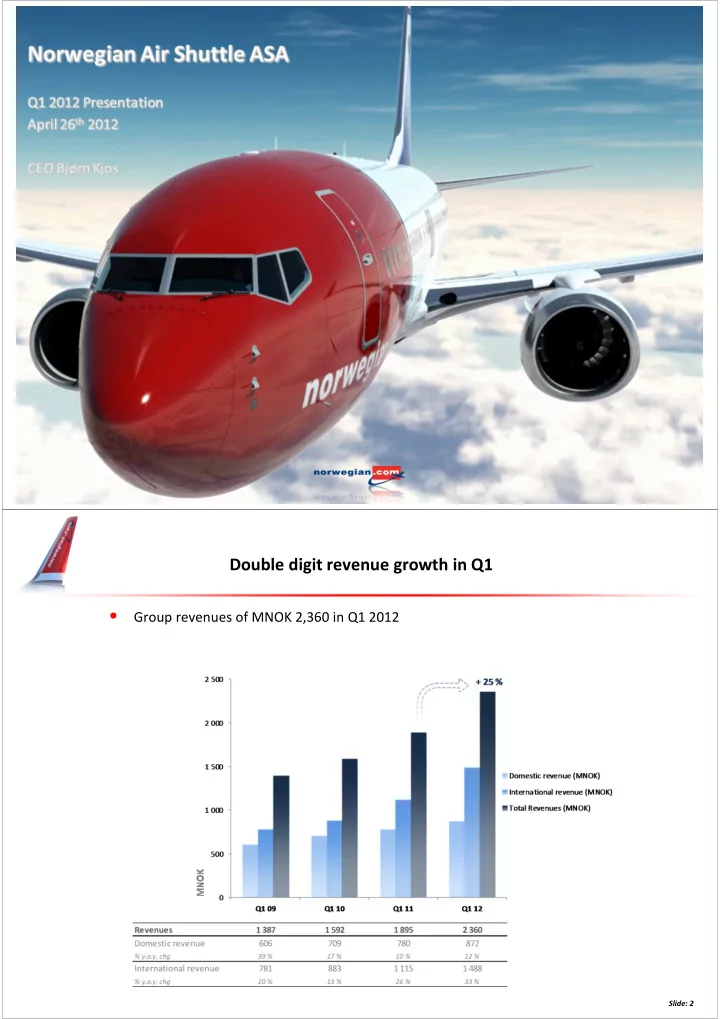
Double digit revenue growth in Q1 Group revenues of MNOK 2,360 in Q1 2012 Slide: 2 Seasonally slow Q1 affected by soaring oil price EBITDAR MNOK - 252 (-230) EBITDA MNOK - 497 (-430) EBIT MNOK - 575 (-495) .


slide-1
SLIDE 1

Double digit revenue growth in Q1

  • Group revenues of MNOK 2,360 in Q1 2012

Slide: 2

slide-2
SLIDE 2

Seasonally slow Q1 affected by soaring oil price

– EBITDAR MNOK

  • 252

(-230)

– EBITDA MNOK

  • 497

(-430)

– EBIT MNOK

  • 575

(-495) .

– Pre-tax profit (EBT) MNOK

  • 398

(-406)

– Net profit MNOK

  • 286

(-293)

Slide: 3

EBT development Q1 EBITDAR development Q1

  • 398
  • 406

115 33 16 100

  • 259
  • 306

25 Result improvement MNOK 47

  • 500
  • 400
  • 300
  • 200
  • 100

100

Q1 2012 Acutal Fuel Price increase More efficient aircraft reduce consumption Provisions re-delivery 737-300 Wet Lease Underlying Q1 2012 Underlying Q1 2011 Expansion (SE, DK, FI) Q1 2011 Actual

EBT (MNOK)

Underlying EBT improvement of MNOK 47

4

  • Fuel price up 15 % since last year – equivalent to MNOK 115
  • More efficient aircraft saves MNOK 25 in fuel cost
  • MNOK 33 accumulated provisions for re-delivery 737-300 ‘s
  • MNOK 16 Wet Lease cost
slide-3
SLIDE 3

Cash & cash equivalents of NOK 1.5 billion

5

  • Cash flows from operations in Q1 2012

MNOK +544 (+229)

  • Cash flows from investing activities in Q1 2012

MNOK -178 (-150)

  • Cash flows from financing activities in Q1 2012

MNOK +15 (-28)

  • Cash and cash equivalents at period-end

MNOK +1,487 (+1,229)

1 229 Cash 1,487 1 260 Receivables 1,552 4 630 Non-current assets 6,646

1 000 2 000 3 000 4 000 5 000 6 000 7 000 8 000 9 000 10 000 Q1 11 Q1 12

MNOK

Equity 1,661 1 506 Pre-sold tickets 2,291 1 822 Other current liabilities 3,527 1 359 Long term liabilities 3,207 2 433

Q1 12 Q1 11

  • Total balance of NOK 9.7 billion
  • Net interest bearing debt NOK 2.5 billion
  • Equity of NOK 1.7 billion at the end of the first quarter
  • Group equity ratio of 17 % (21 %)

Equity improved by more than MNOK 150 compared to last year

Slide: 6 Slide: 6

slide-4
SLIDE 4

Traffic growth of 22 % in Q1 2012

  • Load up 3 p.p. despite capacity growth of 17 %
  • Unit revenue (RASK) up 6 %

Slide: 7 Slide: 7 ASK

208 370 569 933 1 342 2 183 2 674 3 507 4 498 5 266

Load Factor

44 % 65 % 68 % 77 % 75 % 77 % 75 % 75 % 74 % 77 % 44 % 65 % 68 % 77 % 75 % 77 % 75 % 75 % 74 % 77 %

0 % 20 % 40 % 60 % 80 % 100 % 1 000 2 000 3 000 4 000 5 000

Q1 03 Q1 04 Q1 05 Q1 06 Q1 07 Q1 08 Q1 09 Q1 10 Q1 11 Q1 12

Load Factor Available Seat KM (ASK)

ASK Load Factor

+ 17 %

  • An increase of 592,000 passengers

More than 3.6 million passengers in Q1 2012

Slide: 8 Slide: 8 Pax (mill)

0.2 0.4 0.6 1.0 1.3 2.0 2.1 2.7 3.1 3.6

0.0 1.0 2.0 3.0 4.0

Q1 03 Q1 04 Q1 05 Q1 06 Q1 07 Q1 08 Q1 09 Q1 10 Q1 11 Q1 12

Passengers (million)

+ 19 %

slide-5
SLIDE 5

27 % 39 % 8 % 16 % 4 % n/a 29 % 45 % 9 % 15 % 8 % 20 % 30 % 44 % 13 % 17 % 10 % 19 % 29 % 43 % 16 % 22 % 11 % 20 %

0 % 10 % 20 % 30 % 40 % 50 % International From Oslo Airport (OSL) Domestic From Oslo Airport (OSL) International From Stockholm Airport (ARN) Domestic From Stockholm Airport (ARN) International From Copenhagen Airport (CPH) Domestic From Copenhagen Airport (CPH)

Market Share Norwegian (Q1) + 31,000 pax + 52,000 pax + 116,000 pax + 116,000 pax + 97,000 pax

  • 8,000 pax
  • New dom. routes to Malmö & Gothenburg
  • Substantial international production growth

Largest share of growth outside Norway

Newly started base in Helsinki with 300,000 passengers in Q1

Norwegian in Oslo + 83,000 pax

  • Marginal increase in domestic frequencies
  • Growth due to larger aircraft and charter

Norwegian in Stockholm + 232,000 pax Norwegian in Copenhagen + 89,000 pax

  • International production growth
  • Flying cost of 737-800 lower than 737-300
  • 737-800 has 38 “free” seats
  • 3 % lower unit fuel consumption in Q1

Norwegian aiming for CASK NOK 0.30 excluding fuel

10

Scale economies Scale economies New more efficient aircraft New more efficient aircraft Growth adapted to int’l markets Growth adapted to int’l markets Crew and aircraft utilization Crew and aircraft utilization Optimized average stage length Optimized average stage length Automation Automation

  • Uniform fleet of Boeing 737-800s
  • Overheads
  • Fixed costs divided by more ASKs
  • Frequency based costs divided by more ASKs
  • Q1 stage length up by 3 %
  • Cost level adapted to local markets
  • Outsourcing/ Off-shoring
  • Rostering and aircraft slings optimized
  • Q1 utilization of 10.2 BLH pr a/c
  • Self check-in/ bag drop
  • Automated charter & group bookings
  • Streamlined operative systems & processes
slide-6
SLIDE 6

Underlying unit cost down 3 %

Slide: 11 Slide: 11

  • Unit cost up 2 %

– 15 % higher spot fuel price (25 % increase including fuel hedges)

  • More efficient aircraft saved MNOK 25 in fuel cost in Q1

Cost per ASK (CASK) (NOK) 0.56 0.51 0.50 0.51 CASK ex. fuel 0.45 0.40 0.37 0.36

0.45 0.40 0.37 0.36

0.11 0.11 0.13 0.15 0.30 0.35 0.40 0.45 0.50 0.55 0.60 Q1 09 Q1 10 Q1 11 Q1 12

Operating cost EBITDA level per ASK (CASK)

Fuel share of CASK CASK excl fuel

  • 3 %

Norwegian hedges USD/NOK to counter foreign currency risk exposure on USD denominated borrowings translated to the prevailing currency rate at each balance sheet date. Hedge gains and losses are according to IFRS recognized under operating expenses while foreign currency gains and losses from translation of USD denominated borrowings are recognized under financial items and is thus not included in the CASK concept. Hedge effects offset under financial items have not been included in this graph.

Norwegian positioned in the cost “Survival Belt” – a prerequisite for self sustainability

Aiming for the “Comfort Zone”

12

Sources: SAS Group Annual Report 2011, Finnair Plc. year-end report 2011 and Annual Report 2010, Ryanair Annual Report 2011, easyJet Annual Report 2011, Air Berlin Annual Report 2011 and Norwegian’s estimations

  • Cost per available seat kilometer is an industry-wide cost level indicator often referred to as “CASK”. Usually represented as operating expenses before depreciation and amortization (EBITDA level) over produced seat kilometers (ASK). Here represented including depreciation and financial items.
  • Finnair: Non-airline operating expenses calculated by deducting “Airline Business” expenses as presented in the “Business segment data” from total operating expenses.
  • SAS Group: Revenues from mail & freight, ground handling services, technical maintenance and terminal & forwarding services as presented in the 2011 annual report are classified as “non-airline” and are deducted from airline operating expenses.
  • SAS Group’s figures are unadjusted for “restructuring costs” and “one-offs” as both items have been a constant fixture in most financial statements the last decade.
  • Foreign exchange rates used are equivalent to the daily average rates corresponding to the reporting periods and as stated by the Central Bank of Norway
slide-7
SLIDE 7

Ancillary revenue/ scheduled pax 70 80 86 84 Ancillary revenue/ all pax (inc. charter) 70 80 84 82 10 20 30 40 50 60 70 80 90 Q1 09 Q1 10 Q1 11 Q1 12

Ancillary revenue per passenger (NOK)

Ancillary revenues remains a significant contributor

Slide: 13 Slide: 13

  • Ancillary revenue comprises 13 % of Q1 revenues

Current committed fleet plan

14

  • 13 new 800 deliveries in 2012
  • Short term shortage of 800’s

– Temporarily covered by existing 300’s (2012 CASK guidance unaffected)

  • First 787-8 Dreamliner deliveries expected in Q1 2013
slide-8
SLIDE 8

Offering a better product at lower cost

  • Business environment

– Uncertain business climate – Seasonal fluctuations – Continued but stabilized yield pressure

  • Production

– The company expects a production growth (ASK) of approximately 15 % – Primarily from increasing the fleet by adding 737-800’s – Capacity deployment depending on development in the overall economy and marketplace

  • Cost development

– Unit cost expected in the area of 0.43 – 0.44 (excluding hedged volumes)

  • Fuel price dependent – USD 850 pr. ton (excluding hedged volumes)
  • Currency dependent – USD/NOK 6.00 (excluding hedged volumes)
  • Based on the current route portfolio
  • Production dependent
  • Larger share of aircraft with more capacity and lower unit cost

Expectations for 2012

Slide: 16 Slide: 16

slide-9
SLIDE 9

Norwegian offers 294 scheduled routes to 112 destinations

Slide: 18