1
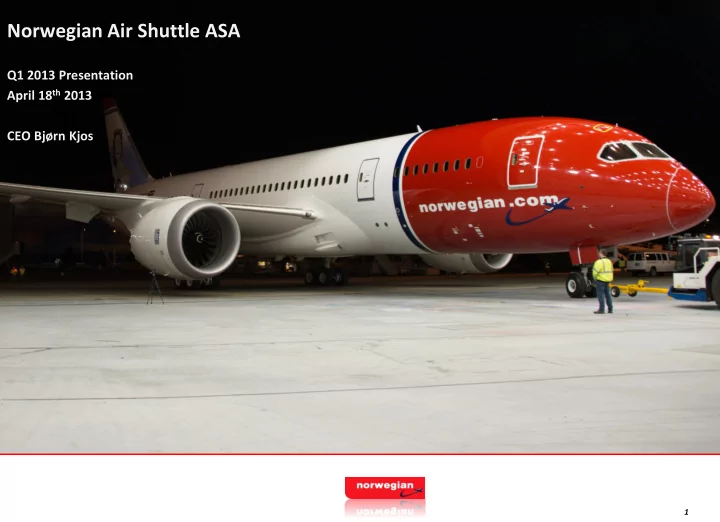
Norwegian Air Shuttle ASA Q1 2013 Presentation April 18 th 2013 CEO - - PowerPoint PPT Presentation
Norwegian Air Shuttle ASA Q1 2013 Presentation April 18 th 2013 CEO Bjrn Kjos 1 Double digit revenue growth in Q1 Group revenues of MNOK 2,904 in Q1 2013 + 23 % 3 000 2 500 2 000 Domestic Revenue (MNOK) International Revenue (MNOK)
Revenues 1 592 1 895 2 360 2 904 Domestic revenue 709 780 872 1 043 % y.o.y. chg
17 % 10 % 12 % 20 %
International revenue 883 1 115 1 488 1 861 % y.o.y. chg
13 % 26 % 33 % 25 %
500 1 000 1 500 2 000 2 500 3 000
Q1 10 Q1 11 Q1 12 Q1 13
MNOK
Domestic Revenue (MNOK) International Revenue (MNOK) Total Revenues (MNOK)
+ 23 %
Double digit revenue growth in Q1
- Group revenues of MNOK 2,904 in Q1 2013
Slide: 2
Q1 10 Q1 11 Q1 12 Q1 13 Q1 10 Q1 11 Q1 12 Q1 13 EBITDAR margin
- 1 %
- 12 %
- 11 %
15 % EBT margin
- 17 %
- 21 %
- 17 %
- 6 %
- 23
- 230
- 252
438
- 300
- 200
- 100
100 200 300 400 500 MNOK
- 275
- 406
- 398
- 160
- 500
- 300
- 100
100 MNOK
Pre-tax profit improved by 238 million in Q1
Slide: 3
EBT development Q1 EBITDAR development Q1
EBITDAR MNOK 438
- 252
EBITDA MNOK 189
- 497
EBIT MNOK 69
- 574
Pre-tax profit (EBT) MNOK
- 160
- 398
Net profit MNOK
- 117
- 285
Underlying EBT improvement of MNOK 165 in Q1
4
Ancillary revenue remains a significant contributor
5
- Ancillary revenue comprises 12 % of Q1 revenues
- NOK 88 per scheduled passenger (an increase of 5 % from last year)
Cash flows from operations in Q1 13 Cash flows from investing activities in Q1 13 Cash flows from financing activities in Q1 13 Cash and cash equivalents at period-end MNOK 2 445 MNOK -407 MNOK 158 MNOK 962
(MNOK 544) (MNOK -178) (MNOK 15) (MNOK 1487)
Cash & cash equivalents of NOK 2.4 billion
6 Condensed Consolidated Statement of Cash Flow
Unaudited Year End
(Mill. NOK) Q1 13 Q1 12 Q1 13 Q1 12 2012 Net cash flows from operating activities 961.6 544.0 961.6 544.0 2 021.6 Net cash flows from investing activities 158.2
- 177.6
158.2
- 177.6
- 2 765.5
Net cash flows from financial activities
- 406.6
14.9
- 406.6
14.9 1 369.4 Foreign exchange effect on cash 0.8 0.3 1.1 0.3 0.3
Net change in cash and cash equivalents
714.0 381.6 1 339.8 381.6 625.8
Cash and cash equivalents in beginning of period
1 730.9 1 104.9 1 730.9 1 104.9 1 104.9
Cash and cash equivalents in end of period
2 444.9 1 486.6 2 444.9 1 486.6 1 730.9
Quarterly (end of Q1 13) YTD (end of Q1 13)
- Total balance of NOK 13.2 billion
- Net interest bearing debt NOK 3.0 billion
- Equity of NOK 2.3 billion at the end of the first quarter
- Group equity ratio of 17 % (17 %)
Equity improved by MNOK 643 compared to last year
Slide: 7 Slide: 7
1 487 Cash 2,445 1 552 Receivables 1,952 2 227 Aircraft prepayments 2,684 4 419 Non-current assets 6,131
2 000 4 000 6 000 8 000 10 000 12 000 Q1 12 Q1 13
MNOK
Equity 2,304 1 661 Pre-sold tickets 3,269 2 291 Other current liabilities 2,904 2 527 Long term liabilities 4,736 3 207
Q1 13 Q1 12
Traffic growth of 19 % in Q1
- Unit revenue (RASK) up 2 %
- Average flying distance up 11 %
Slide: 8 Slide: 8
ASK 370 569 933 1 342 2 183 2 674 3 507 4 498 5 266 6 378 Load Factor 65 % 68 % 77 % 75 % 77 % 75 % 75 % 74 % 77 % 76 % 65 % 68 % 77 % 75 % 77 % 75 % 75 % 74 % 77 % 76 %
0 % 20 % 40 % 60 % 80 % 100 % 1 000 2 000 3 000 4 000 5 000 6 000
Q1 04 Q1 05 Q1 06 Q1 07 Q1 08 Q1 09 Q1 10 Q1 11 Q1 12 Q1 13
Load Factor Available Seat KM (ASK)
ASK Load Factor
+ 21 %
- An increase of 280,000 passengers
3.9 million passengers in Q1
Slide: 9 Slide: 9
Pax (mill) 0.4 0.6 1.0 1.3 2.0 2.1 2.7 3.1 3.6 3.9
0.00 1.00 2.00 3.00 4.00
Q1 04 Q1 05 Q1 06 Q1 07 Q1 08 Q1 09 Q1 10 Q1 11 Q1 12 Q1 13
Passengers (million)
+ 8 %
Marketshare Oslo Airport (OSL) Marketshare Stockholm Airport (ARN) Marketshare Copenhagen Airport (CPH) Marketshare Helsinki Airport (HEL) Marketshare Int'l Gatwick Airport (LGW) Marketshare Int'l Spanish bases (AGP, LPA, ALC) Q1 08 26 % 9 % 2 % 0 % 1 % 1 % Q1 09 33 % 10 % 5 % 0 % 1 % 3 % Q1 10 37 % 11 % 10 % 0 % 4 % 4 % Q1 11 37 % 14 % 11 % 2 % 5 % 5 % Q1 12 36 % 18 % 12 % 8 % 6 % 7 % Q1 13 36 % 18 % 14 % 9 % 6 % 11 % 0 % 5 % 10 % 15 % 20 % 25 % 30 % 35 % 40 %
+ 4,000 pax + 10,000 pax + 104,000 pax + 39,000 pax + 21,000 pax + 170,000 pax
Continued strong international growth in Q1
Sources: Avinor, Swedavia, Copenhagen Airports, Finavia, Gatwick Airport, Aena
Cost per ASK (CASK) (NOK) CASK ex. fuel 0.40 0.51 0.47 0.33 0.50 0.37 0.50 0.36
0.40 0.37 0.36 0.33
0.11 0.12 0.15 0.13 0.30 0.35 0.40 0.45 0.50 0.55 Q1 10 Q1 11 Q1 12 Q1 13
Operating cost EBITDA level per ASK (CASK)
Fuel share of CASK CASK excl fuel
- 8%
- 8%
Unit cost down 8 % in Q1
Slide: 11 Slide: 11
- Unit cost including & excluding fuel down 8 %
Norwegian hedges USD/NOK to counter foreign currency risk exposure on USD denominated borrowings translated to the prevailing currency rate at each balance sheet date. Hedge gains and losses are according to IFRS recognized under operating expenses (“other losses/ (gains)) while foreign currency gains and losses from translation of USD denominated borrowings are recognized under financial items (Net foreign exchange (loss) or gain). For the above reason CASK excludes losses and gains from “other losses/ (gains)” to better reflect the actual cost development.
Aiming for the cost “Comfort Zone”
Sources: SAS Group Q3-2012 report & Annual Report 2011 (cost displayed October 2011 – September 2012), Finnair Plc. Annual Report 2012, Ryanair Annual Report 2012, easyJet Annual Report 2012, Air Berlin Annual Report 2012, Vueling Results Presentation FY’12 and Q4’12 and Norwegian’s estimations
- Cost per available seat kilometer is an industry-wide cost level indicator often referred to as “CASK”. Usually represented as operating expenses before depreciation and amortization (EBITDA level) over produced seat kilometers (ASK).
- Finnair: Non-airline operating expenses calculated by deducting “Airline Business” expenses as presented in the “Business segment data” from total operating expenses.
- SAS Group: Revenues from mail & freight, ground handling services, technical maintenance and terminal & forwarding services as presented in the 2011 annual report are classified as “non-airline” and are deducted from airline operating expenses.
- SAS Group’s figures are unadjusted for “restructuring costs” as it has been a constant fixture in most financial statements the last decade.
- Foreign exchange rates used are equivalent to the daily average rates corresponding to the reporting periods and as stated by the Central Bank of Norway
- Norwegian hedges USD/NOK to counter foreign currency risk exposure on USD denominated borrowings translated to the prevailing currency rate at each balance sheet date. Hedge gains and losses are according to IFRS recognized under operating expenses (“other losses/ (gains)) while foreign
currency gains and losses from translation of USD denominated borrowings are recognized under financial items (Net foreign exchange (loss) or gain). For the above reason CASK excludes losses and gains from “other losses/ (gains)” to better reflect the actual cost development.
Longer distance reduces unit cost
Sources: SAS Group Q3-2012 report & Annual Report 2011 (cost displayed October 2011 – September 2012), Finnair Plc. Annual Report 2012, Ryanair Annual Report 2012, easyJet Annual Report 2012, Air Berlin Annual Report 2012, Vueling Results Presentation FY’12 and Q4’12 and Norwegian’s estimations
- Cost per available seat kilometer is an industry-wide cost level indicator often referred to as “CASK”. Usually represented as operating expenses before depreciation and amortization (EBITDA level) over produced seat kilometers (ASK).
- Finnair: Non-airline operating expenses calculated by deducting “Airline Business” expenses as presented in the “Business segment data” from total operating expenses.
- SAS Group: Revenues from mail & freight, ground handling services, technical maintenance and terminal & forwarding services as presented in the 2011 annual report are classified as “non-airline” and are deducted from airline operating expenses.
- SAS Group’s figures are unadjusted for “restructuring costs” as it has been a constant fixture in most financial statements the last decade.
- Foreign exchange rates used are equivalent to the daily average rates corresponding to the reporting periods and as stated by the Central Bank of Norway
- Norwegian hedges USD/NOK to counter foreign currency risk exposure on USD denominated borrowings translated to the prevailing currency rate at each balance sheet date. Hedge gains and losses are according to IFRS recognized under operating expenses (“other losses/ (gains)) while foreign
currency gains and losses from translation of USD denominated borrowings are recognized under financial items (Net foreign exchange (loss) or gain). For the above reason CASK excludes losses and gains from “other losses/ (gains)” to better reflect the actual cost development.
Operating cost EBITDA level per ASK (CASK) (NOK) Average stage length (KM)
- Flying cost of 737-800 lower than 737-300
- 737-800 has 38 “free” seats
- 5 % lower unit fuel consumption in Q1
Reaching the aim of FY CASK NOK 0.30 excluding fuel
14
Scale economies New more efficient aircraft Growth adapted to int’l markets Crew and aircraft utilization Optimized average stage length Automation
- Uniform fleet of Boeing 737-800s
- Overheads
- Fixed costs divided by more ASKs
- Frequency based costs divided by more ASKs
- Q1 stage length up by 11 %
- Cost level adapted to local markets
- Outsourcing/ Off-shoring
- Rostering and aircraft slings optimized
- Q1 utilization of 10.6 BLH pr a/c (+0.4 BLH)
- Self check-in/ bag drop
- Automated charter & group bookings
- Streamlined operative systems & processes
Offering a better product at lower cost
Trial increases customer perception
16
Comment from CNN and «Quest means business» during low cost airline testing (Apr.2013)
- London - Mediterranean routes with 83% load
– April to date (two first weeks) – Entirely new production
The data is based on the response from 21,491 respondents over the past 44 weeks and as is a Nordic average which includes Norway, Sweden, Denmark and Finland.
Current committed fleet plan
17
- 14 new 737-800 deliveries in 2013
- 3 new 787-8 Dreamliner expected in 2013
- Business environment
– Increased economic uncertainty in parts of Europe – Seasonal fluctuations – Continued but eased yield pressure
- Production
– The company expects a production growth (ASK) in excess of 25%
- Increasing the fleet by adding 737-800’s
- Utilization and distance increase short-haul driven by UK and Spanish bases
- Launch of long-haul operations
– Capacity deployment depending on development in the overall economy and marketplace
- Cost development
– Unit cost expected in the area of 0.42 – 0.43 (excluding hedged volumes)
- Fuel price dependent – USD 950 pr. ton
- Currency dependent – USD/NOK 5.75
- Production dependent
- Based on the currently planned route portfolio
Expectations for 2013 (Group)
Slide: 18 Slide: 18
Norwegian offers 367 scheduled routes to 121 destinations in 37 countries.
20