Google Slides Voluntary Product Accessibility Template (VPAT) Date: - - PDF document

google slides
SMART_READER_LITE
LIVE PREVIEW

Google Slides Voluntary Product Accessibility Template (VPAT) Date: - - PDF document

Google Slides Voluntary Product Accessibility Template (VPAT) Date: 11/2014 Name of Product: Google Slides Point of Contact: Richard Wu Summary Table Supporting Criteria Remarks features Section 1194.21 Software Applications and


slide-1
SLIDE 1

Google Slides

Voluntary Product Accessibility Template (VPAT)

  • Date: 11/2014
  • Name of Product: Google Slides
  • Point of Contact: Richard Wu

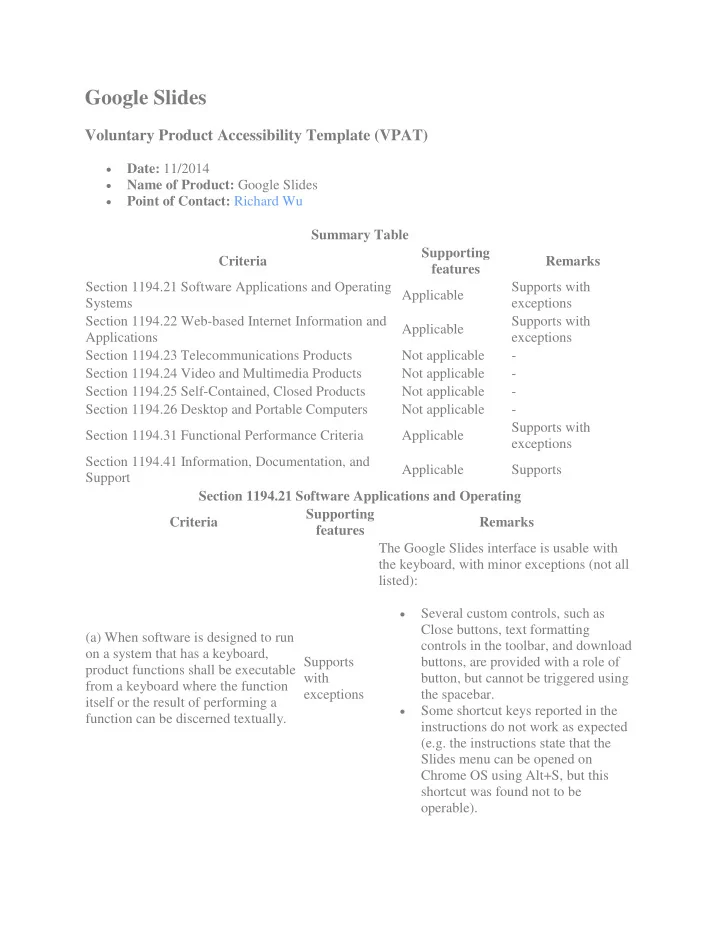
Summary Table Criteria Supporting features Remarks Section 1194.21 Software Applications and Operating Systems Applicable Supports with exceptions Section 1194.22 Web-based Internet Information and Applications Applicable Supports with exceptions Section 1194.23 Telecommunications Products Not applicable

  • Section 1194.24 Video and Multimedia Products

Not applicable

  • Section 1194.25 Self-Contained, Closed Products

Not applicable

  • Section 1194.26 Desktop and Portable Computers

Not applicable

  • Section 1194.31 Functional Performance Criteria

Applicable Supports with exceptions Section 1194.41 Information, Documentation, and Support Applicable Supports Section 1194.21 Software Applications and Operating Criteria Supporting features Remarks (a) When software is designed to run

  • n a system that has a keyboard,

product functions shall be executable from a keyboard where the function itself or the result of performing a function can be discerned textually. Supports with exceptions The Google Slides interface is usable with the keyboard, with minor exceptions (not all listed):

  • Several custom controls, such as

Close buttons, text formatting controls in the toolbar, and download buttons, are provided with a role of button, but cannot be triggered using the spacebar.

  • Some shortcut keys reported in the

instructions do not work as expected (e.g. the instructions state that the Slides menu can be opened on Chrome OS using Alt+S, but this shortcut was found not to be

  • perable).
slide-2
SLIDE 2

Section 1194.21 Software Applications and Operating Criteria Supporting features Remarks

  • Unexpected keyboard behavior for

navigating between tab panels in the Import Slides dialog box (the user must press Enter to activate a tab).

  • Unexpected keyboard behavior when

navigating between possible themes in the Choose a Theme dialog box (navigation between themes involves using the Tab key rather than the expected arrow keys). (b) Applications shall not disrupt or disable activated features of other products that are identified as accessibility features, where those features are developed and documented according to industry

  • standards. Applications also shall not

disrupt or disable activated features of any operating system that are identified as accessibility features where the application programming interface for those accessibility features has been documented by the manufacturer of the operating system and is available to the product developer. Supports Google Slides components do not interfere with or deactivate the accessibility features

  • f the operating system.

(c) A well-defined on-screen indication of the current focus shall be provided that moves among interactive interface elements as the input focus changes. The focus shall be programmatically exposed so that assistive technology can track focus and focus changes. Supports with exceptions Most Google Slides interface elements provide a well-defined on-screen indication

  • f the current focus, with the following

exceptions (not all issues listed):

  • Visible focus is suppressed around

the control represented by the user's name in the header section (and which triggers dialog box containing

  • ptions to view the user's profile, add

an account, and sign out).

  • Visible focus is suppressed around

the Rename control in View > Master.

slide-3
SLIDE 3

Section 1194.21 Software Applications and Operating Criteria Supporting features Remarks

  • Visible focus is suppressed around

the expand/collapse toggle control in the Research panel. (d) Sufficient information about a user interface element including the identity, operation and state of the element shall be available to assistive

  • technology. When an image

represents a program element, the information conveyed by the image must also be available in text. Supports with exceptions Most Google Slides components expose the necessary information to assistive technologies, with the following exceptions (not all issues listed). Missing or incorrect role, state, and property information:

  • The expand/collapse toggle control in

the Research panel is erroneously coded as a tab rather than as a button.

  • The "Find Previous" and "Find Next"

buttons in the Print Settings and Preview view are missing an appropriate role (in this case, a button).

  • "Slow, "Medium", "Fast" and

"Close" controls in the Animations panel are missing a button role. (e) When bitmap images are used to identify controls, status indicators, or

  • ther programmatic elements, the

meaning assigned to those images shall be consistent throughout an application's performance. Supports Bitmap images are used consistently across the Google Slides application. (f) Textual information shall be provided through operating system functions for displaying text. The minimum information that shall be made available is text content, text input caret location, and text attributes. Supports All text information is correctly exposed in Google Slides. (g) Applications shall not override user selected contrast and color selections and other individual display attributes. Supports with exceptions Google Slides does not fully support the Windows Operating System high contrast mode (not all issues listed):

  • Focus indication is lost.
  • Icons for toolbar controls are not

honored.

slide-4
SLIDE 4

Section 1194.21 Software Applications and Operating Criteria Supporting features Remarks

  • Checkboxes/tick icons are not

honored. (h) When animation is displayed, the information shall be displayable in at least one non-animated presentation mode at the option of the user. Supports Google Slides has no core features that utilize animation. Animations may be added to slides, but this is up to user discretion – slides do not animate by default. (i) Color coding shall not be used as the only means of conveying information, indicating an action, prompting a response, or distinguishing a visual element. Supports with exceptions Google Slides does not rely on color coding as the only means of conveying information, with the following exceptions:

  • When searching slides in the Print

Settings and Preview view, examples

  • f search results are highlighted

using a yellow background.

  • When navigating through available

themes in the Choose a Theme dialog, the border of the theme changes from light grey to light blue to indicate it is selected. While this information is conveyed to screen readers, the change may be difficult to perceive visually. (j) When a product permits a user to adjust color and contrast settings, a variety of color selections capable of producing a range of contrast levels shall be provided. Not applicable Google Slides does not permit color themes to be applied to the product interface itself. However, Google Slides permits users to apply a variety of different color themes to their presentations. (k) Software shall not use flashing or blinking text, objects, or other elements having a flash or blink frequency greater than 2 Hz and lower than 55 Hz. Supports Google Slides has no flashing or blinking text, objects, or other elements with a blink frequency greater than 2 Hz and lower than 55 Hz. (l) When electronic forms are used, the form shall allow people using assistive technology to access the information, field elements, and functionality required for completion and submission of the form, including all directions and cues. Supports with exceptions Most Google Slides form functionality is accessible to assistive technologies, with some exceptions including the following (not all issues listed):

  • A small number of secondary labels

(such as the "px" secondary label for custom widths and heights in the Publish to the Web dialog box, and

slide-5
SLIDE 5

Section 1194.21 Software Applications and Operating Criteria Supporting features Remarks the "Use Enter to save. Use Shift+Enter for multiple lines" secondary label in the Word Art dialog box) are not programmatically associated with the related textbox, so are not easily discoverable to users

  • f assistive technologies.
  • A small number of elements that are

focusable do not have a programmatically associated label, such as the drop-down menu allowing the user to select the number of slides on a single page in the Print Settings and Preview view. Section 1194.22 Web-based Internet Information and Applications Criteria Supporting features Remarks (a) A text equivalent for every non-text element shall be provided (e.g., via "alt", "longdesc", or in element content). Supports with exceptions Google Slides graphic elements exposed to users have text equivalents, with the following exception:

  • The ">" ASCII character is used in

several menus to indicate that the menu item has a related submenu. While NVDA, JAWS and VoiceOver skipped this icon, ChromeVox announce "right pointer" along with the menu item text. (b) Equivalent alternatives for any multimedia presentation shall be synchronized with the presentation. Not applicable The Google Slides product interface does not use multimedia. However, users are permitted to include multimedia in their presentations. (c) Web pages shall be designed so that all information conveyed with color is also available without color, for example from context or markup. Supports with exceptions Google Slides is designed so that all information conveyed with color is also available without color, with the following exceptions:

  • When searching slides in the Print

Settings and Preview view, examples of search results are highlighted using a yellow background.

slide-6
SLIDE 6

Section 1194.22 Web-based Internet Information and Applications Criteria Supporting features Remarks

  • When navigating through available

themes in the Choose a Theme dialog, the border of the theme changes from light grey to light blue to indicate it is

  • selected. While this information is

conveyed to screen readers, the change may be difficult to perceive visually. (d) Documents shall be organized so they are readable without requiring an associated style sheet. Not applicable Google Slides is a web-based application (not a document), and therefore the product's user interface depends on the availability of associated style sheets. (e) Redundant text links shall be provided for each active region of a server-side image map. Not applicable The Google Slides product user interface does not use image maps. (f) Client-side image maps shall be provided instead of server-side image maps except where the regions cannot be defined with an available geometric shape. Not applicable The Google Slides product user interface does not use image maps. (g) Row and column headers shall be identified for data tables. Supports Google Slides identifies headers for data tables. (h) Markup shall be used to associate data cells and header cells for data tables that have two

  • r more logical levels of row or

column headers. Not applicable The Google Slides product user interface does not use complex data tables. (i) Frames shall be titled with text that facilitates frame identification and navigation. Supports with exceptions Google Slides frames that are exposed to users are correctly titled, with the following exception:

  • The iframe with a class of modal-dialog-

bg is missing a title attribute. (j) Pages shall be designed to avoid causing the screen to flicker with a frequency greater than 2 Hz and lower than 55 Hz. Supports Google Slides does not cause screen flicker with a frequency greater than 2 Hz and lower than 55 Hz. (k) A text-only page, with equivalent information or functionality, shall be provided to make a web site comply with the Not applicable Google Slides is a web-based application (not a document). The product's user interface and data cannot readily be represented and maintained in a text-only page.

slide-7
SLIDE 7

Section 1194.22 Web-based Internet Information and Applications Criteria Supporting features Remarks provisions of this part, when compliance cannot be accomplished in any other way. The content of the text-only page shall be updated whenever the primary page changes. (l) When pages utilize scripting languages to display content, or to create interface elements, the information provided by the script shall be identified with functional text that can be read by assistive technology. Supports All core functionality of Google Slides that relies on scripting is accessible to assistive technology users. (m) When a web page requires that an applet, plug-in or other application be present on the client system to interpret page content, the page must provide a link to a plug-in or applet that complies with §1194.21(a) through (l). Not applicable Google Slides does not require a plug-in. (n) When electronic forms are designed to be completed online, the form shall allow people using assistive technology to access the information, field elements, and functionality required for completion and submission of the form, including all directions and cues. Supports with exceptions Most Google Slides form functionality is accessible to assistive technologies, with some exceptions including the following (not all issues listed):

  • A small number of secondary labels

(such as the "px" secondary label for custom widths and heights in the Publish to the Web dialog box, and the "Use Enter to save. Use Shift+Enter for multiple lines" secondary label in the Word Art dialog box) are not programmatically associated with the related textbox, so are not easily discoverable to users of assistive technologies.

  • A small number of elements that are

focusable do not have a programmatically associated label, such as the drop-down menu allowing the user to select the number of slides on a

slide-8
SLIDE 8

Section 1194.22 Web-based Internet Information and Applications Criteria Supporting features Remarks single page in the Print Settings and Preview view. (o) A method shall be provided that permits users to skip repetitive navigation links. Supports Google Slides does not provide a single skip navigation link, but instead offers keyboard shortcuts to most of the features in the user interface. (p) When a timed response is required, the user shall be alerted and given sufficient time to indicate more time is required. Not applicable Google Slides does not require a timed response as part of its core functionality. Section 1194.31 Functional Performance Criteria Criteria Supporting features Remarks (a) At least one mode of operation and information retrieval that does not require user vision shall be provided, or support for assistive technology used by people who are blind or visually impaired shall be provided. Supports The core functionality of Google Slides is accessible to assistive technology users. (b) At least one mode of operation and information retrieval that does not require visual acuity greater than 20/70 shall be provided in audio and enlarged print output working together or independently, or support for assistive technology used by people who are visually impaired shall be provided. Supports The core functionality of Google Slides supports the use of screen magnifiers. (c) At least one mode of operation and information retrieval that does not require user hearing shall be provided, or support for assistive technology used by people who are deaf or hard of hearing shall be provided Supports Google Slides does not rely on sound alone to access any of its core functionality. (d) Where audio information is important for the use of a product, at least one mode

  • f operation and information retrieval shall

be provided in an enhanced auditory fashion, or support for assistive hearing devices shall be provided. Supports Google Slides does not rely on audio to present information. (e) At least one mode of operation and information retrieval that does not require Supports Google Slides does not require user speech.

slide-9
SLIDE 9

Section 1194.31 Functional Performance Criteria Criteria Supporting features Remarks user speech shall be provided, or support for assistive technology used by people with disabilities shall be provided. (f) At least one mode of operation and information retrieval that does not require fine motor control or simultaneous actions and that is operable with limited reach and strength shall be provided. Supports with exceptions Most Google Slides core features can be accessed from the keyboard alone, with the following exceptions:

  • Several custom controls, such

as Close buttons, text formatting controls in the toolbar, and download buttons, are provided with a role of button, but cannot be triggered using the spacebar.

  • Some shortcut keys reported in

the instructions do not work as expected (e.g. the instructions state that the Slides menu can be opened on Chrome OS using Alt+S, but this shortcut was found not to be operable).

  • Unexpected keyboard behavior

for navigating between tab panels in the Import Slides dialog box (the user must press Enter to activate a tab).

  • Unexpected keyboard behavior

when navigating between possible themes in the Choose a Theme dialog box (navigation between themes involves using the Tab key rather than the expected arrow keys).