Ginger and Turmeric Production Reza Rafie and Chris Mullins - - PowerPoint PPT Presentation

ginger and turmeric production
SMART_READER_LITE
LIVE PREVIEW

Ginger and Turmeric Production Reza Rafie and Chris Mullins - - PowerPoint PPT Presentation

Ginger and Turmeric Production Reza Rafie and Chris Mullins College of Agriculture Presentation Plan Quick overview of high tunnels Production information about Turmeric and Ginger Discussion and questions Season Extension


slide-1
SLIDE 1

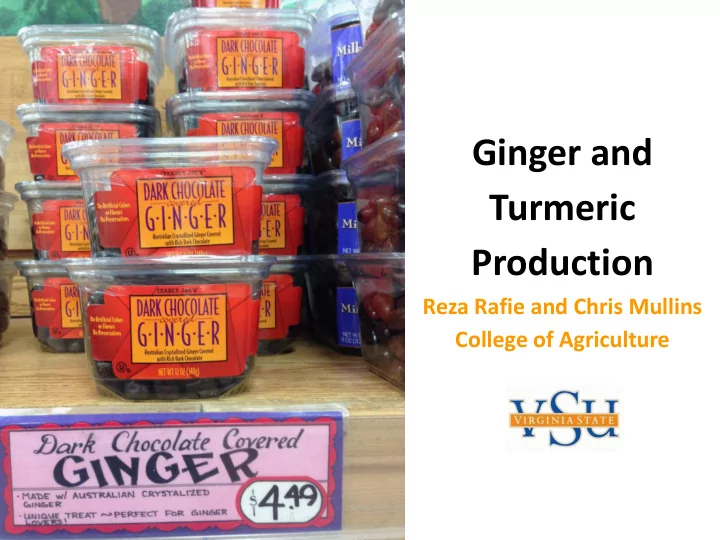
Ginger and Turmeric Production

Reza Rafie and Chris Mullins College of Agriculture
slide-2
SLIDE 2

Presentation Plan

  • Quick overview of high

tunnels

  • Production information

about Turmeric and Ginger

  • Discussion and

questions

slide-3
SLIDE 3

Season Extension

 refers to anything that allows a crop to be cultivated

  • utside of its normal outdoor growing season.
slide-4
SLIDE 4

Opportunity

 Season extension and

  • ut of season growth

 Maximum yield and

increased quality

 Less insect and disease

pressure

 Organic  Locally grown  Specialty crops

slide-5
SLIDE 5

Ways to achieve an extended growing season

 Greenhouse  High tunnel or hoop house  Plastic mulch  Row covers  Cultural practices

slide-6
SLIDE 6

High Tunnel

 Resembles a

conventional greenhouse

 Crops are grown in the

soil

 Season extension

 Spring earliness  Fall extension

 Protects crops from

adverse environmental conditions

slide-7
SLIDE 7

High Tunnel vs. Greenhouse

 Greenhouse

 Electrical input

 Exhaust fans, evaporative

cooling, heater, circulation fans

 Crops usually grown in

containers

 Usually permanent  Cost $$$  Crops grown year-round

 High Tunnel

 No electricity

 No automated systems - no

fans, heater, controls

 Crops grown in the ground,

conventionally

 Temporary  Cost $  Functions to extend the

growing season, limited

slide-8
SLIDE 8

Single Bay Multibay PVC HIGH TUNNELS

slide-9
SLIDE 9
slide-10
SLIDE 10

High Tunnel Costs

 Materials =

approximately $3-4/SF

 Construction = $1-2/SF  Example

 26’ x 96’ round tunnel

 materials $8,735  construction $3,744

slide-11
SLIDE 11

High Tunnel Production of Fresh Baby Ginger Root (Zingiber officinale)

slide-12
SLIDE 12

Ginger (Zingiber officinale)

The official name Zingiber drived, using the Indian Sanskrit name for ginger - singabera, or shaped like a horn. Other spices in the same family with ginger are Tumeric and

Cardamom.

http://www.herbs2000.com/herbs/herbs_ginger.htm

slide-13
SLIDE 13

Ginger plant

The ginger plant has a long history of cultivation, having

  • riginated in Asia. Ginger is considered a tropical plant,

has dark-green erect steams and lanced-shaped leaves that produces underground rhizomes. The plant may reach 2-4 ft in height.

slide-14
SLIDE 14

Sustainable Ginger Production

  • Market
  • Seed-piece selection, mature, disease-free

seed-piece, minimum 2 ounces

  • Disease management, remove diseased plants

and discard them as soon as possible

  • Ginger is a heavy-feeder crop, and it will

deplete your soil, fertilization and organic mater is critical

slide-15
SLIDE 15

Sustainable Ginger Production

  • Mounding plant, otherwise you will be marketing

partially green ginger

  • Plant spacing, 3 feet between rows and two feet

between plants in the same row

  • Shade
  • Rotation
  • Ginger is photoperiod sensitive crop, long days are

needed for plant-foliage development

slide-16
SLIDE 16

Ginger Seed Rhizomes

http://www.ctahr.hawaii.edu/oc/freepubs/pdf/scm-8.pdf: Paul Hepperly and Francis Zee

slide-17
SLIDE 17

Ginger Seed-Rhizome

  • Use only mature, clean, disease-free ginger hands
  • Cut the selected hands into 2-4 oz sections,

sterilizing the knife after each cut

  • Each seed-piece should have two to four well

developed “eyes.”

  • Surface-sterilize the seed-pieces in a 10% solution of

household bleach (1 part bleach in 9 parts water) for 10 minutes

  • Cure the seed-pieces in a clean, disease-free area

for three days or more before planting (Hepperly, P. and Francis Zee, 2004)

slide-18
SLIDE 18
slide-19
SLIDE 19

In February, plant the seed piece in a one gallon pot ½-¾ filled with soilless potting mix (2 parts Compost, 2-4 parts Sphagnum Peat Moss, 1 part Perlite, and 1 part Vermiculite). Maintain in a greenhouse. In May the potted plants are ready to be transplanted in the high tunnel.

slide-20
SLIDE 20
slide-21
SLIDE 21

Tissue Culture plants

slide-22
SLIDE 22
slide-23
SLIDE 23

May August

slide-24
SLIDE 24

September

slide-25
SLIDE 25

Fertilizer

  • Ginger responds well with adequate

fertilizer application.

  • For detail of fertilizer need see
  • http://www.ctahr.hawaii.edu/oc/freepubs/pdf/SCM-8.pdf
slide-26
SLIDE 26

Mounding (Hilling)

Is the periodic covering of the upward-expanding

  • rhizomes. It is an important process in ginger

production.

slide-27
SLIDE 27
slide-28
SLIDE 28

Armyworm, Pseudaletia unipuncta potential problem with high tunnel ginger production

slide-29
SLIDE 29

leaf-spot Phyllosticta zingiberi

slide-30
SLIDE 30

Diseases

Bacterial wilt (Pseudomonas solanacearum) - wilt of entire plant, rhizome rot.

  • spreads by infested soil adhering to hands, boots,

tools, vehicle tires and field equipment, water from irrigation or rainfall, and infected ginger rhizomes (Janse 1996).

  • Infects ginger roots and rhizomes through openings

where lateral roots emerge or wounds caused by handling, parasitic insects or root-knot nematodes (Swanson et al. 2005).

slide-31
SLIDE 31

Diseases Bacterial wilt (Pseudomonas solanacearum) - wilt

  • f entire plant, rhizome rot.
  • The pathogen survives in soils within infected

plant debris in soils and as free bacteria.

  • Crop losses: Crop loss can be complete in

heavily infested soils.

slide-32
SLIDE 32

Bacterial streaming from an infected ginger rhizome suspended in water. The streaming begins only a few minutes after placing the cut rhizome in water

http://cms.ctahr.hawaii.edu/gingerwilt/Symptoms.aspx

Milky, bacterial ooze forming the cut surface

  • f a discolored, infected ginger rhizome
slide-33
SLIDE 33

Diseases

  • Bacterial soft rot (Erwinia sp.) - Leaf, pseudo stem

and rhizome rot.

  • Bacterial leaf blight (Xanthomonas sp.) - Leaf

blight.

  • Fusarium yellows and rhizome rot (Fusarium
  • xysporum f. sp. zingiberi) - Wilt of entire plant,

rhizome rot.

  • Pythium soft rot (Pythium graminicola, P.

splendens and P. aphanidermatum): root rot, and soft rot of rhizomes.

slide-34
SLIDE 34

Rhizome Rot Fusarium oxysporum

slide-35
SLIDE 35

Root-knot nematode

slide-36
SLIDE 36
slide-37
SLIDE 37

Shade

Ginger prefers 30% shade, high tunnel plastic provide sufficient shade. However, if you are growing it under field conditions, you need to intercrop it with other crops, Corn and Pigeon pea

slide-38
SLIDE 38

Local Knowledge

slide-39
SLIDE 39

Seed-Piece removal

slide-40
SLIDE 40

Ginger Deseeding Experiment

slide-41
SLIDE 41

Deseeded

slide-42
SLIDE 42

Date Harvested Deseeded (lbs.) Date Harvested Seed not removed (lbs.)

10/4/17

5.5

9/8/17

11

10/10/17

10

9/28/17

13

10/16/17

7

10/3/17

14

10/19/17

10

10/10/17

11

10/26/17

6

10/12/17

11

10/26/17

7.5

10/12/17

7

10/27/17

13

10/13/17

9

11/10/17

7.5

10/13/17

11.5

11/14/17

5

10/13/17

9

11/15/17

9

10/26/17

8

11/15/17

8.5

10/26/17

13

10/31/17

10.5

11/10/17

13

11/13/17

12

Average 8.1 10.9

Number of plants with BW

8 10 Date harvested and Yield per plant (lbs.) for two treatments; ginger plan were ‘deseeded’ and ‘seed not removed’ at transplanting. VSU, Randolph Farm, 2017.

slide-43
SLIDE 43
slide-44
SLIDE 44
slide-45
SLIDE 45
slide-46
SLIDE 46
slide-47
SLIDE 47

223% increased from 2007 to 2015

slide-48
SLIDE 48

Turmeric, Curcuma longa

  • Is a rhizomatous herbaceous perennial plant of the ginger

family, Zingiberaceae.

  • It is native in Southeast Asia. Growing turmeric requires 9-

11 month from planting the rhizome seed pieces until the harvest.

  • In temperate zones as in Virginia, where the growing

season is 7-8 month, it is recommended to grow turmeric in high tunnel structure

slide-49
SLIDE 49

Turmeric, Curcuma longa

The roots are used for a multitude of purposes including

  • Spice,
  • Food flavoring and coloring agent
  • In cosmetics, for coloring fabric
  • For medicinal purposes
slide-50
SLIDE 50

Turmeric production

Start in January Sprouting is slow, greenhouse temperature >75 F helps with sprouting

slide-51
SLIDE 51
slide-52
SLIDE 52

September

slide-53
SLIDE 53
slide-54
SLIDE 54
slide-55
SLIDE 55
slide-56
SLIDE 56

500 1000 1500 2000 2500 3000 3500 4000

1 1 1 2 1 2 3 4 5 9/16 9/23 10/23 10/23 10/27 10/27 10/27 10/27 10/27

Turmeric weight (grs.) per plant, September 16- October 27, 2015, VSU, Randolph Farm.

3.1 lbs.

7.8 lbs.

slide-57
SLIDE 57

Education and marketing