A step in village landscape planning Developing a realistic, - - PDF document

a step in village landscape planning
SMART_READER_LITE
LIVE PREVIEW

A step in village landscape planning Developing a realistic, - - PDF document

Community based Agricultural Development Plans (CADP) 2015 NUDP EFICAS : overview of Project first year field activities Vientiane, 10 June 2015 A step in village landscape planning Developing a realistic, feasible action plan with


slide-1
SLIDE 1

1

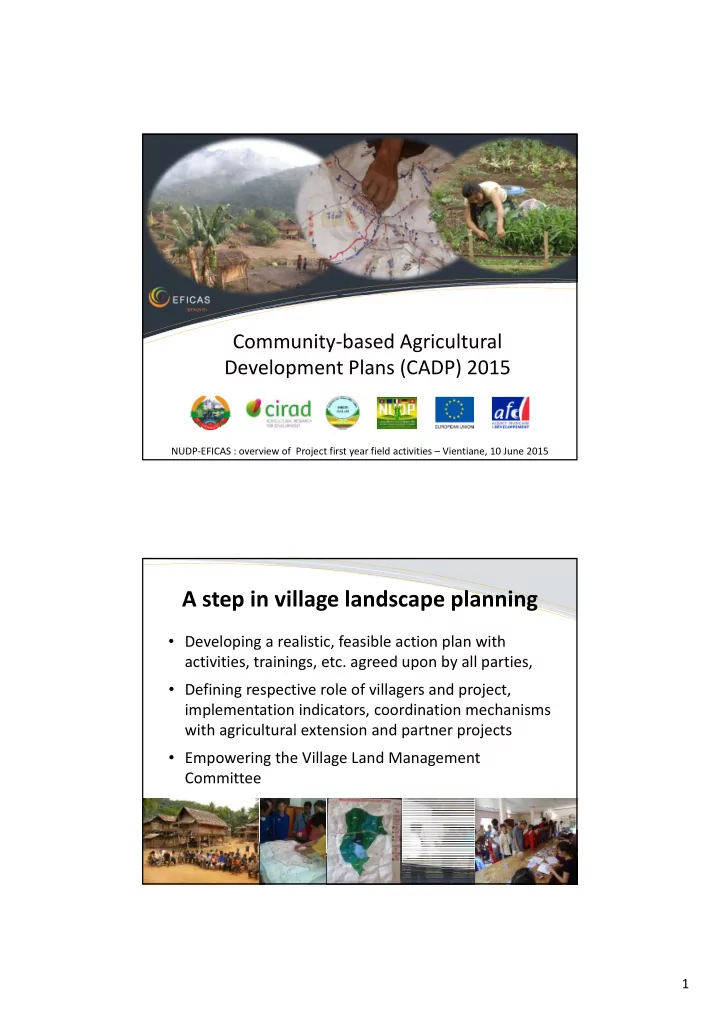
Community‐based Agricultural Development Plans (CADP) 2015

NUDP‐EFICAS : overview of Project first year field activities – Vientiane, 10 June 2015

A step in village landscape planning

  • Developing a realistic, feasible action plan with

activities, trainings, etc. agreed upon by all parties,

  • Defining respective role of villagers and project,

implementation indicators, coordination mechanisms with agricultural extension and partner projects

  • Empowering the Village Land Management

Committee

slide-2
SLIDE 2

2

Content of CADP

  • Action plan that engages the whole village for the

next cropping season,

  • Negotiated by the village community and project

team and implemented together,

  • Support of multiple partners will be sought for

implementation,

  • Clear indicators for implementation and monitoring

How does a CADP look like?

Land Use Planned activities Permanent crop Want to fence permanent crop area with barbwires. Rotational crop Want to plant new crops to feed animals or improve the

  • soil. Are not interested in improved fallows

Plantation Wish to plant coffee and castor beans and increase teak plantations. Improve pasture Want to create an improved pasture area. Paddy Improved irrigation for the existing paddy area; Build new paddy areas up to 9.6 ha. Garden Would like to increase and improve home gardening.

slide-3
SLIDE 3

3

Land Use Planned activities Area - location Who is involved Inputs: labour, knowledge(training) assistance Milestones &Indicators(date of work completion, etc.) Budget resources share Permane nt crop Want to fence permanent crop area with barbwires. Rotation al crop Want to plant new crops to feed animals or improve the soil. Are not interested in improved fallows because. Plantatio n Wish to plant coffee and castor beans and increase teak plantations. Improve pasture Want to create an improved pasture area. Paddy Improved irrigation for the existing paddy area; Build new paddy areas up to 9.6 ha. Garden Would like to increase and improve home gardening.

village communities Project DAFO

Village Action Plan

CADP Implementation steps (4‐day process)

  • Opening village meeting
  • Socio‐economic data collection
  • 4 Focus group discussions

– Problem census (men / women) – Wood, wildlife and NTFP – Village population trends – Land use systems (crop – livestock): input‐output parameters

  • Land management and regulations (3D model, maps)
  • Activity planning

– Discussion on innovative practices – Land management rules, indicators – Field visits, site selection, volunteer households

  • Closing village meeting
slide-4
SLIDE 4

4

Day 1. Opening village meeting

  • Introduction of the project team
  • Presentation of the members of the Village Land

Management Committee (VLMC)

  • Objectives of the meeting and activities that will

take place in the village

Team 1 Team 2

Day 1. Data collection

Household survey

Village socio‐economic data and land tenure analysis

Focus group discussions

  • Problem census
  • Wood, wildlife and NTFP location

and relative abundance

  • Village population trends
slide-5
SLIDE 5

5

Day 1‐2. Data collection

Team 1

Participatory mapping Up‐dating 3D model

Team 2

  • Cropping and livestock systems

analysis

  • Input – output parameters

Focus group discussions

Team 1&2

Data compilation and analysis

Input – output parameters

Land use type Activity Parameters

slide-6
SLIDE 6

6

Maize monocropping Activity Familly Paid Ploughing x x x x 1 Sowing x x x x 1 Herbicide spraying (30-40 DAS) x x x x 5 Weeding / slashing x x 15 Building storage house x x 2 Harvest x x x 25 Maize threshing x x x 2 TOTAL 49 2 Cropping calendar Labor (md/ha) Dec Jan Feb Mar Apr May Jun Jul Aug Sep Oct Nov

Houaybouha, Sayabouri Province (Focus group discussion)

Maize monocropping Mean Production costs (LAK/ha) 2 250 000 Yield (kg/ha) 5 000 Price production (LAK/kg) 1 300 Gross income (LAK/ha) 6 500 000 Net income (LAK/ha) 4 250 000 Familly labour (md/ha) 49 Labour productivity (LAK/md) 86 735

Phialouang, Phongsaly Province (Focus group discussions)

Maize rotational Activity Total Paid Area selection and division x x 1 Land clearing x x 15 Burning x x 1 Collect unburned wood and reburn x x 10 Sowing x x 9 Weeding1 x x 20 Weeding2 x x 10 Building storage house x 4 Harvest x x 25 Milling x 10 Drying x 2 Sale x 2 TOTAL 109 Cropping calendar Labor (md/ha) Dec Jan Feb Mar Apr May Jun Jul Aug Sep Oct Nov

Maize rotational Mean Production costs (LAK/ha) 500 000 Yield (kg/ha) 5 000 Price production (LAK/kg) 1 000 Gross income (LAK/ha) 5 000 000 Net income (LAK/ha) 4 500 000 Familly labour (md/ha) 109 Labour productivity (LAK/md) 41 284

slide-7
SLIDE 7

7

Team 2

Day 3. Data collection and field visit

Field visit ‐ activity planning Focus group: landscape managt

Lowland Rice Terraces Rice Residential areas ‐ Gardens Upland crops Forest River

Focus group: practices Field visit ‐ activity planning

Day 4. Action plan – village meeting

  • Reviewing development options
  • Refining village action plan
  • Preparation of the whole village meeting
  • Village meeting led by village committee
slide-8
SLIDE 8

8

Target villages CADPs 2015

  • Synthesis CADPs 2015/ province

Main activities 2015

  • 1. Fencing of agricultural lands

‒ Increased control of animal roaming as primary condition for agricultural systems (crop‐livestock) intensification ‒ Support to fencing of agricultural or livestock areas (8 villages) ‒ Barber wire fence (implemented) + living fence (on‐going): local species with financial incentive for cuttings maintenance during 2 years period / seedling nursery for exogenous species (legume forage and firewood trees) in TSCs (on‐going)

slide-9
SLIDE 9

9

Main activities 2015

  • 2. Improvement of livestock systems

‒ Integrated approach

  • Animal health: training of village veterinary workers,

revolving fund (9 villages) (to be yet implemented)

  • Animal feeding systems: improved pasture for cut &

carry systems (9 villages) (sown 80%)

  • Animal housing: stalls including better water access and

manure collection facilities (4 villages) (to be done) ‒ Big livestock (9 vill.), pigs (6), and goats (2) raising systems

Main activities 2015

  • 3. Improvement of upland cropping systems

‒ Diversification

  • Intercropping systems rice/maize with pigeon pea

(7 villages) (sown 80%)

  • Intercropping systems maize/job’s tear with rice bean

(2 villages) (not yet)

  • Soybean (1 vill.), rice (1), cassava (1) (sown)
slide-10
SLIDE 10

10

Main activities 2015

  • 4. Improvement of Perennial cropping systems

‒ Crop nutrient and health management: compost and bio‐ insecticide production for coffee and fruit trees production (6 villages) (training implemented)

Main activities 2015

  • 4. Improvement of Perennial cropping systems (continued)

‒ Weed control: Slashing using brushers as alternative to herbicide (rubber) and manual weeding (coffee) (3 villages) (on‐going) ‒ Fructification improvement (Cardamom): stolon clearing (3 villages) (on‐going) ‒ Diversification: improved temperate fruit trees (peach and plums) (6 villages) (implemented)

slide-11
SLIDE 11

11

Main activities 2015

  • 5. Improvement of Lowland production systems

‒ SRI (2 villages) (scheduled) ‒ Fertility improvement of new terraces (2 villages) (on‐going) ‒ Lowland rice genetic diversification (1 villages) (on‐going) ‒ Lowland vegetable production: green house, compost, bio‐ insecticide (1 village) (on‐going) ‒ Dry‐season lowland diversification (vegetable, forage crops) (1 village) (not yet)

Thank you for your attention…