
SLIDE 1
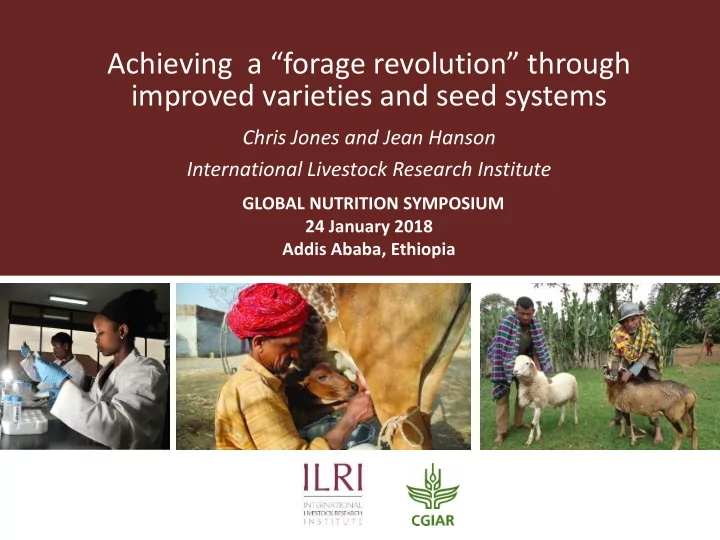
Achieving a “forage revolution” through improved varieties and seed systems
Chris Jones and Jean Hanson International Livestock Research Institute
GLOBAL NUTRITION SYMPOSIUM 24 January 2018 Addis Ababa, Ethiopia
Achieving a forage revolution through improved varieties and seed - - PowerPoint PPT Presentation
Achieving a forage revolution through improved varieties and seed systems Chris Jones and Jean Hanson International Livestock Research Institute GLOBAL NUTRITION SYMPOSIUM 24 January 2018 Addis Ababa, Ethiopia African feeding systems
Chris Jones and Jean Hanson International Livestock Research Institute
GLOBAL NUTRITION SYMPOSIUM 24 January 2018 Addis Ababa, Ethiopia
➢ Poor quality of feeds ➢ Seasonal shortages of feeds ➢ Lack of inputs (seeds, fertilisers) ➢ Land tenure issues/dependence
➢ Lack of enabling policies Forage-based livestock production can: ➢ Increase livestock production by alleviating feed constraints/shortages ➢ Improve soil fertility through nitrogen fixation/leaf drop ➢ Reduce erosion through increased ground cover, especially on slopes ➢ Help control insect pests ➢ Provide environmental services - carbon sequestration, enhanced system water productivity ➢ Improve system resilience - alternative land use strategy for marginal lands and steep slopes
Demand for forages is growing linked to: ➢ Market intensification for milk and meat ➢ Global food prices making grain an expensive feed ➢ Feed scarcity from competition, biofuels, reducing rangelands and natural pastures and drought incidence ➢ Rising feed prices ➢ Demands for re-vegetation, soil and water management ➢ Alternative income generation opportunities
Forage germplasm Characterization and evaluation Promising genotypes Variety registration Basic seed production Delivery to producers
Forage grasses, herbaceous legumes and fodder trees Phenotype Genotype Agronomic Nutrition Adaptation use Selection of best bet genotypes for a range of environments and livestock systems National trials and selection compared to best local checks Information sharing Production
and basic high quality seeds Formal and informal seed sector involvement Laboratory Farmer fields On station research plots Private and public sector
Napier
➢ High yielding Napier grass lines produce 5 times more biomass than natural pastures in Tanzania1 ➢ Yield shown to increase by intercropping with legumes and can be harvested 6 to 9 times per year under irrigation in Ethiopia2 ➢ Smut and stunt disease resistant lines identified from the in trust collection at ILRI and being adopted by farmers
Brachiaria
➢ Climate smart Brachiaria lines well adapted to Kenya and Rwanda ➢ 20,000 Kenyan beneficiaries planted over 1,000 acres with some now able to bridge the perennial feed gap and selling surplus hay
Desho
➢ Drought tolerant grass widely used in Ethiopia ➢ Traded as forage in local markets
1Lukuyu et al. High yielding improved forages. 7th Multi-Stakeholder Partnership Meeting of the Global Agenda for Sustainable Livestock, Addis Ababa, Ethiopia, 8–12
May 2017.
2Adie et al. Lessons from pilot trials with small-scale irrigated forage production in the Amhara Region: potential of integrating the perennial forage Napier grass with
Desmodium and Pigeon Pea in cropping systems. The second Amhara Agricultural Forum. 16 January 2018, Bahir Dar.
➢ Pigeon pea and Napier grass ➢ Desmodium and Napier grass in push pull maize systems ➢ Oats and vetch3
3Bezabih et al. Lessons from small-scale irrigated forage production trials: potential of annual oat-vetch mixtures. The second Amhara Agricultural Forum. 16 January 2018, Bahir Dar.
Established in 1989 to: ➢ Promote national forage seed production ➢ Provide small quantities of basic seeds of selected species ➢ Build capacity in forage seed production ➢ Global mandate but 80-90% of current activity in Ethiopia Produces seeds of 60 best bet forages to be sold at cost of production Provided over 7000 samples in response to 1100 users from 1990 to date
GIZ funded pilot project in Ethiopia ➢ Promotes forage seed agribusiness ➢ Private sector forage seed production Cooperatives, private farmers and crop seed producers ➢ 30 entrepreneurs involved ➢ Training in forage seed production and agri- business provided ➢ Forage seed production scaled up ➢ Seed sales increased from $20,000 to $600,000 over the 2 years of the project
Forage adoption and use has been slow Adoption is improved when: ➢ Use of improved feeds linked to market opportunities ➢ Profitable technologies ➢ Multiple benefits on farm ➢ Good match to production system niche ➢ Easy to manage and match skills of farmers ➢ Strong partnerships between farmers and extension ➢ Supported by innovation platforms, enabling policies and environment
➢ Poor promotion of forages by research and extension ➢ Suitability of species for smallholder farmers ➢ Interest of farmers to grow forages ➢ Development of alternative seed suppliers ➢ Poor private sector involvement ➢ Perennial nature of species ➢ Low purchasing power of farmers ➢ Lack of market access for poor farmers ➢ Lack of supply to match demand - poor harvest, poor forecasting ➢ Seed storage problems ➢ Seed quality and certification
Adoption of sown forages in developing countries in the tropics can be enhanced by: ➢ Provision of germplasm for selection and breeding ➢ Looking for new genotypes adapted to climate change ➢ Increasing the information base about the diversity available ➢ Using molecular tools and sequencing for trait selection and breeding ➢ Developing expert systems for forage selection ➢ Developing affordable systems for quality forage seeds ➢ Working with farmers to get the best match to their needs ➢ Taking a holistic innovation systems approach to scaling up successful technologies ➢ Building national capacity to use germplasm for forage development
This presentation is licensed for use under the Creative Commons Attribution 4.0 International Licence.
ILRI thanks all donors and organizations who globally supported its work through their contributions to the CGIAR system