Geonode David.Kennewell@Hydrata.com Geonode Summit 2018 Turino, - - PowerPoint PPT Presentation

geonode david kennewell hydrata com
SMART_READER_LITE
LIVE PREVIEW

Geonode David.Kennewell@Hydrata.com Geonode Summit 2018 Turino, - - PowerPoint PPT Presentation

Building Flood Models with Geonode David.Kennewell@Hydrata.com Geonode Summit 2018 Turino, Italy The ANUGA finite volume numerical model ANUGA is open-source software for the simulation of the shallow water equation. Open source


slide-1
SLIDE 1

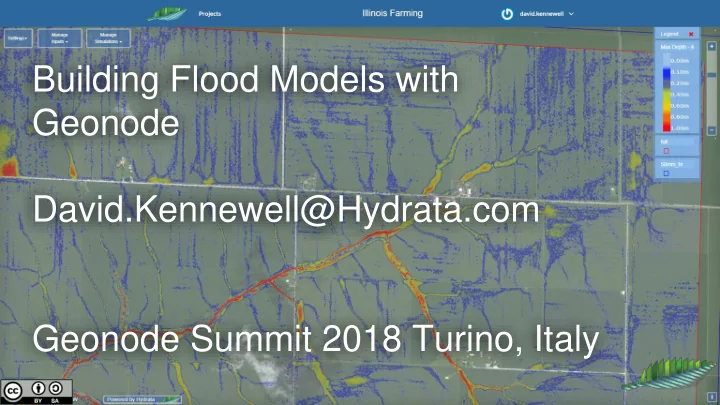
Building Flood Models with Geonode David.Kennewell@Hydrata.com Geonode Summit 2018 Turino, Italy

slide-2
SLIDE 2
slide-3
SLIDE 3

The ANUGA finite volume numerical model

  • ANUGA is open-source software for the

simulation of the shallow water equation.

  • Open source development is led by the Australian

National University and Geoscience Australia.

  • Used to analyse flood, tsunami, dam-break,

bridge design, river restoration, erosion management…

  • Written in Python (most) and C (computational

components) https://github.com/GeoscienceAustralia/anuga_core

slide-4
SLIDE 4

vs

Traditional Flood Study

  • Stored on a specialist’s hard-drive.
  • Hard to update.
  • Hard to manage change.
  • Expensive licensing can restrict

stakeholder access for scenario testing Online Flood Study

  • Stored in Geonode.
  • Update online.
  • Can track change.
  • Open source model licensing

allows for accessible scenario testing and collaboration.

slide-5
SLIDE 5
slide-6
SLIDE 6
slide-7
SLIDE 7
slide-8
SLIDE 8
slide-9
SLIDE 9
slide-10
SLIDE 10
slide-11
SLIDE 11
slide-12
SLIDE 12
slide-13
SLIDE 13
slide-14
SLIDE 14
slide-15
SLIDE 15

Interactive demo: https://hydrata.com/anuga Training video: https://youtu.be/Xztwz3sEDvs GitHub: https://github.com/Hydrata

slide-16
SLIDE 16

How does it work?

slide-17
SLIDE 17

Maploom User Interface Amazon S3 Geonode_data postgis Anugabase django app Geoserver Geonode django app Geonode/ Anugabase postgres Anuganode compute machines

Rest Api GSConfig GSConfig Django ORM

“Vanilla” Geonode

slide-18
SLIDE 18

Some lessons learned

  • Commit to a cloud vendor, but no too much (for example, use IaaS, not Paas)
  • Always script the server build process (for example: vagrant, shell scripts and ansible)
  • The most effective way to namespace data in this case is to prepend identifiers onto any

data filenames when they are uploaded or created: merewether_dem_myfreeformLayerNameHere.shp These datasets can then be filtered/classified/secured by the UI or APIs as required, anywhere in the app.

Project id 10 chars Data type id 3 chars Description the rest

slide-19
SLIDE 19

Please do get in touch. It would be great to:

  • Partner on a project together
  • Collaborate on Geonode development
  • Set you up with a free trial for hydrata.com
  • Receive feedback (bonus points for this!)

david.kennewell@hydrata.com