GEOGRAPHY 104 Worlds Nations (now World Regional Geography) - - PowerPoint PPT Presentation

geography 104 world s nations
SMART_READER_LITE
LIVE PREVIEW

GEOGRAPHY 104 Worlds Nations (now World Regional Geography) - - PowerPoint PPT Presentation

GEOGRAPHY 104 Worlds Nations (now World Regional Geography) Prof. Paul Belasky, Ph.D. SLO1 assessed in the Spring of 2013 SLO1: Demonstrate geographic literacy by identifying major geographic features on the world map,


slide-1
SLIDE 1
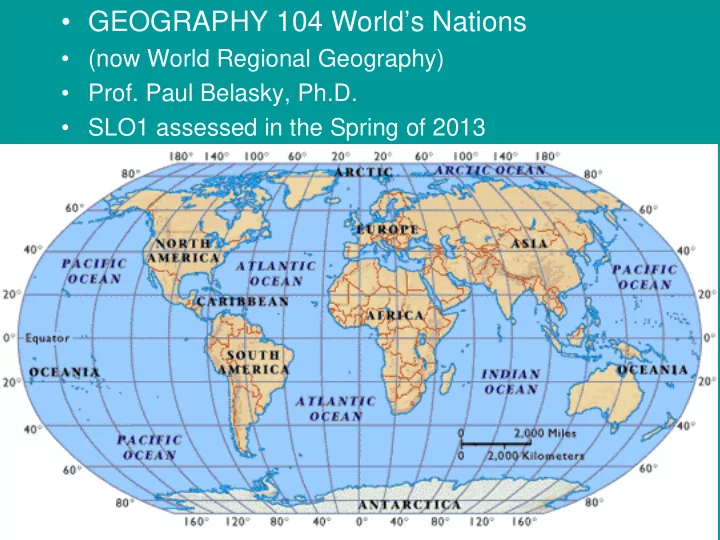
  • GEOGRAPHY 104 World’s Nations
  • (now World Regional Geography)
  • Prof. Paul Belasky, Ph.D.
  • SLO1 assessed in the Spring of 2013
slide-2
SLIDE 2
  • SLO1: Demonstrate geographic literacy by identifying

major geographic features on the world map, both physical and political.

  • Ohlone College motto is “A world of Cultures United

in Learning”. Maintaining high standards of geographic literacy is an essential part of that goal.

  • According to several National Geographic polls of

high school graduates, US ranks near the bottom (and sometimes even at the bottom) of the list among industrialized nations

slide-3
SLIDE 3

A blank map (representing the National Geographic Society’s International Geography Poll) was given twice - in the first week and the last week of class - to all students. They had to place 11 major political and physical geographic features on the map in order to test their geographic literacy (SLO1).

slide-4
SLIDE 4
  • The average score of the 28 students that took the initial quiz was 5.8
  • ut of 11 possible points. The average score of students that took the

final quiz was 10.1 out of 11 points.

  • Out of 16 students participating in the after quiz, 15 out of 16 have

improved their scores.

  • The overall results indicate a 74% improvement by students who took

the course in reaching SLO1, representing a significant shift in geographic literacy.

  • If we correct for sample size (28 vs.16), then the students who took

the second quiz increased their average score from 6.4 to 10.1 out of 11, which is also a significant 58% improvement.

  • They outperformed high school graduates of US (at 4/11 score) and

those of all other countries (including the top scorer – Germany at 8

  • ut of 11) in geographic literacy, as revealed by this standardized quiz.
slide-5
SLIDE 5
  • One concern, however, is student retention in this course. Whereas in most
  • ther classes I teach, retention is about 90%, retention in GEOG 104 has

been generally lower (60%-75%).

  • One likely reason, I believe, is homework, which for this course is not limited

to reading of the textbook and notes, but involves the completion of detailed, time-consuming map exercises that are essential in achieving geographic literacy

  • Some students do not complete this amount of required homework. Though I

do not plan to reduce the importance of map exercises, I plan to improve them by putting them online and making them more user-friendly with available

  • pen-access digital tools and software, such as the GoogleEarth.
  • They will also include virtual field trips and country tours, where students

can actually visit some of the places that they are putting on the map. This will make the exercises easier to complete, more relevant and interesting, result in better-quality maps that students can easily review, and increase assignment completion and retention rates in GEOG 104. But involves a lot of work on my part and is part of my current sabbatical leave proposal.

slide-6
SLIDE 6