
SLIDE 1
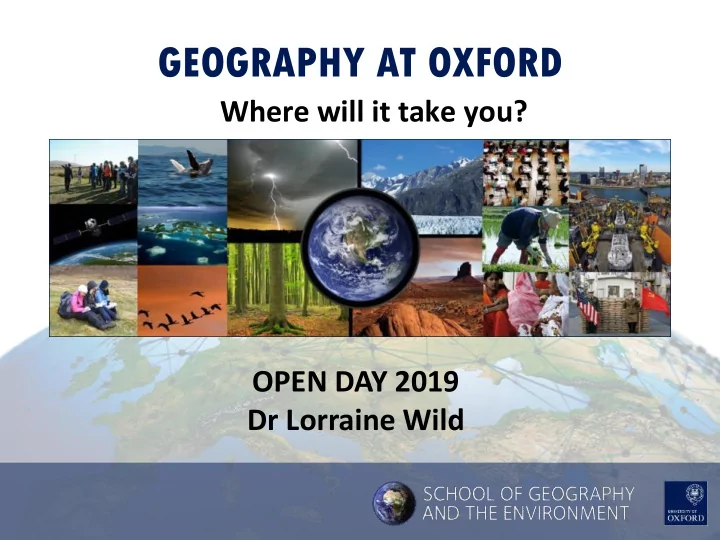
GEOGRAPHY AT OXFORD Where will it take you? OPEN DAY 2019 Dr - - PowerPoint PPT Presentation
GEOGRAPHY AT OXFORD Where will it take you? OPEN DAY 2019 Dr Lorraine Wild Why Geography? Interdisciplinary Broad Deals with key world issues vs specialised Employability Why Geography at Oxford? Why is Oxford special? The School of
Interdisciplinary …vs specialised Broad… Deals with key world issues Employability
The School of Geography and the Environment has been ranked 1st in the 2019 QS World University Rankings for Geography.
Four written examinations Fieldwork report 1,500 word essay
Six written examinations Fieldwork report (4,500 words) 3 submitted essays (4,500 words each) Dissertation (12,000 words)
Lectures 1st years – 7/8 hours a week 2nd/3rd years – 4/5 hours a week
Tutorials
Fieldwork
Independent Learning
1-2 tutorials per week Practicals 1.5 hours a week Independent learning
– Ecology – Climatology – Geomorphology
– Space and Place – Networks and Mobilities – Power and Identity
– Fieldwork
– importance of a critical understanding of the use of evidence and data in geographical argument
Option 1 2nd year Option 2 3rd year
Option 3 3rd year
Note: These optional subjects are either currently offered or are being planned for next year. Not all subjects may be
Critical Development Studies Climate Change and Variability Geographies of Finance Climate Change Impacts and Adaptation Cultural Spaces Complexity Critical Development Geographies Desert Landscapes and Dynamics Transport and Mobilities Island Life Geographies for the Anthropocene The Quaternary Period New Approaches in Urban Geography Geographies for the Anthropocene Geography at War Geopolitics in the Margins Childhood and Youth in the Global South
Tempelhof Airport Sieving in Prinzessinn- engarten
Walking in the pine forest within the cloud band near the Chinyero Volcano
El Teidi
*travel and accommodation covered – students may need to purchase meals and
museum entry
Dissertations are up to 12,000 words in length from research in the summer of 2nd year Characterising the low- level jet dust emission mechanism over the Etosha Pan, Namibia Challenging Postcolonial Education in Guyana – Perspectives from Paramakatoi Fighting Like A Girl: Female embodiment in the male- dominated spaces of amateur boxing High-latitude tree-growth responses to climate change in Wytham Woods, Oxford, since the 18th Century Human-elephant conflict in Sri Lanka: an evaluation of management methods Forest fires in the South of France during the 2003 European heat wave – a detection and attribution study on the role of soil moisture
are not part of the assessment
criteria about number of GCSE 8/9/A*
what teachers tell you
14 Oxford colleges admit Geography students: Brasenose, Christ Church, Hertford, Jesus, Keble, Mansfield, Regent’s Park, St. Anne’s,
Geography not an absolute requirement. The A* does not need to be in Geography
admitted each year
All candidates must take the GAT pre-interview test on 30th October 2019 at their school or local test centre. For more information about the GAT see: http://www.ox.ac.uk/admissions/undergraduate/applying-to-oxford/tests/gat. It is up to each candidate to register separately for the GAT. Candidates who do not take the GAT will not be called for interview unless special circumstances apply.
Online: https://www.geog.ox.ac.uk/study/undergraduate/ www.admissions.ox.ac.uk www.geog.ox.ac.uk/isoxfordgeogforyou Alternative Oxford Geography Prospectus (available via the SoGE website) Get in touch: undergraduate.enquiries@ouce.ox.ac.uk After October 15th (deadline for applications) you must direct any questions to the College to which you have applied