
SLIDE 1
GASPING FOR BREATH With air quality becoming a serious issue clean - - PDF document
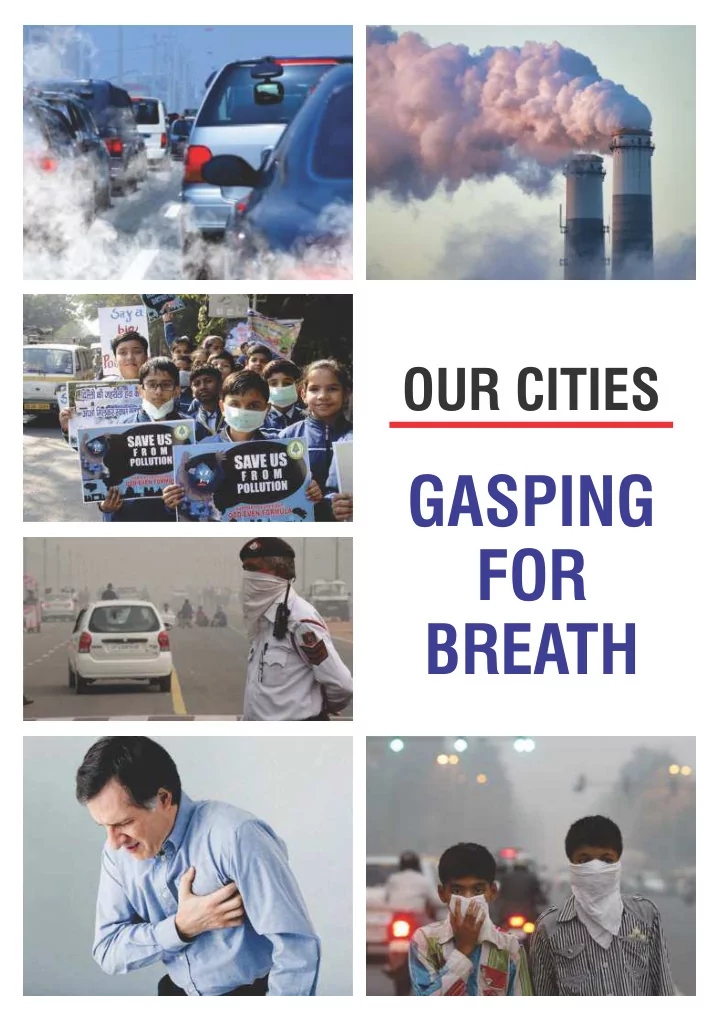
OUR CITIES GASPING FOR BREATH With air quality becoming a serious issue clean air is today very important for all of us. This is important for you and your family and even more fo r people with allergies and respiratory diseases. for Internal
With air quality becoming a serious issue clean air is today very important for all of us. This is important for you and your family and even more for people with allergies and respiratory diseases.
for Internal Circulation only
How the Poisons in the Air Affect You.
Lead
A Toxic metal that’s present in the air as fine particles. Can affect the central nervous system, cause rental damage and hypertension. Children are three times more at risk than adult. Particles of dust and carbon, coated with toxic gases, all emanating from factory emissions and vehicle exhaust. They coat the lungs. Cause respiratory infections, persistent cough and throat
asthma. Colourless and
from petrol vehicles, mostly two and three wheelers. Reduces the ability of blood to carry oxygen. Exacerbates heart disorders. Formed during fuel combustion in motor vehicles and power stations. Convert to nitrogen dioxide, which leads to bronchial infections, cold headaches and eye irritation. A recent spurt in fibrosis cases in Mumbai has been traced to these pollutants.
Oxides of Nitrogen Benzene Carbon Monoxide Areas Effected Lungs Respiratory Tract Nose/Eyes Brain Kidney Entire Body
Cannot be seen. It’s a part of unleaded petrol and is emitted from catalytic converters. A known carcinogen, it has been linked to lung cancer and leukaemia and is said to damage the central nervous system. No safe limit: there just shouldn’t be any benzene around. Colourless gas that is a part
respiratory tract. Causes bronchial problems, nose blockage and a hacking cough.
Sulphur Dioxide
Unburnt fuel from diesel
irritation, cough and are suspected to be cancer causing. There is no such thing as a safety level for PAHS.
Polycylic Aromatic Hydrocarbons (PAHS) Suspended Particulate Matter
for Internal Circulation only
Annual Average Levels of PM 2.5 and PM 10 in Major Indian Cities
(Safe Limits fixed by WHO PM 2.5 is 10 & PM 10 is 20 micro gram/m³)
DELHI
With more vehicles than the other metros put together, emissions are
Power plants emit dangerous amounts of nitrogen dioxide.
PM 2.5 PM 10
122 3 mg/m Safe Limit Safe Limit300 250 200 150 100 50 300 250 200 150 100 50
229 3 mg/mKANPUR
Despite closure of textile and leather units, pollution continues to be high. Newer industries and a vehicle boom are responsible.
PM 2.5 PM 10
Safe Limit300 250 200 150 100 50 300 250 200 150 100 50
215 3 mg/m 144 3 mg/m 268 3 mg/mDomestic waste, too many vehicles, increasing construction and growing population make the situation bad. 39 sponge iron factories, 7 power units, 250 rolling mills contribute significantly to the pollution.
RAIPUR
PM 2.5 PM 10
Safe Limit300 250 200 150 100 50 300 250 200 150 100 50
Diesel three wheelers have pushed emissions beyond safe limits
JAIPUR
Desert sands contribute to much of the load.
PM 2.5 PM 10
Safe Limit Safe Limit300 250 200 150 100 50 300 250 200 150 100 50
100 3 mg/m 187 3 mg/mCALCUTTA
Much of the city’s air pollution comes from foundries and coal-based industries. Traffic snarls send emissions soaring further.
PM 2.5 PM 10
61 3 mg/m Safe Limit300 250 200 150 100 50 300 250 200 150 100 50
135 3 mg/mLUDHIANA
Industries, vehicles, construction activity and agricultural activity are four major pollutants. In addition to this, garbage burning also adds to the pollution levels in the city.
PM 2.5 PM 10
122 3 mg/m Safe Limit300 250 200 150 100 50 300 250 200 150 100 50
228 3 mg/m 100 3 mg/mAHMEDABAD
A large number of textile mills are also responsible for emissions. Industries contribute to a major chunk os air pollution.
PM 2.5 PM 10
Safe Limit Safe Limit300 250 200 150 100 50 300 250 200 150 100 50
83 3 mg/mfor Internal Circulation only
Source : 2016 air ambient database from WHO
115 3 mg/m Safe Limit Safe Limit Safe LimitPATNA
Dust spreading from
sites major pollutant. Gaseous emission from
the poor air quality.
PM 2.5 PM 10
149 3 mg/m Safe Limit300 250 200 150 100 50 300 250 200 150 100 50
167 3 mg/m Safe Limit Safe LimitMUMBAI
The sea soaks in pollution, yet the danger marks are being crossed. Industrial emissions from suburbs like Chembur area major problem.
PM 2.5 PM 10
Safe Limit300 250 200 150 100 50
63 3 mg/m 117 3 mg/m300 250 200 150 100 50
Safe LimitBANGALORE
A two wheeler boom is pushing emission to worrying levels. In pockets, pollution is well above the danger mark. Trees keep overall levels down.
PM 2.5 PM 10
Safe Limit300 250 200 150 100 50
118 3 mg/m Safe Limit 63 3 mg/m300 250 200 150 100 50
for Internal Circulation only AQI Air Pollution Level Health Implications Cautionary Statement (for PM2.5) Everyone should avoid all outdoor exertion Health alert: everyone may experience more serious health effects. Unhealthy for Sensitive Groups Hazardous Air quality is acceptable; however, for some pollutants there may be a moderate health concern for a very small number of people who are unusually sensitive to air pollution. Active children and adults, and people with respiratory disease, such as asthma, should limit prolonged outdoor exertion. Moderate 51-100 Active children and adults, and people with respiratory disease, such as asthma, should limit prolonged outdoor exertion. Members of sensitive groups may experience health effects. The general public is not likely to be affected. 101-150 Active children and adults, and people with respiratory disease, such as asthma, should avoid prolonged outdoor exertion; everyone else, especially children, should limit prolonged outdoor exertion. Everyone may begin to experience health effects; members of sensitive group may experience more serious health effects. Unhealthy 151-200 Active children and adults, and people with respiratory disease, such as asthma, should avoid all outdoor exertion; everyone else, especially children, should limit outdoor exertion. Health warnings of emergency
more likely to be affected. Very Unhealthy 201-300 300+ 0-50 Good Air quality is considered satisfactory, and air pollution poses little or no risk. None
Source : http://aqicn.org/city/delhi/r.k.-puram/m/
Air Quality Index (PM 2.5) and it's Implications
D e l h i m i g h t b e p a y i n g t h e s t e e p e s t p r i c e f
i t s a i r p
l u t i
w i t h l i f e e x p e c t a n c y d r
p i n g b y 6 . 4 y e a r s w h i l e U t t a r P r a d e s h a n d M a h a r a s h t r a a r e l i k e l y t
c c
n t f
t h e h i g h e s t n u m b e r
p r e m a t u r e d e a t h s i n I n d i a , a s t u d y b y t h e I n d i a n I n s t i t u t e
T r
i c a l M e t e
y h a s r e v e a l e d . C
d u c t e d b y I I T M s c i e n t i s t s i n c
l a b
a t i
w i t h t h e N a t i
a l C e n t r e f
A t m
p h e r i c R e s e a r c h ( N C A R ) , C
a d
t h e s t u d y i s l i k e l y t
u r t h e r i g n i t e c
c e r n
e r t h e n e e d t
m p r
e a i r q u a l i t y i n t h e c a p i t a l a n d u r g e n t l y m a p i t s s
r c e s
p
l u t i
a n d t h e i r c
t r i b u t i
t
a k i n g i t a n u n h e a l t h y c i t y . T h e s t u d y i s b a s e d
d a t a c
p i l e d i n t h e 2 1 1 c e n s u s t
r r i v e a t t h e f i g u r e s
“ p r e m a t u r e m
t a l i t y “ d u e t
x p
u r e t
a r t i c u l a t e m a t t e r a c r
s t h e c
n t r y . L i f e e x p e c t a n c y i n M a h a r a s h t r a d r
p e d b y 3 . 3 y e a r s d u e t
x p
u r e t
l u t i
, a c c
d i n g t
s t u d y . T h e r e p
t , t i t l e d ` P r e m a t u r e M
t a l i t i e s d u e t
M 2 . 5 ( f i n e r p a r t i c u l a t e m a t t e r ) a n d O z
e E x p
u r e i n I n d i a ' , s t a t e s t h a t M a h a r a s h t r a r e c
d e d 1 %
t h e c
n t r y ' s d e a t h s d u e t
l u t i
w i t h U P t
p i n g a t a r
n d 1 5 % .
Most Premature Deaths Due To PM2.5 In UP
I I T M s c i e n t i s t S a c h i n G h u d e , w h
a s i n v
v e d i n t h e s t u d y , s a i d , “ A l t h
g h t h e s e r e s u l t s a r e i n l i n e w i t h
h e r g l
a l e s t i m a t e s , s u c h a s t h e W
l d H e a l t h O r g a n i z a t i
( W H O ) a n d t h e G l
a l B u r d e n
D i s e a s e s ( G B D ) , t h e r e ' s n
h y s i c a l w a y t
e l l w h
a s a c t u a l l y b e e n k i l l e d b y a i r p
l u t i
. “ G h u d e a d d e d , “ T h e m e t h
s u s e d i n t h i s s t u d y r e l y
s t a t i s t i c a l a l g
i t h m s t
s t r u c t e s t i m a t e s a b
t a p
u l a t i
' s r e s p
s e t
l u t i
e x p
u r e u s i n g p r e v i
s c
c r e t e
s e r v a t i
s
p
l u t i
a n d p u b l i c h e a l t h . “ T h e p r
l e m i s t h a t m
t
t h e s e
s e r v a t i
a l s t u d i e s h a v e t a k e n p l a c e i n r e g i
s w i t h c
p a r a t i v e l y l
p
l u t i
l e v e l s , s u c h a s E u r
e
t h e U S , a n d w e d
' t h a v e a n y e p i d e m i
i c a l s t u d i e s i n I n d i a t h a t l
a t t h e l
g
e r m e f f e c t s
a i r p
l u t i
m
t a l i t y , “ G h u d e a d d e d . W e s t B e n g a l ( 9 % ) a n d B i h a r ( 8 % ) f
l
M a h a r a s h t r a . O t h e r s t a t e s w i t h h i g h p r e m a t u r e m
t a l i t i e s d u e t
M 2 . 5 a r e A n d h r a P r a d e s h , T a m i l N a d u , G u j a r a t , K a r n a t a k a , M a d h y a P r a d e s h , O r i s s a a n d R a j a s t h a n , w h i c h c
l e c t i v e l y a c c
n t f
3 2 %
t h e c
n t r y w i d e p r e m a t u r e m
t a l i t i e s . T h e r e s e a r c h a l s
a l c u l a t e s m
t a l i t i e s d u e t
x p
u r e t
a r m f u l
e ( O 3 ) p
l u t i
, w h e r e M a h a r a s h t r a s t a n d s f
r t h w i t h 7 %
t h e c
n t r y ' s d e a t h s a f t e r U P ( 1 8 % ) , B i h a r ( 1 1 % ) a n d W e s t B e n g a l ( 9 . 5 % ) . T h e r e p
t c i t e s P M 2 . 5 , w h i c h e x p e r t s s a y i s m
t l y e m i t t e d b y v e h i c l e s , a s t h e c a u s e f
c h r
i c p u l m
a r y d i s e a s e s .
M e e n a k s h i R
a t g i
C
s u m e r s w i l l p a y f
c l e a n e r a i r
Consumers will have to shell out more for power, fuel and cars in a few years as these industries begin to pass on the burden of technology upgrades for meeting stringent green and emission norms, reports Sanjay Dutta.
P l a n t
u r n c a p i t a l i n t
a r c i t y
The Delhi government has prepared a roadmap for making the capital an environment-friendly solar city. The newly approved solar policy
mandates, incentives and tax breaks.
J u n 7 2 1 6 : T h e T i m e sJ u n 7 2 1 6 : T h e T i m e s
I n d i a ( D e l h i )
for Internal Circulation only
smoking between 10 and 20 cigarettes every day.
higher than the safe limits.
result in abnormal baby.
its GDP
the highest annual burden on India's economy.
bronchitis reported each year & 370,000 annual hospitalizations
and productive urban population to particulate matter
cardiopulmonary and chronic obstructive pulmonary diseases.
(http://www.downtoearth.org.in/news/health-cost-of-air-pollution-in-india-assessed-at-3-per-cent-
for Internal Circulation only
added every year.
(https://delhitrafficpolice.nic.in/about-us/statistics/)
with 620,000 premature deaths. This is up from 100,000 in 2000 – a six-fold increase.
(http://www.downtoearth.org.in/news/air-pollution-killing-620000-indians-every-year-global- burden-of-disease-report--40316)
people will die per year due to air pollution
(http://indiatoday.intoday.in/education/story/delhi-pollution/1/476767.html)
respiratory related ailments in many hospitals due to massive deterioration in air quality & pollution levels.
(http://www.thehindu.com/news/cities/Delhi/doctors-colour-code-asthma-zones-in- delhi/article7189462.ece)
most polluted cities.
capital, 4.4 million already have irreversible lung damage.
(http://www.theguardian.com/environment/2015/nov/03/delhis-air-pollution-causing-health-crisis- so-what-can-be-done)
for Internal Circulation only
pollution in the air and therefore are more susceptible to colds and allergies.
not know, the air inside offices and homes is more dirty than the air outside, Indoor air pollution is made up of pollen, dust, spores, cigarette smoke, cooking smoke, skin flakes, animal dander, dirt, carpet fibres and even bacteria and viruses. And these pollutants circulates throughout your home or offices, they are trapped indoor specially in air-conditioned areas, so not only is outdoor air kept out, but indoor air is sealed in... with you. In some offices it may give rise to lethargy and general malaise, commonly referred to as “sick building syndrome”.
see in a ray of sunlight through the window. But for every particle you see, there are 99 particles small to see.
for Internal Circulation only
Deadly Pollution Attacks You, Round the Clock
PLACE Animal Hair Cigarette Smoke Dust from the Street Industrial Smoke Kitchen Smell Pollen Room Dust Micro Organisms & Insects Houses 14 Hours Roads 2 Hours POLLUTANTS ATTACKING YOU TIME SPENT
8 Hours Office
for Internal Circulation only
Is Ozone bad or good to human health? Both actually; in the upper atmosphere the large concentration of ozone, referred to as the
preventing this radiation from reaching the surface of the earth and thus helping to make life on earth possible. This is the positives side
At the surface of the earth, where we humans live, ozone is found in low concentrations in the natural atmosphere. It is a very toxic gas and can become harmful as the concentration level increases. Ozone can be produced by man-made electrical discharge such as arc welding, electronic air cleaner and photocopiers
for Internal Circulation only
Ionizer is the word used for those types of electrical appliances that are designed to reduce the concentration of airborne particulate in an indoor environment through ionization alone, which is the process by which negative ions are generated and are propelled into the air. In turn the charge is attracted to airborne particulate which become heavy and fall to the ground
By recreating indoors an approximation of nature’s outdoors natural ion balance, the air once ionized, will feel “fresher”. Caution : Because ionizers do not have a fan to circulate clean air into a room or car (nor to direct dirty air into a filter) nor have a filter to trap particulate in the alternative to air purifiers (which have both fans and filters designed to trap pollutants and re- cycle clean air). In any case, ionizers have a very limited air cleaning ability. Ionizer (or ionization) is also used to describe a feature included in (other) filter type air purifiers in order to a) enhance the air cleaning process by reducing airborne particulate prior to them entering the filter (as above) b) re-stimulate the stale air by recreating nature’s natural balance of negative ions (as above) c) form an integral part of the filter mechanism by adding a charge to the particulate which will directly cause them to be attracted to the filter.
for Internal Circulation only
An Air Purifier is an electrical appliance which is designed to reduce the concentration of dust particles, smoke, pollen, bacteria and other airborne particulate in an indoor environment. Typically an air purifier consists of a fan which circulates the air through a filter in order that the airborne particulate become entrapped in the filter.
for Internal Circulation only
To reduce indoor air pollution Although tobacco smoke is probably the most visible form of indoor air pollution, unfortunately it is not the only form. Modern, air-tight and energy-efficient homes and office buildings, without sufficient air changes, are plagued with air pollution that has been recognised by the US Environmental Protection Agency as one of the biggest risks to human health today. With the average person spending 90% of his time indoors, this is of concern to all of us. Indoor pollutants are produced and released by many artificial sources such as: copiers and printers releasing ozone and ink particles, furniture exuding formaldehyde gas, air-conditioners etc. Natural air pollutants such as dust mites (breeding in carpets and mattresses), micro-organism, animal hair, dander, pollen and dust particles also reduce the quality of the indoor air. Most of these indoor air pollutants are odourless and invisible to the human eye, yet they are present at different concentration levels
“Sick Building Syndrome” The use of an effective air purifier can transform stale and dry air into invigorating, fresh air without producing harmful ozone. All Glen units provide high air flow and efficient filtering, two basic elements are required for effective air purification. In-house studies in the States have shown that consumers have indicated that their was reason for purchasing an air purifier Allergies : 60% Smoke/Odour : 33% Other : 7%
for Internal Circulation only
FEATURE BENEFIT ADVANTAGE
filters to trap remove pollen,
airborne animals hair, dust
particulate particles, dust mites
etc. asthma and other respiratory problems filters to trap remove smoke
airborne sociable living particulate environment for smokers and non-smokers alike filters to absorb remove odours
some airborne unpleasant smells gases
smells going into curtains, carpets and other materials filters to trap reduce indoor
airborne pollution control the qualities of the particulate air they breathe both in a domestic and working environment filters to trap reduce indoor
airborne pollution provide a healthy and particulate safe indoor environment for their employees and Increase work productivity
As a Consumer As a Employer
for Internal Circulation only
for Internal Circulation only
with
AP 6031 | 45 W
Maximum room coverage area 310
Sq. Ft.
Noise Level Speed III 44 DBA Silent 26 DBA
AP 6032 | 45 W
Maximum room coverage area 590
Sq. Ft.
Noise Level Speed III 44 DBA Silent 26 DBA
Micro mesh Pre-Filter Cold catalyst filter 3mm coconut-shell active carbon True HEPA Built-in Ionizer
for Internal Circulation only
Micro mesh Pre-Filter: Effectively removes fibre particulate matter bigger than 0.28 mm with hair, dandruff, coarse grains & fine dust blocking rate over 99.90%. Cold catalyst filter: Cold catalyst filter efficiently removes pollen, dust, bacteria, cigarette smoke, harmful airborne chemicals from carpeting, flooring and household cleaners and decomposes the harmful gases like formaldehyde, ammonia, benzene etc. Activated carbon: 3mm coconut shell active carbons have high degree of micro porosity, and the honeycomb design increases the efficiency of gas
TOVC and other hydrocarbons. True HEPA: True HEPA removes up to 99.97% above 0.3 micron diameter particulate, such as fine dusts, haze and smoke particulate, pet dander, mold spores, pollen, some bacteria and viruses. Built-in Ionizer: Built-in Ionizer produces million of negative ions to promote elimination of airborne allergens and germs.
for Internal Circulation only
Air Quality Indication The colour of the Light Indicator changes with the quality
automatically illuminates when the appliance is switched ON. Filter Replacement Indicator Once the filters get choked the air purifier indicates that it is time for cleaning and replacement of filters. The filter replacement light glows and the speed lights start flashing. The micro mesh pre-filter is the first point that traps the dust and is washable, all the other filters must be replaced when choked.
Blue Green Purple Red Excellent Good Moderate Bad
for Internal Circulation only
AIR QUALITY LIGHT INDICATOR
Auto Mode The built-in air quality sensor measures the ambient air quality and automatically selects the most appropriate speed setting to guarantee the best possible air quality in your room. When the air is clean, the appliance will run on slowest
starts running at a higher fan speed and the noise level will go up. Night Mode The appliance works in harmony with its surroundings. In auto mode, the appliance automatically switches to night mode when the room in which it is operating becomes dark. The lights of the appliance go out, the fan speed and noise level are reduced and the energy consumption is minimized. If the room becomes bright again for 5 minutes or longer the appliance returns to normal operation. Fan Speed If not using the auto mode you can select from 3 speed
airflow when the air in the room is very dirty.
for Internal Circulation only
For Free Demo at your Home/Office please call
Scan the QR code to register on the website
Helpline : 9548-130-131