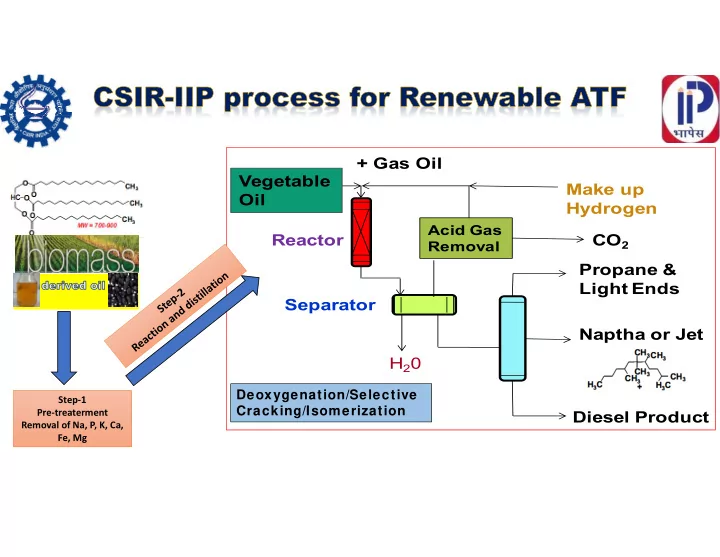
+ Gas Oil Vegetable Make up Oil Hydrogen Acid Gas Reactor CO 2 - - PowerPoint PPT Presentation

gas oil vegetable make up oil hydrogen
SMART_READER_LITE
LIVE PREVIEW

+ Gas Oil Vegetable Make up Oil Hydrogen Acid Gas Reactor CO 2 - - PowerPoint PPT Presentation

+ Gas Oil Vegetable Make up Oil Hydrogen Acid Gas Reactor CO 2 Removal Propane & Light Ends Separator Naptha or Jet H 2 0 Deoxygenation/Selective Step1 Cracking/Isomerization Pretreaterment Diesel Product Removal of Na, P,


slide-1
SLIDE 1

Acid Gas Removal

Vegetable Oil Reactor Separator H20 CO2 + Gas Oil Make up Hydrogen Propane & Light Ends Naptha or Jet Diesel Product

Deoxygenation/Selective Cracking/Isomerization

Step‐1 Pre‐treaterment Removal of Na, P, K, Ca, Fe, Mg

slide-2
SLIDE 2

Step-1 Pre-treatment of feedstock

Step 1 Step 2 Step 3 7.5 MTPA

  • il

(Rs 60/lt) Raw feedstock to Batch reactor for metal removal ACID ADDTION

DI WATER

CSTR

Lower layer (20 % rejection) Upper layer (pre‐treated Jatropha)

80% OF RAW FEED

Electric power for heating (Rs 0.2/l)

1.019 MLPA acid, (Rs 0.062/lt) 326 MLPA water (Rs 0.4/lt) 6 MTPA(Rs61/lt) WATER ADDTION

slide-3
SLIDE 3

Single Step Novel Process and Catalyst (Non noble metal) (1) Hydro‐deoxygenation (2) Hydro‐cracking (3) Hydro‐isomerisation (4) Aromatization (5) Cyclization (6) Hydrogenation

3

Catalyst features

  • Support with optimized acidity for desirable cracking and isomerisation ability to maximize

the kerosene yield

  • Sulfided base-metal (non-noble) catalyst on the support (lower in cost as compared to

competing technologies)

US 2017 / 0253808 A1, US 2018 /0010052 A1, WO 2014049621 A1, WO2016038633A1

Catalyst & Process Highlights

slide-4
SLIDE 4

Gasoline 13.3% Kerosene 31.1% Diesel 35.6% Water 8.9%

Methane 0.4% Ethane 0.4% Propane 6.7% Butane 0.8% Pentane 0.8% Carbon Dioxide 2.0%

Gases 11.0%

4

Hydrogen Consumption---3-5% of Liquid feed Kerosene (Bio-ATF)---Main product Diesel and Gasoline--- High cetane diesel-Cetane Improver, Gasoline for reforming / 100 LL Avgas Gases---------------------Useful for LPG recovery and Fuel gas

Product Pattern

slide-5
SLIDE 5

Commercial Technologies Hydrodeoxygenation (HT catalyst) C15‐C18 n‐paraffins Mild Hydrocracking & Hydroisomerization (Pt catalyst) to meet freeze point C9‐C15 Kerosene range iso‐, n‐paraffins 2006‐16

Process/ Property

100% CSIR-IIP’s Bio- Jet 50:50 Jet A1: CSIR-IIP’s Bio-Jet 100% Internationally available Bio-Jet 50:50 Jet A 1: Internationally Available Bio-Jet

  • Single-Reactor Process
  • Single Catalyst

Multifunctional, Low-cost: (1) Deoxygenations (2) Isomerization (3) Selective cracking (4) Desired aromatics

  • Two-Reactor Process:
  • Two Catalyst System (Incl. Precious metal)

(1) Deoxygenations (2) Isomerization & Selective cracking

  • Aromatic Addition

(Extra Step in Supply Chain )

Flash Point, oC

49 42.5 45 44.0

Freeze Point oC

  • 63
  • 58
  • 57
  • 58

Total Aromatics, vol%

12.8 15.7 <.03 9.5

Density (15°C), kg/m3

781.3 793.1 766.6 784.7 New Technology CSIR‐IIP Hydrodeoxygenation Hydrocracking, cyclization & Hydroisomerization (HC catalyst) C9‐C15 Kerosene range iso‐, n‐paraffins, cycloparaffins,aromatics 2017‐19

Reduced Capex and Opex; Patent Estate Established

CSIR‐IIP BIOJET VS COMMERCIALLY AVAILABLE BIO‐ATF CSIR‐IIP BIOJET VS COMMERCIALLY AVAILABLE BIO‐ATF
slide-6
SLIDE 6