SLIDE 1
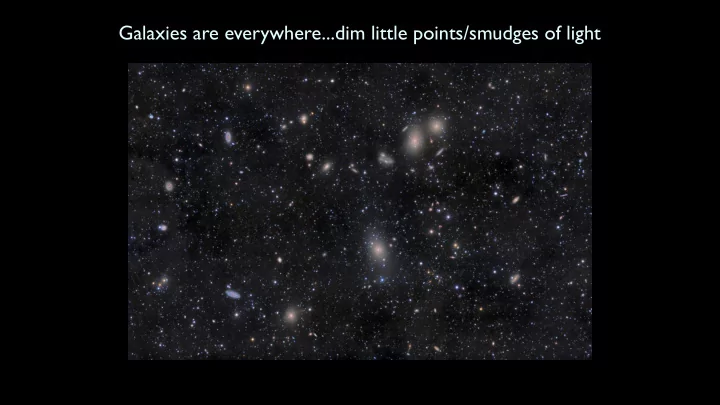
Galaxies are everywhere...dim little points/smudges of light
SLIDE 2 Whirlpool Galaxy: image taken with our own telescope! the size of the field of view
telescope is 26 arc minutes
SLIDE 3
Galaxies are everywhere...dim little points/smudges of light This is an especially dark, uninteresting small part of the sky (2.5 arc minutes across)
SLIDE 4
Virgo cluster: nearest big galaxy cluster
SLIDE 5
Virgo cluster: nearest big galaxy cluster
SLIDE 6 Galaxies are everywhere...dim little points/smudges of light and we can detect supernova explosions in them, even when they
few pixels!
SLIDE 7
2df galaxy survey: each dot is a galaxy
SLIDE 8
there is a limit to the size scale of structure (~100 million light years)
SLIDE 9
Large scale structure simulation
zoom in
SLIDE 10 but first, The Cosmological Principle
weak: the Universe is the same everywhere (homogeneous and isotropic
strong: also, the same at all times
SLIDE 11 but first, The Cosmological Principle
weak: the Universe is the same everywhere (homogeneous and isotropic
strong: also, the same at all times
SLIDE 12
Contents of the Universe changes with time: Quasars as a function of redshift (and thus distance and lookback-time)
SLIDE 13 but first, The Cosmological Principle
weak: the Universe is the same everywhere (homogeneous and isotropic
strong: also, the same at all times strong: ruled out by observations; including the darkness of the night sky
SLIDE 14
Olber’s paradox: if the Universe (or forest) were infinitely large, we’d see a star/galaxy (or tree) in every direction
SLIDE 15
Cosmological Principle: Universe is the same everywhere homogeneous? scale is the key
SLIDE 16
Chuck Close, Maggie, 1996 Jackson Pollock, Number 1, 1950 (Lavender Mist)
SLIDE 17
a wheat field is homogeneous...but that characterization depends on the scale
SLIDE 18
and it might be homogeneous without being isotropic
view from the left vs. the right?
SLIDE 19
we observe isotropy on large scales; if we are not in a special place, then this implies global homogeneity
SLIDE 20
On small scales, the Universe is clearly not homogeneous Working our way out from Earth in increasingly larger scales, here are some examples of inhomogeneity
SLIDE 21
Earth and Moon: sizes to scale
SLIDE 22
Earth and Moon: sizes to scale and distance to scale
SLIDE 23
The Sun, our star: 8 light minutes away and 4 light seconds across
SLIDE 24
The Sun, our star: volume about a million times larger than the Earth
SLIDE 25
the distribution of stars in the sky is not uniform
SLIDE 26
we live inside a flattened disk of stars: the Milky Way Galaxy
SLIDE 27
Milky Way composite, seen from Earth’s surface
SLIDE 28
Our neighbor galaxy: Andromeda
SLIDE 29
Andromeda: thought to be much like the Milky Way corresponds to our location in the Milky Way
SLIDE 30
Our neighbor galaxy: Andromeda infrared view
SLIDE 31
The Whirlpool Galaxy (M51): grand-design spiral
SLIDE 32
characterization of individual stars in galaxies: starting around 1915
SLIDE 33
Virgo cluster: nearest big galaxy cluster
SLIDE 34
Virgo cluster: nearest big galaxy cluster
SLIDE 35
SLIDE 36
Edwin Hubble (late 1920s)
SLIDE 37
Part of what made it possible to determine that Andromeda is a separate galaxy was the discovery of Cepheid variable stars by Henrietta Leavitt
she also developed a clever method for using these variable stars as distance indicators
SLIDE 38
Hubble’s original (1929) velocity-distance relationship
SLIDE 39
Hubble constant determinations over time