1 Implied Conditional Independencies Markov Models Recap X 1 X 2 X - - PDF document

1
SMART_READER_LITE
LIVE PREVIEW

1 Implied Conditional Independencies Markov Models Recap X 1 X 2 X - - PDF document

Reasoning over Time or Space CSE 473: Artificial Intelligence Markov Models Often, we want to reason about a sequence of observations Speech recognition Robot localization User attention Medical monitoring Need to introduce


slide-1
SLIDE 1

1

CSE 473: Artificial Intelligence Markov Models

Steve Tanimoto --- University of Washington

[Most slides were created by Dan Klein and Pieter Abbeel for CS188 Intro to AI at UC Berkeley. All CS188 materials are available at http://ai.berkeley.edu.]

Reasoning over Time or Space

  • Often, we want to reason about a sequence of observations
  • Speech recognition
  • Robot localization
  • User attention
  • Medical monitoring
  • Need to introduce time (or space) into our models

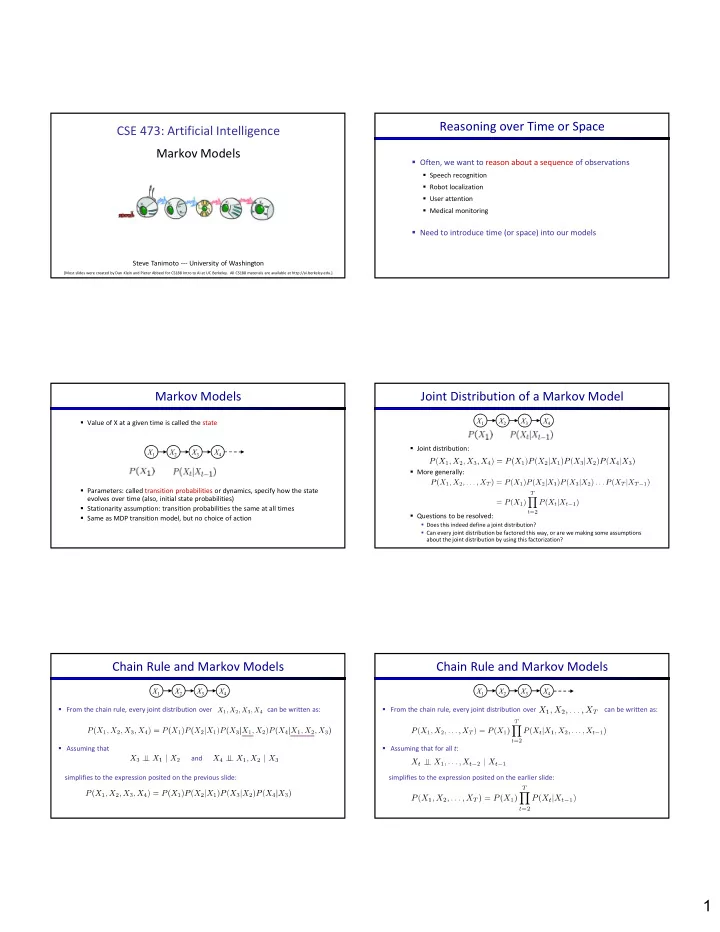
Markov Models

  • Value of X at a given time is called the state
  • Parameters: called transition probabilities or dynamics, specify how the state

evolves over time (also, initial state probabilities)

  • Stationarity assumption: transition probabilities the same at all times
  • Same as MDP transition model, but no choice of action

X2 X1 X3 X4

Joint Distribution of a Markov Model

  • Joint distribution:
  • More generally:
  • Questions to be resolved:
  • Does this indeed define a joint distribution?
  • Can every joint distribution be factored this way, or are we making some assumptions

about the joint distribution by using this factorization?

X2 X1 X3 X4

Chain Rule and Markov Models

  • From the chain rule, every joint distribution over can be written as:
  • Assuming that

and simplifies to the expression posited on the previous slide: X2 X1 X3 X4

Chain Rule and Markov Models

  • From the chain rule, every joint distribution over can be written as:
  • Assuming that for all t:

simplifies to the expression posited on the earlier slide: X2 X1 X3 X4

slide-2
SLIDE 2

2

Implied Conditional Independencies

  • We assumed: and
  • Do we also have

?

  • Yes!
  • Proof:

X2 X1 X3 X4

Markov Models Recap

  • Explicit assumption for all t :
  • Consequence, joint distribution can be written as:
  • Implied conditional independencies:

Past independent of future given the present i.e., if then:

  • Additional explicit assumption: is the same for all t

Example Markov Chain: Weather

  • States: X = {rain, sun}

rain sun 0.9 0.7 0.3 0.1

Two new ways of representing the same CPT

sun rain sun rain 0.3 0.9 0.7 0.1 Xt-1 Xt P(Xt|Xt-1) sun sun 0.9 sun rain 0.1 rain sun 0.3 rain rain 0.7

  • Initial distribution: 1.0 sun
  • CPT P(Xt | Xt-1):

Example Markov Chain: Weather

  • Initial distribution: 1.0 sun
  • What is the probability distribution after one step?

rain sun 0.9 0.7 0.3 0.1

Mini-Forward Algorithm

  • Question: What’s P(X) on some day t?

Forward simulation

X2 X1 X3 X4

Example Run of Mini-Forward Algorithm

  • From initial observation of sun
  • From initial observation of rain
  • From yet another initial distribution P(X1):

P(X1) P(X2) P(X3) P(X∞) P(X4) P(X1) P(X2) P(X3) P(X∞) P(X4) P(X1) P(X∞)

… [Demo: L13D1,2,3]

slide-3
SLIDE 3

3

Video of Demo Ghostbusters Basic Dynamics Video of Demo Ghostbusters Circular Dynamics Video of Demo Ghostbusters Whirlpool Dynamics

  • Stationary distribution:
  • The distribution we end up with is called

the stationary distribution

  • f the

chain

  • It satisfies

Stationary Distributions

  • For most chains:
  • Influence of the initial distribution

gets less and less over time.

  • The distribution we end up in is

independent of the initial distribution

Example: Stationary Distributions

  • Question: What’s P(X) at time t = infinity?

X2 X1 X3 X4

Xt-1 Xt P(Xt|Xt-1) sun sun 0.9 sun rain 0.1 rain sun 0.3 rain rain 0.7

Also:

Application of Stationary Distribution: Web Link Analysis

  • PageRank over a web graph
  • Each web page is a state
  • Initial distribution: uniform over pages
  • Transitions:
  • With prob. c, uniform jump to a

random page (dotted lines, not all shown)

  • With prob. 1-c, follow a random
  • utlink (solid lines)
  • Stationary distribution
  • Will spend more time on highly reachable pages
  • E.g. many ways to get to the Acrobat Reader download page
  • Somewhat robust to link spam
  • Google 1.0 returned the set of pages containing all your

keywords in decreasing rank, now all search engines use link analysis along with many other factors (rank actually getting less important over time)