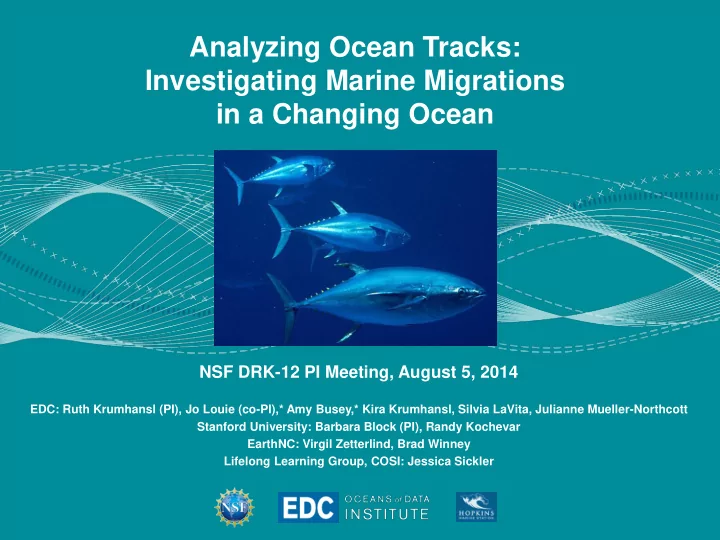
SLIDE 1 Analyzing Ocean Tracks: Investigating Marine Migrations in a Changing Ocean
NSF DRK-12 PI Meeting, August 5, 2014
EDC: Ruth Krumhansl (PI), Jo Louie (co-PI),* Amy Busey,* Kira Krumhansl, Silvia LaVita, Julianne Mueller-Northcott Stanford University: Barbara Block (PI), Randy Kochevar EarthNC: Virgil Zetterlind, Brad Winney Lifelong Learning Group, COSI: Jessica Sickler
SLIDE 2 Agenda
- Session Goals
- Project Background
- Tour of the Ocean Tracks Interface
- Ocean Tracks Exploration
- Research Findings
- Discussion and Feedback
SLIDE 3 Product Feedback Session Goals
- Share current capabilities of Ocean Tracks interface
- Exchange strategies for supporting scientific practices
with data
- Identify ways to extend Ocean Tracks work
- Connect with others for potential future collaboration
SLIDE 4
Project Background
SLIDE 5
SLIDE 6
SLIDE 7
The Opportunity
“Science is not just a body of knowledge that reflects current understanding of the world; it is also a set of practices used to establish, extend, and refine that knowledge. Both elements— knowledge and practice—are essential.” Next Generation Framework for K-12 Science Education, NRC 2011, p. 2-3
SLIDE 8
How do you design student-friendly interfaces to professionally-collected data sets?
SLIDE 9 Goals for students
Promote scientific practices
- Ask questions that can be investigated using data
- Examine relationships between variables
- Analyze and visualize data through multiple means
- Construct explanations from the data
- Select data that best support claims
SLIDE 10 Goals for students
Explore questions of current scientific interest
- What might influence the movement of marine species?
- Why might movement be affected by oceanographic
factors?
- How does the importance of these factors differ across
species?
- Can we predict where marine species will congregate in
the future, to target for protection?
SLIDE 11
The Data
SLIDE 12
The Ocean Tracks Interface
SLIDE 14
The Interface
SLIDE 15
Get students quickly to the data
SLIDE 16
Get students quickly to the data
SLIDE 17
Allow them to easily create and interact with data displays
SLIDE 18
Allow them to easily create and interact with data displays
SLIDE 19
Allow them to easily create and interact with data displays
SLIDE 20
Allow them to easily create and interact with data displays
SLIDE 21
Allow them to easily create and interact with data displays
SLIDE 22
Allow them to easily create and interact with data displays
SLIDE 23
Allow them to easily create and interact with data displays
SLIDE 24
Customized content supports
SLIDE 25 Ocean Tracks Phase 1
Teacher facilitation Curriculum and
Easy access to data Student-friendly data analysis/ visualization tools Scientific expertise Ocean Tracks Phase 1
SLIDE 26 Learning Modules
- 1. Introduction to Ocean Tracks - diving into the data
- 2. Prey Maps – using environmental and tracking data to
locate prey
- 3. Biological Hotspots – exploring relationships between
individuals, species, and their shared habitats
- 4. Human Impacts - independently investigating human
impacts on marine habitats
- 5. Conservation Strategy - synthesis
SLIDE 27
Ocean Tracks Exploration
SLIDE 28
Hotspot Map
SLIDE 29 Where are the species hot spots in the Pacific Ocean?
Using the elephant seal or white shark data available in the Ocean Tracks interface, investigate the following questions:
- Where are the habitat hot spots?
- What might the animals be doing both inside and outside
- f the hot spots?
- Why is this area a hot spot? Why might animals be
attracted to these locations?
- What types of evidence can you provide to support your
ideas?
SLIDE 30 Ocean Tracks Exploration – Report Out
- What ideas and evidence did you/your group generate?
- What did you find interesting or engaging? What other
data or questions would you like to explore?
- What did you find challenging? What would you expect
high school students or teachers to find challenging in a similar investigation?
SLIDE 31
Research Findings
SLIDE 32 Research and Development Activities
- Iterative development of Ocean Tracks interface
- Initial development: alpha
‒ Fall 2012–winter 2013
‒ Spring 2013, 5-6 weeks ‒ 3 high school science teachers, n=61 students
- Revisions: beta 1
- Pilot test 2
‒ Fall 2013, 4-6 weeks ‒ 4 high school science teachers, n= 134 students
SLIDE 33 Research Questions
Usability:
- Which aspects of the interface and materials were
students able to use most and least easily? Engagement:
- Which aspects of the interface and materials were most
and least engaging for students? Scientific Practices/Thinking:
- What types of questions, reasoning, and claims did
students generate using Ocean Tracks?
SLIDE 34 Data Sources
- Classroom observations
- Screen capture recordings
- Student surveys
- Student focus groups
- Online notebook entries (Pilot 1)
- Student work
- Teacher logs
SLIDE 35 Findings: Interface Usability
Successes:
- Students could easily navigate major features of the
interface to access multiple types of data
‒ Could quickly pan, zoom ‒ Able to select and display animal tracks and overlays ‒ Could use interface tools to take basic measurements ‒ Able to use map markers, save maps
SLIDE 36 Findings: Interface Usability
Challenges:
- Slow Internet speed
- Windows management
- Measurement table
- Efficient use of available tools
- Teacher monitoring and commenting on student work
SLIDE 37 Findings: Student Engagement
Successes:
- Students found Ocean Tracks data interesting and
engaging
– Most enjoyed the opportunity to learn about marine animals and see their migration patterns (74% of survey responses, Pilot 1) – Motivated by working with real, authentic data
“I found it most interesting that you guys actually had the power to track an animal and know exactly where they are every minute.”
– Particularly interested in human impacts layer
SLIDE 38 Findings: Student Engagement
Challenges:
- Modules felt long, repetitive
- Attention spans of 20 minutes
- Classroom management
SLIDE 39 Findings: Scientific Practices/Thinking
Successes:
- Students were able to take measurements,
describe patterns, and generate hypotheses
“I noticed that the seal track follows the area of higher chlorophyll levels. There are more nutrients in the water where there is more chlorophyll so that is why they are attracted there because there is probably a greater chance of finding suitable food there… The concentration is between 10-12 where it was lingering.”
SLIDE 40 Findings: Scientific Practices/Thinking
Successes:
- Ocean Tracks prompted thoughtful questions
“I thought it was cool to watch the animals to see how not only just one animal went in this certain route, but how all the animals of that species and even some animals of different species go in that particular route… “It was also interesting how within the same species, certain animals will completely separate from the normal predicted path and go do something that’s miles away. It’s interesting to think about what that one specific animal is doing that’s different from the rest of its species.”
SLIDE 41 Findings: Scientific Practices/Thinking
Challenges:
- Understanding temporal relationships among
animal tracks and data overlays
- Understanding data irregularities
- Developing and describing ideas or claims based
- n data measurements or observations
SLIDE 42 Findings: Supports Needed
- Curriculum activities
- How much scaffolding?
- Tools to support data recording and observations
- How manage online?
- Context and connections to real science and scientists
- How connect?
- Teacher supports
- How best to prepare for using Ocean Tracks?
- How best to support student monitoring and feedback?
SLIDE 43
Discussion and Feedback
SLIDE 44 Future directions
For more info: www.oceantracks.org www.oceansofdata.org www.edc.org Teacher facilitation Curriculum and
Easy access to data Student-friendly data analysis/ visualization tools Scientific expertise Ocean Tracks Phase 1
SLIDE 45 Questions for Discussion
- What do we know about how best to support scientific
practices with data?
- What additional supports should Ocean Tracks provide?
- In what ways could Ocean Tracks support others’ work?
- In what other contexts might Ocean Tracks be useful?
- Which directions have the most potential to advance the
field of building scientific practices with data?