Gain ins in in Submarine and Ship Pla latform Desig ign - - PowerPoint PPT Presentation

gain ins in in submarine and ship pla latform desig ign
SMART_READER_LITE
LIVE PREVIEW

Gain ins in in Submarine and Ship Pla latform Desig ign - - PowerPoint PPT Presentation

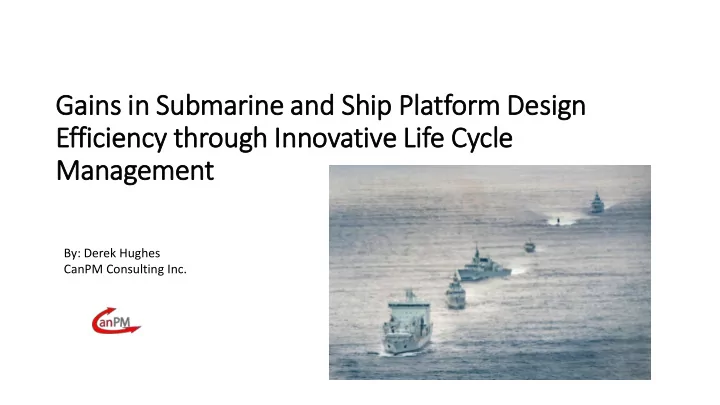
Gain ins in in Submarine and Ship Pla latform Desig ign Efficiency through In Innovative Lif ife Cycle Management By: Derek Hughes CanPM Consulting Inc. Agenda D&B Shipyard Focus Design Efficiency Systems Thinking

slide-1
SLIDE 1

Gain ins in in Submarine and Ship Pla latform Desig ign Efficiency through In Innovative Lif ife Cycle Management

By: Derek Hughes CanPM Consulting Inc.

slide-2
SLIDE 2

Agenda

  • D&B Shipyard Focus
  • Design Efficiency
  • Systems Thinking
  • Sustainment
  • Unmanned Autonomous Ships
  • Revitalization
  • “Best Fit” LCC
  • Recommendations
slide-3
SLIDE 3

D&B Shipyard Focus

  • Build to contractual specification where the margins are pre-determined;
  • Meeting the rigour of the quality and standards set by the military client;
  • Developing and sustaining skilled workers for follow-on projects;
  • Avoiding the peaks and troughs of shipbuilding by striving for a continuous

build program with commercial and military platform orders;

  • Maintaining corporate integrity through a high standard of platform build;

and

  • Achieving cost savings where possible and reaching an acceptable profit

for the shareholders.

slide-4
SLIDE 4

Plan Plan Plan Plan Plan

Design Efficiency

Pre- Planning Modelling Mgmt Schedule Mgmt Cost Estimating

Modelling Modelling Modelling Modelling Modelling Scheduling Scheduling Scheduling Scheduling Scheduling

Cost Cost Cost Cost Cost

Design Efficiency

  • Strategic View
  • Efficiency
  • Pre-Planning
  • Modelling Management
  • Schedule Management
  • Cost Estimating
  • Iterative process
  • Feedback, Comms, Lessons

Learned are factors

slide-5
SLIDE 5

Systems Thinking

  • Beware the hidden dangers
  • Complexity is a reality
  • Strive for transparency to avoid

the unknowns

slide-6
SLIDE 6

Sustainment – Four Principles

  • Performance - defence equipment that is operationally ready and

mission capable

  • Value for money - the required outcomes are procured at a price

commensurate with the market rate for comparable procurements

  • Flexibility - an adaptable and scalable support system that can readily

be adjusted to changes in operational requirements and/or operating budgets

  • Economic benefit - leverage industrial benefits from defence

procurements to create jobs and economic growth for companies in Canada

slide-7
SLIDE 7

Uncrewed Autonomous Ships

  • Reduced costs to crewing and maintaining skilled sea-faring

members;

  • Reduction in storage and living space for crews which allows for more

weaponized spaces under the design margins for the ship;

  • More compartment space for additional fuel to ensure enhanced

endurance for the ship; and

  • More flexibility for the Naval Architect and Marine engineers to

utilise their design constraints with enhanced features to include additional equipment performance parameters and weapon capacity storage.

slide-8
SLIDE 8

Failure Rate Useful Life Infant Mortality Wear out Period Constant Failure Rate Decreasing Failure Rate Increasing Failure Rate

Recognize Efficiencies

  • Traditional vs Performance
  • Lean approach
  • Forecasting and trending
  • Integrated Logistics Support
  • Data Analytics
  • Dashboard Reporting and

Milestone establishment

  • Plan for PM, CM,

Obsolescence

slide-9
SLIDE 9

OFSV OOSV Polar Icebreaker

slide-10
SLIDE 10

Designing in “Best Fit” LCC Solutions

  • Developing a design framework for integrating a lean sustainment

system;

  • Defining a new product development, acquisition, and sustainment

process based on modular, incremental design and leading edge technology;

  • Use of lean principles to determine cost savings, greater efficiency,

and higher quality as we enhance responsiveness to military demands; and

  • Minimizing disruption in the design efficiency through flexibility,

performance, value for money and economic benefit for the respective client and Government purchases under consideration.

slide-11
SLIDE 11

ILS Effect on LCC

Dev Cost Disp Cost

60-80% of Total LCC

Prod Cost

Operate & Support Cost

What you do here

PRE CONCEPT CONCEPT DEVELOPMENT PRODUCTION UTILISATION & SUPPORT RETIREMENT

slide-12
SLIDE 12

Life Cycle of Platform

  • ILS Elements
  • Maintenance Planning
  • Manpower and Personnel
  • Supply Support
  • Support Equipment
  • Technical Data
  • Training and Training Support
  • Facilities
  • Packaging, Handling, Storage, and Transportation
  • Design Interface
  • Obsolescence Plan
  • Materiel Sustainment
  • Technology Insertion
  • Update and Refresh
  • Mission Orientated
slide-13
SLIDE 13

ILS during development and production to avoid hitting the “logistical iceberg.”

Documentation Training Disposal Service Ground- and Test-Equipment Spare Parts Packaging Storage

Make Operation & Support Costs low Make Life Cycle Costs transparent

Costs for Development and Production Personnel Infrastrucuture Software Transportation

The logistical Iceberg

 cause support considerations to influence both requirements and design;  define the support requirements which are

  • ptimally related to the

design and to each

  • ther;

 design the required support  acquire the required support; and  provide the required support over the life of the equipment at the

  • ptimum cost.
slide-14
SLIDE 14

Recommendations

  • Achieving advanced planning for all aspects of the program and project work

supporting the submarine and ship design and build;

  • Providing attention to cost estimating requiring detail and realistic funding

appreciation before a build can be realised for its through life spending requirement;

  • Developing a cohesive strategy with firm Governance by all stakeholders will

allow for adequate efficiency gains throughout the life cycle management;

  • Establishing a consistency in achieved efficiencies and change management is a

feature throughout the life cycle where external factors will impact the design

  • efficiency. i.e. obsolescence, increased capability, inadequate requirements,

platform role change; and

  • Employ relational contracting to allow for open dialogue early and often

between the contractor and Government.

slide-15
SLIDE 15

Naval Proverb!

Beginning is easy; continuing, hard.

Japanese (on permanence and change)

slide-16
SLIDE 16

Thank You