Search for Hidden Particles (SHiP): an experimental proposal at the - - PowerPoint PPT Presentation

search for hidden particles ship an experimental proposal
SMART_READER_LITE
LIVE PREVIEW

Search for Hidden Particles (SHiP): an experimental proposal at the - - PowerPoint PPT Presentation

Search for Hidden Particles (SHiP): an experimental proposal at the SPS ship.web.cern.ch/ship Mario Campanelli (UCL) On behalf of ShiP-UK: Bristol, ICL, RAL, UCL, Warwick The hidden sector approach to new physics Searches for new


slide-1
SLIDE 1

Search for Hidden Particles (SHiP): an experimental proposal at the SPS

ship.web.cern.ch/ship Mario Campanelli (UCL) On behalf of ShiP-UK: Bristol, ICL, RAL, UCL, Warwick

slide-2
SLIDE 2

The “hidden sector” approach to new physics

  • Searches for new particles at the LHC so far unsuccessful, maybe new physics has a

very small coupling?

  • If an additional, weakly interacting, term to the Lagrangian could lead to particles very

difficult to observe, but contributing to dark matter.

Particle content of SM made symmetric by adding 3 HNL: N1, N2, N3

With M(N1) ~ few KeV, it is a good DM candidate (or DM can be generated outside of this model through decay of inflaton) With M(N2, N3) ~ GeV, could explain Barion Asymmetry of Universe (via leptogenesis), and generate neutrino masses through see-saw.

The νMSSM

T.Asaka, M.Shaposhnikov, PL B620 (2005) 17 M.Shaposhnikov Nucl.

  • Phys. B763 (2007) 49
slide-3
SLIDE 3

HNL production and decay modes

Interaction with Higgs vev leads to mixing with active neutrinos, resulting in a bahaviour similar to oscillation to the HNL and back into a virtual neutrino, that produces a muon and a W (→ hadrons, eg pions) Exact branching fractions depend n flavor mixing Due to small couplings, ms lifetimes, decay paths O(km)

Decay mode Branching ratio N2,3→µ,e + π 0.1 – 50 % N2,3→ µ-/e- + ρ+ 0.5 - 20% N2,3→ ν + µ + e 1 – 10%

slide-4
SLIDE 4

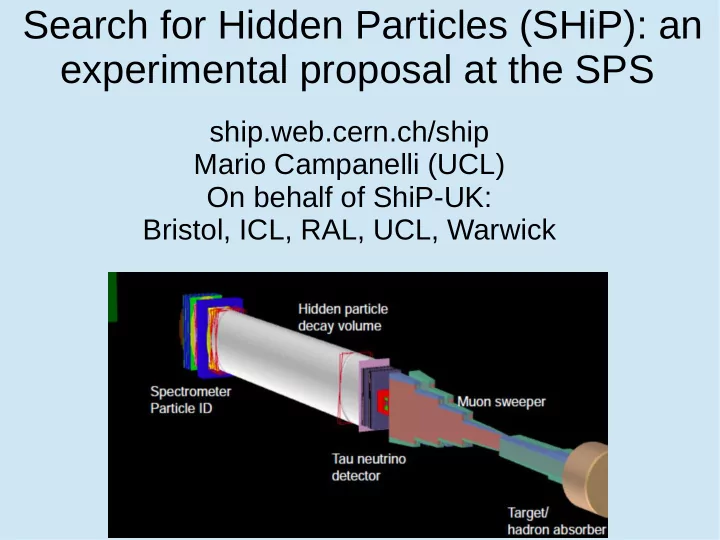
An experiment in practice

Use protons from CERN's SPS: 500 kW is 4x1E13 protons/7 s ->2E20 in 5y Slow (ms → 1s) and uniform extraction to reduce detector occupancy and combinatorics

  • HS particles produced by mesons (mainly charm) decays; need to absorb all SM decay

products to minimise BG

→ heavy material thick target, with wide beam to dilute energy deposition (different from neutrino facility)

  • Muons cannot be absorbed by target

→ active muon shield

  • Long vacuum (or helium) decay tunnel away from external walls to minimise rescattering of

muons and neutrons close to detector

  • Far-away detector with good PID and resolutions
  • An additional emulsion detector for tau neutrino studies
slide-5
SLIDE 5

The SHiP proposal

  • Proposal for a new facility at the CERN SPS

accelerator:

  • hidden sector detector
  • ντ facility

235 experimentalists from 45 institutes and 15 countries + CERN

  • Technical Proposal submitted in April last year

(arXiv:1504.04956)

  • Physics Proposal signed by 80 theorists

(arXiv:1504.04855)

  • SPSC has given the green light to the next

stage, a Comprehensive Deign report, to be submitted in about 3 years

  • ShiP recommended by the CERN research

board

slide-6
SLIDE 6

The SHiP detector

slide-7
SLIDE 7

Background rejection for HNL searches

slide-8
SLIDE 8

SHiP in the UK

  • UK physicists proposed the experiment and Andrei Golutvin (ICL) is the

spokesperson, and muon shield group lead by UK physicists

  • UK work-package: background rejection (crucial for the success of the

experiment)

– Active muon shield – Target design – DAQ and triggering

  • A SoI was submitted last year, with the experiment still under SPSC review
  • Since then, we had positive recommendations from the SPSC, the research

board, and we are now included in the MTP. With other countries starting to get resources, we need to maintain current responsibilities

  • SHiP-UK will not be able to maintain its leadership without dedicated resources

to contribute to the Comprehensive Design Report.

slide-9
SLIDE 9

Sensitivity to HNL

Critically improving present limits in U2; access masses up to mB Probe region of special interest:

  • left open by cosmological
  • •observations (BBN)
  • explains ν masses (seesaw); explains matter-antimatter asymmetry (BAU)
  • Sensitivity in all Ue , Uμ , Uτ channels
slide-10
SLIDE 10

Sensitivity to dark photons

Production

  • Decays of π0→Vγ, η→Vγ,

ω→ Vπ0

  • Proton bremsstrahlung and parton

bremsstrahlung above Λ(QCD)

  • Decay into pair of SM particles
  • SHiP will have a unique sensitivity

Planned and future experiments

slide-11
SLIDE 11

The ντ detector

  • An OPERA-like tau neutrino emulsion detector
  • Current status of tau neutrino measurements:

– DONUT observed 9 events (from charm), OPERA 4 events (from oscillations) – No tau antineutrino has been even observed

  • Ship can increase by 200 the current tau neutrino sample, discover tau

antineutrinos and measure structure functions

slide-12
SLIDE 12

SHiP at CERN and timeline

From Fabiola’s June presentation to the CERN staff: From CERN’s medium term plan

slide-13
SLIDE 13

Conclusions

  • Light hidden-sector particles can solve many problems of

the SM, and SHiP is the only dedicated detector to discover them

  • The SPSC asked the experiment to produce a

Comprehensive Design Report, and the Research Board has favourably recommended it

  • UK physicists proposed the experiment, we have the

spokesperson and are in charge of the muon shield system

  • We require commensurate resources and some recognition

from the UK community to preserve the current roles and maintain the strong impact we have in the collaboration during the CDR phase and beyond