G \ ; 9, \~ LAtJl_.s, Suresh Gondalia Company Secretary End: as - - PDF document

g
SMART_READER_LITE
LIVE PREVIEW

G \ ; 9, \~ LAtJl_.s, Suresh Gondalia Company Secretary End: as - - PDF document

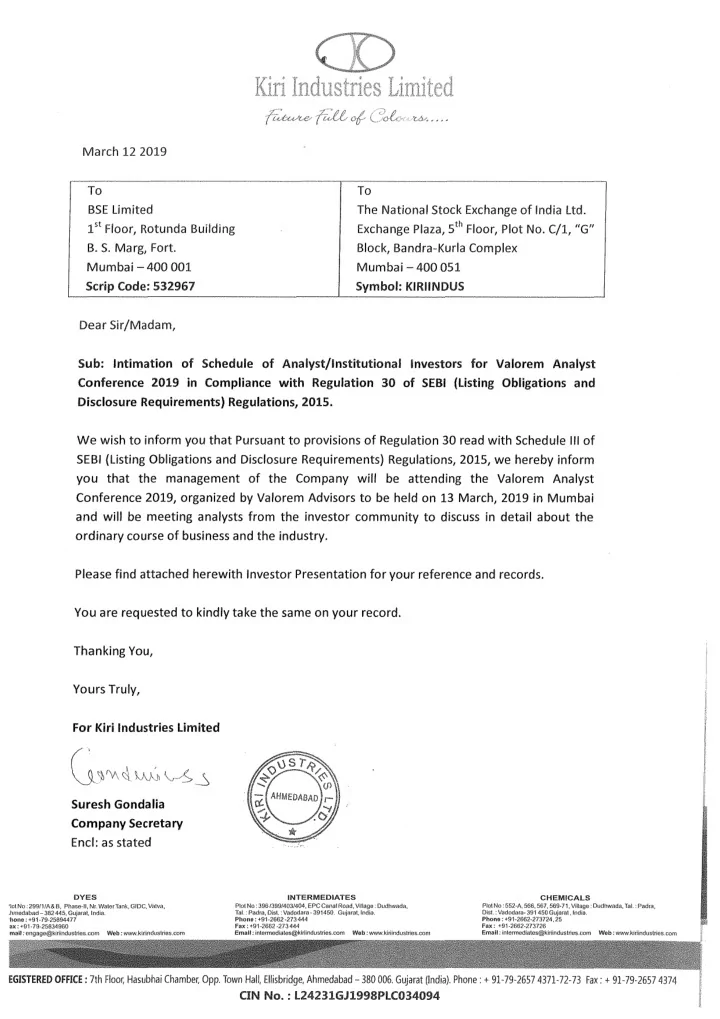
~I\. \~\ March 12 2019 To To BSE Limited The National Stock Exchange of India Ltd. 1 st Floor, Rotunda Building Exchange Plaza, 5 th Floor, Plot No. C/l, "G" B. S. Marg, Fort. Block, Bandra-Kurla Complex Mumbai - 400001 Mumbai - 400051


slide-1
SLIDE 1

March 12 2019 To

BSE Limited

1st Floor, Rotunda Building

  • B. S. Marg, Fort.

Mumbai - 400001 Scrip Code: 532967 Dear Sir/Madam, To The National Stock Exchange of India Ltd. Exchange Plaza, 5th Floor, Plot No. C/l, "G" Block, Bandra-Kurla Complex Mumbai - 400051 Symbol: KIRIINDUS Sub: Intimation of Schedule of Analyst/Institutional Investors for Valorem Analyst Conference 2019 in Compliance with Regulation 30 of SEBI (listing Obligations and Disclosure Requirements) Regulations, 2015. We wish to inform you that Pursuant to provisions of Regulation 30 read with Schedule III of SEBI (Listing Obligations and Disclosure Requirements) Regulations, 2015, we hereby inform you that the management of the Company will be attending the Valorem Analyst Conference 2019, organized by Valorem Advisors to be held on 13 March, 2019 in Mumbai and will be meeting analysts from the investor community to discuss in detail about the

  • rdinary course of business and the industry.

Please find attached herewith Investor Presentation for your reference and records. You are requested to kindly take the same on your record. Thanking You, Yours Truly, For Kiri Industries Limited

G \ ;

9, \~

~I\.

\~\

LAtJl_.s,

Suresh Gondalia Company Secretary End: as stated

DYES INTERMEDIATES CHEMICALS

'lot No: 299/1JA& 8, Phase-fl, Nr, WHlerTank, GlDC, Valva, ,hmedabad - 382 445, Gujaral, India. Plot No : 396/399/4031404, EPG Canal Hoad, Village: Dudl1wada, Tal.: Padra, oisl.: Vadodara- 391450. Gujamt, India, Plot No: 552·A, 566, 156'1. !569·'11, Village; Dudtlwada, Tal.: Padra, Disl.: Vadodara· 391460 Gujaral, India.

hone: +91-79·25894477 Phonl}: ~91·262

  • 273 444

Phone: ·'·91·26G2·273'124, 25 ax: +91-79,2S834960 Fax: +91 .. 2(i62 -273 444 Fax: +91·26(i2·273726 mall; engage@kiriindustries,com

Web: www.kiriindlJslriBs.com Email: inlermedia!es@kifindlJstri{~s.com Web: wVl"w.kiriinduslries.colll Email ;inlermediales@kiriindustrles.comWeb:Wlwd<iriindustries.com

EGISTERED OFFICE: 7th Floor, Hasubhai Chamber, Opp. Town Hall, Ellisbridge, Ahmedabad - 380 006. Gujarat (India). Phone: + 91-79-26574371-72-73 Fax: + 91-79-26574374

CIN No.:l24231GJ1998PlC034094

slide-2
SLIDE 2

Kiri Industries Limited

(CIN:L24231GJ1998PLC034094) IN INVESTOR PRE RESENTATION | | FEBRUARY 20 2019 19

slide-3
SLIDE 3

2

  • Kiri Industries Limited (KIL) is one of the largest manufacturers

and exporters of a wide range of Dyes, Dyes Intermediates and Basic Chemicals from India.

  • KIL is an accredited and certified Key Business Partner with the

world’s top Dyestuff majors across Asia-Pacific, the EU and America.

  • It has sophisticated quality control practices and procedures,

modern manufacturing facilities and ERP driven enterprise management that enabled KIL to offer internationally recognized quality products and services.

  • KIL is listed on both the BSE and NSE exchanges and has market

capitalisation of approximately INR 14013.90 Mn as on 31st December, 2018.

Executive Summary

TOTAL REVENUE INR INR 11,3 ,368 Mn n 3 Y Yea ear r - CAGR CAGR 6.8 .82% EBITDA INR INR 1,8 ,826 Mn 3 3 Yea ear r - CAGR CAGR 21.6 .62% PAT INR INR 1,2 ,267 Mn

OVERVIEW FI FINANCIAL HIGHLIGHTS* PRODUCTS

Dyes In Inter ermedia iates H-acid Vinyl Sulphone Specialty Intermediates Dyes Reactive dyes Acid Dyes Direct Dyes Disperse Dyes Bas asic ic Che hemic icals ls Sulphuric Acid Oleum 65% and 23% Chloro Sulphonic Acid Thionyl Chloride

IN INDUSTRIES S CATERED

For For Dyes inter ermed ediates

  • Various

manufacturers of reactive dyes across the globe. For For Dyes

  • Textile

manufacturers, including manufacturers of cotton fabrics, dress material, papers, carpets, bed sheets, etc.

  • Leather

manufacturing, dying, finishing, etc.

* Consolidated (FY18)

slide-4
SLIDE 4

COMPANY OVERVIEW

slide-5
SLIDE 5

4 Company Overview

  • Based out of Gujarat since 1998, Kiri Industries

Limited (KIL), has emerged as one of the largest manufacturers and exporters of a wide range of Dyes, Dyes Intermediates and Basic Chemicals from India.

  • It is also considered amongst the fastest growing

companies in the Dyestuffs & Dyes Intermediates space in the country.

  • It provides products and services across the whole value chain in numerous industrial sectors

(apparel, hosiery, automotive, carpets, leather, paper, home upholstery, industrial fabrics, etc.)

  • In its 20 years of corporate journey, KIL has been focusing on providing products of high

quality standards, executing collaborations and strategic acquisition, implementing environment aligned R&D, finding innovative solutions and all-encompassing customer care.

  • All initiatives taken by KIL has enabled it to set its footprints in over 50 countries across 7

continents.

  • The Company has the sizeable manufacturing facility of Dyes Intermediates and Basic

chemicals at, Padra (Vadodara, Gujarat).

  • To strengthen its competitive edge in dyes vertical, KIL formed a joint venture with

Longsheng (China) and set up a manufacturing facility for dyes at Padra (Vadodara, Gujarat).

  • KIL has built a strong and differentiated business model with focus on Green Manufacturing

(ISO 9001 & 14001 certification).

Dyes 41% Dyes Intermediates 56% Basic Chemicals 3%

Revenue Break-up (9 (9M-FY19)

3,544 5,211 6,746 7,353 6,473 5,245 3,377 4,117 3,681 4,517 4,722 4,678

FY14 14 FY15 15 FY16 16 FY17 17 FY18 18 9M-FY19

Con

  • nsolidated Revenue Break-up (IN

(INR Mn Mn) )

Domestic International

slide-6
SLIDE 6

5 Management Team

Mani anish Kiri Kiri (Man anagin ing Dir irec ector)

  • He has a Bachelors of Engineering

(Electronics & Communication) from Gujarat University and a Master’s Degree in Business Management from Wayne State University, USA.

  • He

envisions the company’s

  • perational strategies and its future

forays and expansions. He also designs its marketing strategies and commandeers their implementation. He oversees the overall sales and exports, customer relationship management and expansions, ensuring a sustainable growth of the company.

  • He

was the force behind the Company’s JV (Lonsen Kiri Chemical Industries Ltd.), and acquisition of DyStar.

  • He

was awarded ‘Outstanding Entrepreneur’ by Ahmedabad Management Association in year 2011. Prav ravin in Kiri Kiri (C (Cha hair irman)

  • He is a science graduate from Gujarat University and started his career in the year 1966 by associating

himself with Jay Chemical Industry (Kharawala Group) as a partner and was responsible for all the technical matters of the group.

  • He has a wide interest and knowledge in the areas of synthesizing organic structures of Dyes and

Intermediates.

  • He looks after the manufacturing activities and is focused on operational strategy, quality control and

research & development activities. Ke Keyur ur Bak akshi (I (Indepen enden ent Direc ector)

  • He is a practicing Company Secretary and holds degrees in Commerce and Law from Gujarat University.
  • He is a Fellow Member of the Institute of Company Secretaries of India and had served as the President
  • f Institute of Company Secretaries of India in the year 2008.
  • Actively involved in various assignments relating to Corporate Laws, Finance, amalgamations, mergers /

de-mergers, acquisitions and takeovers, corporate restructuring and planning. Muk ukesh Desai (I (Ind ndependent Dire rector) r)

  • He has an engineering background with more than 35 years of techno commercial management

experience in multi -product, multi location project installation and operation. Ve Veen ena Padi adia (I (Indepen enden ent Direc ector)

  • She has a Masters of Economics from M. S. University and has a vast leadership experience in providing

strategic advisory expertise and directing development and implementation of widespread programmes and organisations through insights into livelihood, education, microfinance, gender, and health relating to gender and marginalised and socially excluded communities.

  • She has worked with private-sector CSR divisions, government agencies and international donors and

NGOs such as World Bank, CARE, etc.

slide-7
SLIDE 7

6 Key Milestones

2010 2010 2008 2008 2006 2006 Incorporat ion of Kiri Dyes and Chemicals

  • Pvt. Ltd

1998 1998 2004 2004 Two-Star Export House Obtained Environmental Clearance for further expansion Conversion of manufacturing unit into a 100% Export Oriented Unit Commercial production

  • f

backward integrated project with respect to Vinyl Sulphone Entered into a JV Agreement with Well Prospering

  • Ltd. for

manufacturing facility for Dyestuff Successfully completed IPO Acquisition of assets of DyStar 2018 2018 2015 2015 2013 2013 DyStar became profitable Filed minority

  • ppression

suit against Senda and DyStar in Singapore Court Achieved highest PAT since inception Singapore Court delivered milestone judgement in favour of KIL for buyout of KIL’s Stake in DyStar by Senda Started export to USA and Taiwan Started strategic backward integration project Started Backward Integration project for production

  • f H Acid

Successfully completed JV Project. Successfully completed installation of basic chemical plant and started commercial production Changed the Name to ‘Kiri Industries Ltd’ Completed expansion of Intermediate Project and KIL became the largest VS manufacturer in India Restructured debts of the Company Successfully repaid majority of restructured debts 2011 2011 2007 2007 2005 2005 1999 1999 2009 2009 2017 2017 2014 2014

slide-8
SLIDE 8

7

Loca

  • cation: Vadodara, India.

Prod roducts manu anufactured:

  • Reactive Dyes

Cap apacit ity Ins Install lled:

  • 50,000 MTPA

Not

  • te:
  • A JV Company between Zhejiang Longsheng (China) (60%) and KIL (40%).
  • Engaged in the activity of manufacturing and selling reactive dyes.

Uni nit V Loca

  • cation: Ahmedabad, India.

Prod roducts manu anufactured:

  • S. O. Dyes
  • Disperse Dyes

Capa apacit ity Ins Install lled ed:

  • Reactive Dyes : 36,000 MTPA
  • Disperse Dyes: 8,000 MTPA

Loca

  • cation: Vadodara, India.

Prod roducts manu anufactured:

  • Intermediates - V. S. H. Acid and
  • ther specialties.

Capa apacit ity Ins Install lled ed:

  • Commodity Intermediates :

25,200 MTPA

  • Vinyl Sulphone - 18,000 MTPA

Loca

  • cation: Vadodara, India.

Prod roducts manu anufactured:

  • Sulphuric acid
  • Oleum
  • Chloro-sulphonic acid

along with 3.3 MW steam based power plant

Manufacturing Facilities

Uni nit I, I, Uni nit II II & IV IV Lon

  • nsen Kiri

Kiri Plan ant JV JV wit ith Lon

  • ngsheng (C

(Chi hina) Uni nit III III KIL KIL is a a te tech chnolo logy-driv iven en em emerg ergin ing global l play player er as as wel ell as as a a pre premie ier bud buddin ing spe specia ialt lty chem chemic icals ls play player er

  • H-Acid - 7,200 MTPA
  • Specialty Intermediates : 10,000 MTPA
  • Acetanilide – 12,000 MTPA

Capa apacit ity Ins Install lled ed:

  • Basic Chemicals : 500 TPD (182,500 MTPA)
  • Sulphuric Acid – 280 TPD
  • Oleum – 23% – 50 TPD
  • Oleum – 65 % – 70 TPD
  • Chloro Sulphonic Acid – 100 TPD
  • Thionyl Chloride – 150TPD
slide-9
SLIDE 9

8 Manufacturing Process

Sulp lphur & B Bulk lk Chemicals Division Dyes In Intermediates Division Dyestuff Division

End Use Industry

Ice Napthalene Sulphur Water Aniline Caustic Soda Chlorine Sodium Nitrate Soda Ash KeyInputs

Textiles Leather Paper Detergent / Pharma / Fertilizer / Agro chemicals

Acid Dyes Reactive Dyes DirectDyes Disperse Dyes Acetanilide Sodium Bi Sulphate Oleum 65% Oleum 23% Chloro Sulphonic Acid Sulphuric Acid Beta-Nepthol Para Nitro Aniline Thionyl Chloride MPD Vinyl Sulphone Ester (Acetanilide Parabase) | Vinyl Sulphone Paracresidine Base | Vinyl Sulphone Ester of 2:5 Di Methoxy Aniline | Bronner’s Vinyl Sulphone | Ortho Anisidine Vinyl Sulphone | Sulpho Para Vinyl Sulphone | Sulfo Ortho Anisidine Vinyl Sulphone | | 4:4 Diamino Sulphanilide | 4:4 Diamino Di Phenyl Amine 2-Sulphonic Acid | Gamma Acid | H.Acid | B.D.S.A | Sulpho Tobias Acid (STA) | K-Acid | | MPDSA | | MUA | | 6 Chloro 2.4. DNA | | DCPNA | | PNA | | MAA | | AMA

slide-10
SLIDE 10

9 Geographical Presence INDIA TURKEY TAIWAN PERU ECUADOR THAILAND IRAN CHILE BANGLADESH SYRIA COTE D'IVOIRE INDONESIA TUNISIA ITALY DEMOCRATIC REPUBLIC OF CONGO ARGENTINA BRAZIL THE NETHERLANDS SPAIN UK HONDURAS SOUTH AFRICA USA CHINA SRI LANKA BELGIUM NEPAL MAURITIUS EGYPT ZIMBABWE HUNGARY CZECH REPUBLIC SINGAPORE HONG KONG KENYA PORTUGAL AUSTRALIA KOREA PAKISTAN AHM AHMEDABAD VA VADODARA Manufacturing Facilities Exports

slide-11
SLIDE 11

10 Awards and Accolades

Award for Export performance of more than INR 6 Cr for Direct export

  • f Self Manufactured Dye and Dye

Intermediaries - 1999-2000 Award for Direct Export

  • f Self Manufactured

Dyes - 2000-01 Platinum Award for Small Scale Sector - 2002-03 Trishul Award for Small Scale Sector - 2005 Chemexcil Gold Award - 2006-07 First Award for Direct Export of Self Manufactured Dyes - 2008-09 First Award for Direct Export of Self Manufactured Dyes - 2009-10 Outstanding Entrepreneur Award - 2011 Certificate for The Next Fortune 500 Companies

  • 2017

Industrial Safety Award - 2018

slide-12
SLIDE 12

11

  • Their facility is versatile and has the

flexibility to produce Reactive Dyes, acid / metal complex dyes and wool reactive dyes.

  • By virtue of large scale facilities and

fully integrated

  • perations

from manufacturing of basic chemicals, dye intermediaries and dyes, the Company derives benefits

  • f

economies

  • f

scales and high standards of quality control.

  • The

research and development department broadly comprises various processes for developing new products and standardizing new analytical methods.

  • It focuses especially on technologies

that improve products and processes.

  • The team continuously interacts with

consumers to obtain feedback on its existing as well as new products to complement its product development activities.

  • The

Company has dedicated and experienced promoters.

  • The Board consists of a healthy mix of

promoters and independent directors who ensure high levels of corporate governance.

Key Strengths

  • High entry barriers due to a stringent

process of acquiring new permissions.

  • Heavy capital expenditure.
  • Strict implementation of environmental

and pollution norms.

  • Ability to integrate and offer value

added products.

  • One of the largest manufacturers of

Reactive Dyes, Dye Intermediates and Basic Chemicals with support of backward integration. En Entry Barri arrier Com

  • mpetit

itive ve Pos

  • sit

itio ion Diver ersif ificatio ion Manu anufac acturin ing Faci Facili lity Re Resea earc rch & Dev evelo lopmen ent Ex Exper erie ienced ed Boar

  • ard
  • The Company established a track record
  • f long-term relationship with key global

names and the ability to pass on price increases.

slide-13
SLIDE 13

BUSINESS OVERVIEW

slide-14
SLIDE 14

13

Thionyl Chloride Other Speciality Chemical Vinyl Sulphone H Acid Disperse Dyes Direct Dye Acid Dye Reactive Dye Sulphuric Acid Oleum 65% & 23% Chloro Sulphonic Acid

Dyes 43% Intermediates 56% Basic Chemicals 1%

Revenue Break-up (FY (FY14)

Dyes 41% Intermediates 56% Basic Chemicals 3%

Revenue Break-up up (9M (9M-FY19)

Business and Product Mix

Dy Dye In Inte termedia tes tes 56% 56%

Dyes es 41% 41% Bas asic ic Che hemic icals ls 3% 3%

slide-15
SLIDE 15

14 Value Chain – Dye Stuff Manufacturing

Dyestuffs

Dyes Intermediates Aniline Naphthalene B-Napthol MPD, etc. In-house Acids and Usage of effluents & by-products Raw Materials for Dyes Intermediates such as VS, H-Acid, Gamma Acid, K-Acid MUA, etc. Inputs Result of Zero Waste Manufacturing process Future Potential Branded Dyestuffs and Colourants

Black Red Yellow

slide-16
SLIDE 16

15 Benefits of Zero Waste

  • The Company’s focus on becoming a

Zero Waste company has ensured that Spent Acids are a source of revenue (converted into commercially viable products) and not a source of expense (frees the hassles of management and disposal

  • f the by-products).
  • In

an industry where non- conformance leads to plant shutdowns, Zero Waste convinces buyers of the sustainability factor of

  • perations,

resulting in supply consistency. Entry Barrier Operating Efficiency Integration Better Margins Superior Return Ratios Meets Global Environment Norms Diversification

slide-17
SLIDE 17

16

Dyestuff are organic and inorganic substances which can absorb light as well as reflect some light to show colour. The dyestuff is also a water soluble substance. Cri riter eria ia for for a Sui uitable le Dyestuff

  • Economical / Competitive
  • Non-toxic
  • Compatible to other dyes and chemicals
  • High colour strength
  • Better brightness
  • Better fastness
  • Good levelness on the materials
  • A dye is a coloured compound, normally used in soluble form, which is capable of being

fixed to a fabric/ application substrates. The dye must be ‘fast’ or chemically stable so that the colour does not wash out with soap and water much or fade due to exposure to sunlight, etc.

  • Many types of
  • f dyes: Reactive dyes, Acid dyes, Direct dyes, Azoic dyes, Disperse dyes, Vat

dyes, Solvent dyes, Sulphur dyes, Cationic dyes, etc.

  • Textile sector is a major consumer of Dyestuffs. Reactive Dyes, Vat Dyes and Azo Dyes are

mainly required for dyeing and printing of various fibres. Disperse Dyes are mainly consumed for dyeing synthetic fibres. Acid Dyes are consumed in leather, silk, nylon and woollen products.

  • KIL caters to mainly Reactive dyes, Acid dyes and Direct dyes. It has just entered into

Disperse dyes.

2,406 3,060 3,809 3,808 3,749 3,037 12% 10% 16% 22% 26% 26%

FY14 FY15 FY16 FY17 FY18 9M-FY19

Tot

  • tal

l Revenue (IN (INR Mn Mn) & Gr Gross Mar argins

Dyestuff – An Overview

slide-18
SLIDE 18

17 Dyestuff Manufacturing Process

Dissolving of Coupling Component (Coupling Component + Water + Ice + Caustic Lye) Coupling of Diazo with Coupling Components + NaHCO3 Clarification Standardization Spray Drying Blending and fine standardization Packing Diazotization

  • f Amine

+ HCl + Sodium Nitrite + Water + Ice Coupling component is slurried in ice and water in reactor and it is dissolved by adding Caustic Lye by constant stirring at suitable temperatures and PH required for efficient reactions. Diazotized Amine is coupled with component to the diazo reaction vessel by stirring at suitable temperatures and PH required for efficient reactions. The spray dried powder is then charged to the blender and standardized as per the requirement of customers/ market. The liquid dye is spray dried.

slide-19
SLIDE 19

18 Reactive Dyes

  • Reactive Dyes are the most versatile and popular class of Organic Dyes for importing

colour on cellulosic fibres.

  • These are water soluble dyes which react to fibre, forming a direct chemical linkage with

the application materials, which is not easily broken and offers good wash fastness.

  • Col
  • lours av

avai aila lable le: Red, Yellow, Black, Orange, Blue, Green, Violet, etc.

  • Ty

Types of

  • f Dyes: Kirazol VS dyes, Kirazol KR/KX dyes, Kirazol S &W dyes, Kiractive ME dyes,

Kiractive ED dyes, Kiractive HE dyes, Kiractive CN dyes, Kiractive P dyes, etc.

  • Fe

Feature res: Brilliant shades, ease of application, overall good fastness properties, economical, etc.

  • Appli

licatio ions in in Textil ile Industrie ies: The popularity of Reactive dyes with textile processors is due to its versatility in application by various dyeing methods such as exhaust dyeing, semi-continuous and continuous dyeing as well as various printing methods by direct printing, resist printing, discharge printing and the newly- introduced inkjet printing.

  • Prop

ropertie ies :

  • Found in power, liquid and print paste form which are water soluble.
  • The dyes have very stable electron arrangement and can protect the degrading effect
  • f ultra-violet ray.
  • Textile materials dyed with reactive dyes have very good wash fastness with superior
  • rating. Reactive dyes give brighter shades and have moderate rubbing fastness, etc.
  • It requires less time and low temperature for dyeing and are comparably economical.
slide-20
SLIDE 20

19 Other Dyes

Acid cid Dy Dyes

  • Acid dyes are the dyes which can be applied directly to the application materials from an

aqueous solution (without mordant).

  • The Company has been working on developing Acid dyes since a decade. It has been

manufacturing this range of dyes for a long time.

  • Col
  • lours Ava

vail ilab able: Red, Yellow, Orange, Blue, Green, Violet, Black, Brown, etc.

  • Ty

Types of

  • f Dyes: Acid Black 210, Acid Black 194, Acid Blue 193, Acid Green 104, Acid Violet

90, Acid Red 357, Acid Red 362 and Acid Orange 142.

  • Appl

pplic ication on

  • n: Nylon, Silk, Wool, Leather, Blended Fibre, etc.
  • Advantages: 1) Easy in application 2) Complete colour range with very good bright shades

3) Pre-metalized dyes have very good light fastness even in pale shades 4) Properties of acid dyed silk is better than reactive dyed silk.

Di Direct Dy Dyes

  • Direct dye, also known as Substantive Dye, is a class of coloured, water-soluble

compound that has an affinity for fibre and is taken up directly, mostly it is sodium salt of aromatic compounds.

  • Direct dyes are usually economical, very easy to apply and with an easy application which

can yield bright colours.

  • Adv

dvan antages of

  • f Direc

ect dy dyes:

  • Direct dyes are easy to apply after proper training and they can be used in almost any

dye house equipment by exhaust or continuous. Direct dyes offer a predictable shade build-up and good repeatability from lot to lot.

  • Direct dyes are less affected by variations in liquor ratio than reactive dyes.
slide-21
SLIDE 21

20 Dyes Intermediates

  • Dyes intermediates are the main raw materials used for manufacturing dyestuffs.
  • The manufacturing chains of dyes and dyes intermediates can be traced back to

petroleum-based products.

  • Naphtha and natural gases are used for the production of Benzene and Toluene, which are

subsequently used for manufacturing nitro-aromatics.

  • Hence, the third forward stage of production, i.e., from nitro aromatics to a dyes

intermediates is part of the dyes and dyes intermediates sector. Examples of major dyes intermediates are Vinyl Sulfone, Gamma Acid, H Acid, CPC, J Acid, α-Naphthyl Amine, etc.

  • In order to ensure uninterrupted supply line of key raw materials and stability of pricing for

its customers, KIL has established a fully integrated manufacturing base at its production facilities.

  • Approximately 60% of intermediates required for dye manufacturing are manufactured at

the Company’s manufacturing facilities.

  • Th

The com commissioning of

  • f dy

dyes inter ermedia iates facil facility has has em empo powere red KIL KIL to to:

  • Manage cost of raw materials.
  • Monitor the quality of key raw materials thus ensuring desired quality control of the

finished product.

  • Manage fluctuations in prices of raw materials.
  • Manage efficient production schedules.
  • Meeting customers’ expectations.

3,160 4,325 4,708 5,453 4,736 4,147 38% 39% 33% 35% 46% 45%

FY14 FY15 FY16 FY17 FY18 9M-FY19

Tot

  • tal

l Revenue (IN (INR Mn Mn) & Gr Gross Mar argins

slide-22
SLIDE 22

21 Dyes Intermediates – H-Acid

  • H-acid

id is one of the leading dyes intermediates in the world, used in the manufacture of black dyes.

  • H-acid (8-amino- 1-hydroxynaphthalene-3,6-disulfonic acid), an important dye intermediate, is produced from Naphthalene by a combination of the

unit processes of sulphonation, nitration, reduction, hydrolysis and other processes. H-Acid is used in the manufacture of a large number of azo dyes and pigments.

  • The Company has a capacity of 7,200 MTPA and the current capacity utilization is 89%.

H-Acid id

INP INPUT Sulphonation Nitration Neutralizer Filtration Reduction Filtration Evaporator Fusion Isolation Filtration Centrifuging Final Product Water Steam CI Powder Acetic Acid Soda Ash LSP Glauber Salt Water Nitric Acid Naphthalene Suplhuric acid Water Oleum NOx (scrubbing)-ETP Co2 Gypsum (73%) (sludge) Steam Iron Sludge (70%)

  • Rec. Water

Methenol (rec) SO2 SBS (450Kg) Mother Liqour Evaporation + Crystalliser + Spray Dyer Mother Liqour Evaporation + Crystalliser + Spray Dyer OUTP TPUT Water Caustic Flakes Methanol Spent Acid Sulphuric Acid Water

Man anufacturin ing Process

slide-23
SLIDE 23

22 Dyes Intermediates – Vinyl Sulphone

Vin inyl yl Su Sulp lphone

  • Vinyl

yl Sulphone is an industrial chemical used as a key raw material for manufacturing reactive dyes, having application mainly in textiles. It is manufactured from aniline.

  • It has applications in manufacturing of Reactive dyes.
  • The Company has a capacity of 18,000 MTPA and the current capacity utilization is 87%.

Vin inyl yl Su Sulp lphone

INP INPUT Sulphonation Drowning Reduction Ethoxylation Centrifuge & Washing Drying Esterification Fin Final Prod roduct Sulphuric Acid Wash Water Ethylene Oxide Spent Acid SBS Slurry SBS Caustic Iye (48%) Water Acetanilide Chloro Sulphonic Acid Thinoyl Chloride HCL(1st) S.B.S. Slurry(1st

st)

HCL(2nd) S.B.S. Slurry(2nd) Spent Acid Mother Liquor Evaporation Acetic Acid OUTP TPUT Manu anufac acturin ing Proce rocess Amonium / Sodium Sulphate

slide-24
SLIDE 24

23 Basic Chemicals

  • As part of strategic backward integration, the Company has set up Basic Chemical facility

to manufacture:

  • Sulphuric Acid
  • Oleum
  • Chloro Sulphonic Acid
  • Thionyl Chloride
  • All these products are made in one integrated plant and uses Sulphur as the basic raw

material.

  • KIL produces basic chemicals for its own consumption and also for sale in the domestic

market.

  • Along with the facility, KIL has put in a 3.5 MW captive power plant which can run from

the steam generated by the facility itself.

  • The electricity generated will be sufficient, not only to run basic chemical plant, but also

to contribute power requirement of dyes intermediates plant.

  • Appli

licatio ion Industrie ies: Chemicals, Pharmaceuticals, Fertilizers, Automobile batteries, Paper bleaching, Sugar bleaching, Water treatment, Sulfonation agents, Cellulose fibers, Steel manufacturing, Coloring agents, Regeneration of ion exchange resins, etc.

70 157 260 256 206 217 20% 25% 32% 35% 36% 38%

FY14 FY15 FY16 FY17 FY18 9M-FY19

Tot

  • tal

l Revenue (IN (INR Mn Mn) & Gr Gross Mar argins

slide-25
SLIDE 25

24 Future Outlook – Foray Into Disperse Dyes

Dis isperse dy dye:

  • Disperse dyes are synthetic organic dyes and is a kind of organic substance which is free of

ionizing group. They are less soluble in water and are used for dyeing synthetic textile

  • materials. Disperse dyes are mainly used for dyeing polyester yarn or fabric.
  • For dyeing polyester fibres, in practical terms, only disperse dyes are suitable, which makes

these kind of dyes the highest consuming product range globally.

  • Through their hydrophobic properties, these dyes are capable of penetrating into similar

hydrophobic polyester fibres.

  • This class of dyes have extremely poor solubility in water; for this reason, dispersing agent

is added to the dyebath to maintain dispersion stability, especially in the case of high temperature dyeings. Adv dvan antages:

  • Fa

Fastness to to wet tre reatment - In terms of providing satisfactory wash fastness on polyester, dye selection has become far more critical than it had ever been, because of the more demanding wash fastness tests employed currently as well as the widespread use of after

  • treatments. Nearly all disperse dyes give very good to excellent results.
  • Fa

Fastness to to dry dry he heat - Sublimation or dry heat, fastness is an important property of disperse-dyed polyester because of the use of heat treatments in the finishing of the fabric; disperse dyes must be small, non-ionic molecules of low molecular weight.

  • Fa

Fastness to to li light - Dispersed dyes do not fade away when left exposed to sunlight for prolonged periods.

  • Hydrophobic

ic fib ibre res - Disperse dyes can be applied to a whole range of chemically diverse, hydrophobic manmade fibres, which include acetate, acrylic, modacrylic, nylon, polyester and polyurethane fibres.

slide-26
SLIDE 26

DYSTAR

slide-27
SLIDE 27

26 About Dystar

KIL IL ac acquired Dy DySt Star in in 20 2010 10, alo along with ith Zh Zhenji jiang Longsheng hold

  • lding 37

37.5 .57% presently

  • The DyStar Group is a leading dyestuff and chemical manufacturer and solution provider,
  • ffering a broad portfolio of colorants, specialty chemicals, and services to customers

across the globe.

  • With a heritage of more than a century in product development and innovation for the

textile industry, DyStar also caters to multiple sectors including paints, coatings, paper and packaging industries. Its expansion into food and beverages and personal care sectors reinforces the company’s position as a specialty chemical manufacturer.

  • DyStar’s global presence offers customers reliable access to experts from offices,

competence centres, agencies and production plants spanning over 50 countries.

  • DyStar has 16 manufacturing plants with a combined production capacity of 176,000 TPA.

It is a market leader in global dyes market with a market share of over ~21%.

  • It has expertise in dyes, dyes solutions, leather solutions, performance chemicals, and

custom manufacturing of special dyes/ pigments.

822 938 898 871 1,016 1,128 CY13 CY14 CY15 CY16 CY17 CY18

Tot

  • tal

l Revenue (U (USD Mn Mn)

50 103 97 76 84 132 CY13 CY14 CY15 CY16 CY17 CY18*

Profit aft fter Tax (U (USD Mn Mn)

* Including disputed provisions/write off of USD 86.35 Mn

slide-28
SLIDE 28

27 History

DyStar was founded in 1995 as a joint venture between Hoechst AG and Bayer Textile Dyes. In 2000, the textile dyes business from BASF was

  • integrated. In 2010, DyStar Group

was acquired by Kiri Industries Limited (KIL).

COLORATION SPECIALIST SOLUTION PROVIDER SUSTAINABILITY LEADER 2016 2016 2012 2012 2007 2007

FOUNDATION JO JOIN INT T VE VENTU TURE OF: F: Bayer AG and Hoechst AG (Textile dyes, Ind. Mitsubishi) 2002 2002 ACQUISITION: Color Solutions International FO FOUNDATION: Sustainable Textile Solutions ACQUISITION: Emerald Performance Materials Specialities Group 2010 2010 2004 2004

  • 2006

2006 2013 2013 1995 1995 2000 2000 ACQUISITION: Texaniab JO JOIN INT VENTURE OF: F: Bayer AG, Hoechst AG, BASF AG (Textile dyes, Ind. ICI/Zeneca dyes and Mitsui LAUNCH: econfidence program ACQUISITION: Yorkshire Americas, Rotta Group and Boehme Group ACQUISITION BY K KIL IL ACQUISITION: Lenmar Chemicals (Business and Assets)

slide-29
SLIDE 29

28

Su Successfull lly y tu turnin ing ar around th the op

  • perations of
  • f Dy

DySt Star

  • The turn-around plan was successfully executed by replacing high cost German manufacturing base with low cost

manufacturing in India, China and Indonesia, etc.

  • KIL is entitled to profit shares of INR 826 Mn, INR 1,976 Mn, INR 1,700 Mn, INR 1,561 Mn and INR 2,313 Mn over

the 5 fiscals from FY14 to FY18.

Value Creation in DyStar

  • Although DyStar made substantial profits, KIL was neither paid dividend nor was allowed to get benefits to the
  • perations of DyStar. KIL suffered because of the severe minority operations conducted by Longsheng along with

DyStar’s management. Hence, KIL initiated legal proceedings against Longsheng Sub Senda and Dystar in the Singapore High Court. Later on, the suit was transferred to Singapore International Commercial Court (SICC). A trial proceeding was completed in March 2018 and the judgement was announced on 3rd July, 2018.

  • As per the Court judgement, Senda has to buyout KIL stake at fair market value.
  • Singapore International Commercial Court (“SICC”) vide their judgement dated 8th January 2019 has directed for

commencement of valuation process of DyStar including assessment of loss cause on account of various

  • ppressive conducts by majority shareholder. As per direction of the SICC valuation process is going on according

to timeframe stipulated by the Hon’ble SICC. Further as per direction of the court of appeal, appeal filed by Senda and DyStar against the order dated 3rd July, 2018 has fixed for hearing before the Court of Appeal for the sitting between dates from 25th March, 2019 to 12th April, 2019.

Lik Likely y favourable le ju judgement se securin ing th the receivables at a a fair market valu lue

slide-30
SLIDE 30

INDUSTRY OVERVIEW

slide-31
SLIDE 31

30 The Colourant Industry

  • Global colourants market is estimated to reach ~USD 38.4 Bn by the end of 2021, a

growth of ~5% CAGR during 2016-21, on the back of strong growth in high-value products.

  • From the current market size of ~USD 4.1 Bn (2016), the Indian colourants' industry is

expected to grow to USD 8.4 Bn by the end of 2021 (CAGR of 14.9%) on the back of: (1) Strong growth in key end-user industries. (2) Tightening of environment norms and increasing operating cost in China. (3) Rising demand for finished products from India. (4) Shift from generic/ commodity to high value specialty/ eco-friendly colourants. (5) A switch from small and unorganised players to large integrated players.

  • The Colourant industry in India is highly fragmented, with ~900 manufacturers, and the

top five players accounting for less than 30% of the industry’s production.

  • 15-20 are large and medium-sized organised units and the rest are small and

unorganised.

  • Large players dominate the value-added segment, middle level players serve as

suppliers to MNCs and smaller players who largely cater to the domestic market.

  • ~80% of colourant manufacturing units are located in Gujarat and Maharashtra, due to

the dominance of the textile industry, availability of raw materials in these regions and proximity to ports. Colo

  • lourants Ind

Industry (~U (~USD 4.1 .1 Bn Bn) Dyes estuffs (25 (25%) Majo ajor Ty Types: Reactive Disperse Direct Azo Other: (Vat/ Sulphur/ Acid/ Basic/ Mordant/ Cationic (binding agent)/ Optical Brightener Agent – OBA) Dyes Int Intermedia iate tes (47 (47%) Majo ajor Ty Types: Vinyl Sulphone H-Acid J-Acid K-Acid Gamma Acid FC-Acid R-Sal Meta Ureido Beta Naphthol Pigments (28 (28%)

Source: FICCI, Ministry of chemicals & fertilizers, Systematix Institutional Research, Industry Reports, Company Annual Reports, Gujarat Dyestuff Manufacturers’ Association, Bloomberg

slide-32
SLIDE 32

31 Indian Dyestuff Industry

(La (Lakh TP TPA) FY FY09 FY FY16 CAGR CAGR % S Share hare in n FY FY09 % S Share hare in n FY FY16 Reactive 0.44 1.06 13.4% 43% 55% Disperse 0.23 0.44 9.4% 23% 22% Direct 0.11 0.21 9.6% 11% 11% Azo 0.13 0.10

  • 4.2%

13% 5% Other 0.11 0.14 4.1% 11% 7% DS Prod roductio ion: : (TP (TPA) 1.0 .02 1.9 .94 9.6 .6% 100% 100% 100% 100%

Source: FICCI, Ministry of chemicals & fertilizers, Systematix Institutional Research, Industry Reports, Company Annual Reports, Gujarat Dyestuff Manufacturers’ Association, Bloomberg

0.37 1.03 2.45 2009 2016 2021

In India – DS DS In Industry ry si size (U (USD Bn Bn)

Dyestuff Ind Industry ry:

  • Dyestuff (DS) accounts for ~25% (USD 1.03 Bn) of the total colourants industry in India.
  • It is expected to maintain a higher double digit growth and reach ~USD 2.45 Bn by the

end of 2021 on the back of: (1) Strong growth in the key end-user industries (textile, leather, paper, etc.). (2) Tightening of environment norms in China. (3) An increase in the demand for finished products from India. (4) Forward integration by Indian DI manufacturers into DS to tap the large exports

  • pportunity.

Re Reac activ ive dy dyes gai ain mar arket sha share re :

  • The share of reactive DS production in India increased from 43% in FY09 to 55% in FY16,

as users are shifting from highly toxic Azo dyes to reactive and disperse dyes (Azo dyes are banned in most European countries).

slide-33
SLIDE 33

32

0.7 1.9 3.6 2009 2016 2021

DI DI market in in In India (U (USD Bn)

Indian Dyes Intermediates Industry

Dy Dyes In Intermediates In Industry:

  • In terms of value, DI accounts for 47% (~USD 1.9 Bn) of the total colourant industry in

India and posted a CAGR of 16.8% from 2009 to 2016.

  • Over 70% of the DI industry in India is organised due to the clients’ preference for fully

compliant suppliers and higher cost of ETPs (20-30% of the project cost and 40-50% of land occupation).

  • Going forward, it is expected that India’s DI capacity is to be used captively to produce DS

by large integrated manufacturers, while standalone DI manufacturers will focus on the exports and domestic market.

China 70% India 17% ROW 13%

% of

  • f Global DI

I Vol

  • lume

VS & H acid 60% Other Di 40%

% of

  • f To

Tota tal l DI I Vo Volu lume

Source: FICCI, Ministry of chemicals & fertilizers, Systematix Institutional Research, Industry Reports, Company Annual Reports, Gujarat Dyestuff Manufacturers’ Association, Bloomberg

slide-34
SLIDE 34

33 Industry Overview

2 4.1 8.4 2011 2016 2021

In Indian Col

  • lourant In

Industry ry

8.40% 13.50% 21.90% 2011 2016 2021

In Indian Col

  • lourant In

Industry ry Sh Share Gl Globally

25% 25% 29% 44% 47% 42% 31% 28% 29% 2009 2016 2021

RoE an and RoC

  • CE

DS DI Pigment 0.44 1.06 43% 55% 2009 2016

In India – Reactive DS DS

Reactive DS (production tpa) Reactive (% of total DS) (RHS) 23.8 30.1 38.4 2011 2016 2021

Gl Global l Col

  • lourant In

Industry ry

Domestic 54% Export 46%

In India's Col

  • lourant Do

Domestic-Export Mix ix

Source: FICCI, Ministry of chemicals & fertilizers, Systematix Institutional Research, Industry Reports, Company Annual Reports, Gujarat Dyestuff Manufacturers’ Association, Bloomberg

slide-35
SLIDE 35

34 India’s Competitive Advantage

Chi hina Fact Factors:

  • In China, apart from the ETP hurdle, there is:

(1) Reduction in refund of VAT from 17% to about 13% on DI (2) Cancellation in power subsidy (a major cost, 6-9% of revenue) (3) Non refund of VAT on DS export out of China causing imposition of export duty on dyestuffs (4) Increasing labour cost (~USD 300 p.m compared to ~USD150 p.m in India) 2014-present (Industry is shifting to other Asian countries; India is well placed to grab the opportunity) Intervention of Chinese government (due to environmental issues):

  • ETPs for adequate environment compliances became compulsory in China, which

increased capital + operating costs.

  • Chinese unit margins and ROIs are declining due to increasing costs.
  • India gains market share.
  • A similar trend is expected in China and Chinese DS manufacturers are expected to start

importing DI (raw material for DS) from India.

Source: FICCI, Ministry of chemicals & fertilizers, Systematix Institutional Research, Industry Reports, Company Annual Reports, Gujarat Dyestuff Manufacturers’ Association, Bloomberg

slide-36
SLIDE 36

STRATEGIC OVERVIEW

slide-37
SLIDE 37

36

Focus on expanding the existing Disperse dyes and its intermediate facilities Set up manufacturing facilities of Specialty Intermediates Focus on setting up manufacturing facility of Commodity chemicals under ‘Make In India’ Initiative Inorganic and

  • rganic growth

through merger and acquisition Focus on establishing joint ventures with leading MNCs for setting up manufacturing facilities in or

  • utside India

Focus on strengthening product mix to improve margins Focus on Free Cash Flow Generation and high sustainable RoE and RoCE

The Way Forward

slide-38
SLIDE 38

FINANCIAL OVERVIEW

slide-39
SLIDE 39

38

PART RTIC ICULARS (I (INR Mn) n) FY FY15 FY FY16 FY FY17* FY FY18* 9M 9M-FY19* To Tota tal l Inco Income 7,8 ,826 8,9 ,967 10,3 ,355 9,0 ,046 7,5 ,582 Total Expenses 7,116 8,064 9,059 7,712 6,350 EB EBITDA 710 710 903 903 1,2 ,296 1,3 ,334 1,2 ,232 EB EBITDA Marg rgin in 9.0 .07% 10.0 .07% 12.5 .52% 14.7 .75% 16.2 .24% Depreciation 202 204 222 250 202 Finance Cost 844 672 80 17 32 Exceptional Items

  • (47)
  • PBT

PBT (336) 336) 74 74 994 994 1,0 ,067 998 998 Tax 32 (17) 51 42 17 Profi rofit After fter Ta Tax (368) 368) 91 91 943 943 1,0 ,025 981 981 PAT T Marg rgin in (4.7 .70)% 1.0 .01% 9.1 .11% 11.3 .33% 12.9 .94% Other Comprehensive Income

  • (1)

1

  • To

Tota tal l Com

  • mpre

rehensiv ive e Inco Income (368) 368) 91 91 942 942 1,0 ,026 981 981 Dilu luted EP EPS (I (INR pe per r sha share re) (12.9 .92) 2.8 .87 25.8 .82 22.3 .33 18.9 .92

Standalone Income Statement

*As per IND-AS

slide-40
SLIDE 40

39

PART RTIC ICULARS (I (INR Mn) n) FY FY17 FY FY18 H1 H1-FY FY19 PART RTIC ICULARS (I (INR Mn) n) FY FY17 FY FY18 H1 H1-FY FY19 Eq Equit ity 3,9 ,941 5,1 ,109 5,8 ,868 Non

  • n-Curre

rent Ass ssets 5,2 ,289 5,4 ,424 5,7 ,778 Equity Share Capital 278 302 313 a) Property, Plant and Equipment 3,048 3,485 3,419 Other Equity 3,663 4,807 5,555 b) Other Intangible assets 1 1 1 c) Capital Work In Progress 360 321 596 Non

  • n Curr

urren ent Liabil ilities 1,9 ,963 1,8 ,890 1,7 ,760 d) Investment in Subsidiary/Associate 1,650 1,460 1,460 a) Financial Liabilities 1,579 1,432 1,293 e) Financial Assets b) Provisions 90 122 122 (i) Investments 2 1 1 c) Deferred Tax Liabilities (Net) 294 336 345 (ii) Other financial assets 62 64 79 d) Other Non-Current Liabilities

  • f) Other Assets

166 92 222 Curre urrent Liab abili lities 1,8 ,844 1,6 ,639 1,8 ,894 Curre urrent Ass ssets 2,4 ,459 3,2 ,214 3,7 ,744 a) Financial Liabilities a) Inventories 403 568 781 (i) Borrowings 145 131 206 b) Financial Assets (ii) Trade Payables 1,457 1,152 1,092 (i) Investments 32 222 160 (iii) Other Financial Liabilities 97 232 348 (ii) Trade Receivables 1,404 1,750 1,727 b) Other Current liabilities 135 110 231 (iii) Cash and Cash Equivalents 36 56 170 c) Provisions 10 14 17 (iv) Bank balances other than above 10 10 10 d) Current Tax Liabilities (Net)

  • (v) Loans

47 120 146 (vi) Other financial assets 165 102 129 c) Current Tax Assets (Net) 95 106 126 d) Other Current Assets 267 280 495 GRA RAND TO TOTA TAL - EQ EQUITIES & LIA IABILITES 7,7 ,748 8,6 ,638 9,5 ,522 GRA RAND TO TOTA TAL – ASSET ETS 7,7 ,748 8,6 ,638 9,5 ,522

Standalone Balance sheet (IND-AS)

slide-41
SLIDE 41

40 Consolidated Income Statement

PARTICULARS (IN (INR Mn) FY FY15 FY FY16 FY FY17* FY FY18* 9M 9M-FY19*

To Tota tal l Inco Income 9,3 ,328 10,4 ,427 12,0 ,007 11,3 ,368 10,0 ,092 Total Expenses 8,313 9,173 10,393 9,542 8,239 EB EBITDA 1,0 ,015 1,2 ,254 1,6 ,614 1,8 ,826 1,8 ,853 EB EBITDA Marg rgin in 10.8 .88% 12.0 .03% 13.4 .44% 16.0 .06% 18.3 .36% Depreciation 284 269 291 341 269 Finance Cost 863 738 91 35 40 Exceptional Items

  • (48)
  • PBT

PBT (13 (132) 295 295 1,2 ,232 1,4 ,450 1,5 ,544 Tax 29 38 137 183 231 Pro rofit fit Afte fter Tax ax (1 (161) 257 257 1,0 ,095 1,2 ,267 1,3 ,313 PAT T Marg rgin in NA NA 2.4 .46% 9.1 .12% 11.1 .15% 13.0 .01% Income from Associate 1,976 1,700 1,561 2,313 585 Other Comprehensive Income

  • 1
  • To

Tota tal l Com

  • mpre

rehensiv ive e Inco Income 1,8 ,815 1,9 ,957 2,6 ,656 3,5 ,581 1,8 ,898 EP EPS (I (INR pe per r sh shar are) e) 63.6 .63 61.8 .88 72.8 .84 77.9 .93 36.6 .62

*As per IND-AS

slide-42
SLIDE 42

41

PART RTIC ICULARS (I (INR Mn) n) FY FY17 FY FY18 H1 H1-FY FY19 PART RTIC ICULARS (I (INR Mn) n) FY FY17 FY FY18 H1 H1-FY FY19 Eq Equit ity 10,3 ,324 14,0 ,047 16,0 ,018 Non

  • n-Curre

rent Ass ssets 11,6 ,615 14,1 ,156 15,3 ,391 Equity Share Capital 278 302 313 a) Property, Plant and Equipment 3,668 4,033 3,934 Other Equity 10,046 13,745 15,705 b) Other Intangible assets 96 85 77 c) Capital Work In Progress 360 321 596 Non

  • n Curr

urren ent Liabil ilities 2,0 ,025 1,9 ,945 1,8 ,813 d) Investment in Subsidiary/Associate 7,163 9,477 10,416 a) Financial Liabilities e) Financial Assets (i) Borrowings 1,579 1,432 1,293 (i) Investments 2 1 1 b) Provisions 96 128 128 (ii) Other financial assets 71 74 89 c) Deferred Tax Liabilities (Net) 350 385 392 f) Other Assets 255 165 278 d) Other Non-Current Liabilities

  • Curre

urrent Ass ssets 3,1 ,115 4,1 ,123 5,0 ,092 Curre urrent Liab abili lities 2,3 ,381 2,2 ,287 2,6 ,652 a) Inventories 825 1,191 1,332 a) Financial Liabilities b) Financial Assets (i) Borrowings 235 157 190 (i) Trade Receivables 1,475 2,093 2,381 (ii) Trade Payables 1,840 1,681 1,631 (ii) Cash and Cash Equivalents 122 125 324 (iii) Other Financial Liabilities 113 249 416 (iii) Bank balances other than above 34 32 38 b) Other Current liabilities 141 114 232 (iv) Loans 45 118 145 c) Provisions 10 14 18 (v) Other financial assets 177 91 112 d) Current Tax Liablities (Net) 42 72 166 c) Current Tax Assets (Net) 95 106 126 d) Other Current Assets 342 367 634 GRA RAND TO TOTA TAL - EQ EQUITIES & LIA IABILITES 14,7 ,730 18,2 ,279 20,4 ,483 GRA RAND TO TOTA TAL – ASSET ETS 14,7 ,730 18,2 ,279 20,4 ,483

Consolidated Balance sheet (IND-AS)

slide-43
SLIDE 43

42 Consolidated Financial Highlights

10,427 12,007 11,368 FY16 FY17 FY18

Tot

  • tal

l Revenue (IN (INR Mn)

257 1,095 1,267 2.46% 9.12% 11.15% FY16 FY17 FY18

PAT (IN (INR Mn) & PAT Mar argins (% (%)

31% 26% 25% 11% 11% 9% FY16 FY17 FY18

RoE an and RoC

  • CE

ROE (%) ROCE (%) 0.41 0.16 0.1 FY16 FY17 FY18

Ne Net De Debt : : Equity

6,354 10,324 14,047 FY16 FY17 FY18

Ne Net Worth (IN (INR Mn)

1,254 1,614 1,826 12.03% 13.44% 16.06% FY16 FY17 FY18

EBIT ITDA (IN (INR Mn) & EBIT ITDA Mar argin ins (% (%)

slide-44
SLIDE 44

43

Price Data (31st Dec, 2018) INR Face Value 10.00 Market Price 447.10 52 Week H/L 684.00/ 384.05 Market Cap (Mn) 14013.90 Equity Shares Outstanding (Mn) 31.34 1 Year Avg Trading Volume (‘000) 281.72 Shareholding Pattern as on 31st Dec, 2018 Share Price Data as on 31st Dec , 2018 Promoters 45% FII/Banks 13% DII 4% Public 38%

Capital Markets

  • 30%
  • 20%
  • 10%

0% 10% 20% 30% 40% Jan-18 Feb-18 Mar-18 Apr-18 May-18 Jun-18 Jul-18 Aug-18 Sep-18 Oct-18 Nov-18 Dec-18 Kiri Sensex

slide-45
SLIDE 45

44 Disclaimer Ki Kiri ri Industr trie ies Lim Limite ited Di Discla laim imer: The information contained in this presentation is only current as of its date. All actions and statements made herein or otherwise shall be subject to the applicable laws and regulations as amended from time to time. There is no representation that all information relating to the context has been taken care off in the presentation and neither we undertake any obligation as to the regular updating of the information as a result of new information, future events or otherwise. We will accept no liability whatsoever for any loss arising directly or indirectly from the use of, reliance of any information contained in this presentation or for any

  • mission of the information. The information shall not be distributed or used by any person or entity in any jurisdiction or countries were such distribution or use would be contrary to the applicable laws or
  • Regulations. It is advised that prior to acting upon this presentation independent consultation / advise may be obtained and necessary due diligence, investigation etc may be done at your end. You may also contact

us directly for any questions or clarifications at our end. This presentation contain certain statements of future expectations and other forward-looking statements, including those relating to our general business plans and strategy, our future financial condition and growth prospects, and future developments in our industry and our competitive and regulatory environment. In addition to statements which are forward looking by reason of context, the words ‘may, will, should, expects, plans, intends, anticipates, believes, estimates, predicts, potential or continue and similar expressions identify forward looking statements. Actual results, performances or events may differ materially from these forward-looking statements including the plans, objectives, expectations, estimates and intentions expressed in forward looking statements due to a number

  • f factors, including without limitation future changes or developments in our business, our competitive environment, telecommunications technology and application, and political, economic, legal and social

conditions in India. It is cautioned that the foregoing list is not exhaustive This presentation is not being used in connection with any invitation of an offer or an offer of securities and should not be used as a basis for any investment decision Val Valor

  • rem Adv

Advis isors Dis Discla laim imer: Valorem Advisors is an Independent Investor Relations Management Service company. This Presentation has been prepared by Valorem Advisors based on information and data which the Company considers reliable, but Valorem Advisors and the Company makes no representation or warranty, express or implied, whatsoever, and no reliance shall be placed on, the truth, accuracy, completeness, fairness and reasonableness of the contents of this Presentation. This Presentation may not be all inclusive and may not contain all of the information that you may consider material. Any liability in respect of the contents of, or any omission from, this Presentation is expressly excluded. Valorem Advisors also hereby certifies that the directors or employees of Valorem Advisors do not own any stock in personal or company capacity of the Company under review.

For For furt further r de detail ils, plea please e feel feel free free to to con contact our

  • ur Inve

Investor r Re Relatio ions Re Repr presentativ ives: Mr.

  • r. Anuj

j So Sonpal Valo alorem Advisors Tel: +91-22-4903-9500 Email: kiri@valoremadvisors.com

slide-46
SLIDE 46

THANK YOU