Thermodynamic model for predicting hydrogen segregation at grain - - PDF document

thermodynamic model for predicting hydrogen segregation
SMART_READER_LITE
LIVE PREVIEW

Thermodynamic model for predicting hydrogen segregation at grain - - PDF document

Transactions of the Korean Nuclear Society Virtual Spring Meeting July 9-10, 2020 Thermodynamic model for predicting hydrogen segregation at grain boundaries for bcc-iron Sojeong Yang, Takuji Oda , * Department of Nuclear Engineering, Seoul


slide-1
SLIDE 1

Thermodynamic model for predicting hydrogen segregation at grain boundaries for bcc-iron

Sojeong Yang, Takuji Oda,*

Department of Nuclear Engineering, Seoul National University, 1 Gwanak-ro, Gwanak-gu, Seoul, Republic of Korea

*Corresponding author: oda.snu.ac.kr

  • 1. Introduction

Hydrogen embrittlement is one of the significant issues in maintaining the integrity of structural components in nuclear reactors because hydrogen is inevitably generated from fabrication or corrosion as well as by some nuclear reactions in nuclear materials, and hydrogen isotopes are the fuel for the fusion reactor. In many structural materials including stainless steels, the hydrogen behavior is known to be highly influenced by defects. Among several typical lattice defects, grain boundaries (GBs) are important because hydrogen is easily trapped at GBs and consequently lowers the cohesion energy. However, due to the complexity and diversity of GBs, predicting hydrogen behaviors, such as solubility and diffusivity, has limits in the accuracy unlike for the case of perfect crystals. In our previous study, by using molecular dynamics (MD) simulation, the solubility and diffusivity of hydrogen in a GB-incorporated bcc-iron, which is a base metal for many structural components, were determined for a specific GB (Σ19b,<111>46.8°, {5 -3 - 2}) as a function of the hydrogen concentration [1]. However, it is practically difficult to perform MD simulations for many different types of GBs in diverse conditions, such as different external hydrogen pressure, grain size, and temperatures. Therefore, in this study, we aim to construct thermodynamic models that can predict the segregation of hydrogen to a GB, focusing

  • n the bcc-iron. The performance of the models are

verified by the comparison with MD simulation results.

  • 2. Methods

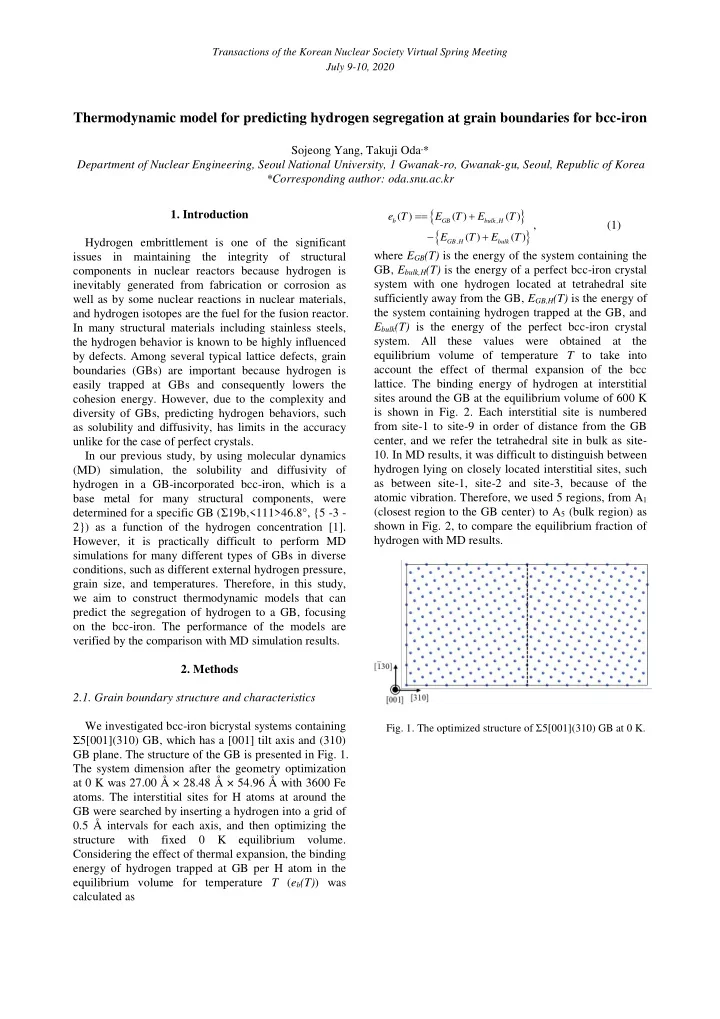
2.1. Grain boundary structure and characteristics We investigated bcc-iron bicrystal systems containing Ʃ5[001](310) GB, which has a [001] tilt axis and (310) GB plane. The structure of the GB is presented in Fig. 1. The system dimension after the geometry optimization at 0 K was 27.00 Å × 28.48 Å × 54.96 Å with 3600 Fe

  • atoms. The interstitial sites for H atoms at around the

GB were searched by inserting a hydrogen into a grid of 0.5 Å intervals for each axis, and then optimizing the structure with fixed 0 K equilibrium volume. Considering the effect of thermal expansion, the binding energy of hydrogen trapped at GB per H atom in the equilibrium volume for temperature T (eb(T)) was calculated as

   

, ,

( ) ( ) ( ) ( ) ( )

b GB bulk H GB H bulk

e T E T E T E T E T    

, (1) where EGB(T) is the energy of the system containing the GB, Ebulk,H(T) is the energy of a perfect bcc-iron crystal system with one hydrogen located at tetrahedral site sufficiently away from the GB, EGB,H(T) is the energy of the system containing hydrogen trapped at the GB, and Ebulk(T) is the energy of the perfect bcc-iron crystal

  • system. All these values were obtained at the

equilibrium volume of temperature T to take into account the effect of thermal expansion of the bcc

  • lattice. The binding energy of hydrogen at interstitial

sites around the GB at the equilibrium volume of 600 K is shown in Fig. 2. Each interstitial site is numbered from site-1 to site-9 in order of distance from the GB center, and we refer the tetrahedral site in bulk as site-

  • 10. In MD results, it was difficult to distinguish between

hydrogen lying on closely located interstitial sites, such as between site-1, site-2 and site-3, because of the atomic vibration. Therefore, we used 5 regions, from A1 (closest region to the GB center) to A5 (bulk region) as shown in Fig. 2, to compare the equilibrium fraction of hydrogen with MD results.

  • Fig. 1. The optimized structure of Ʃ5[001](310) GB at 0 K.

Transactions of the Korean Nuclear Society Virtual Spring Meeting July 9-10, 2020

slide-2
SLIDE 2

1 2 3 4 5 0.0 0.1 0.2 0.3 0.4 0.5

A5; bulk A4 A3 A2 A1

eb (eV) Distance from GB center (Å)

  • Fig. 2. The binding energy of hydrogen per atom at

interstitial sites around GB at the equilibrium volume of 600 K as a function of the distance from GB center.

2.2. Thermodynamic model with configurational entropy (model-1) To predict the segregation of hydrogen at GB, we constructed a thermodynamic model using equilibrium

  • theory. First, we applied a simple model assuming that

the contribution of vibrational entropy is negligible but the contribution of configurational entropy is high. Then, the Helmholtz free energy A is expressed as

 

10 ,

ln ,

H i b i i

A E TS N f e kT W     

(2)

 

10 1 10 1

ln ln ln ln ~ , ( )ln( )

i H i

n N f i i i i H i H i i i H i i H

W C n n f N f N n f N n f N

 

          

 

(3)

10 1

1,

i i

f

(4) where NH is the number of hydrogen in the MD system, which is 10 and 160 in this study, fi is the hydrogen fraction at site i, eb,i is the binding energy of hydrogen per atom at site i, k is the Boltzmann constant, and W is the number of possible configurations. When ni is the number of available sites for H atom and NHfi is the number of H atoms at an equilibrium state at site i, the number of possible configurations in the system is the multiplication of the possible configuration for each site, which is

i H i

n N f

C . The ni values in the current supercell are presented in Table 1. Then, using Starling’s approximation, lnW term can be expanded as presented in Eq. (3). In addition, the summation of the hydrogen fraction should be 1 as presented in Eq. (4). The equilibrium fraction of hydrogen at each interstitial site was calculated by minimizing the Helmholtz free energy A with respect to f1, f2, …, and f10, which is achieved by

1 10

0. A A f f       

(5)

Table 1. The number of available sites for H atom at each site; from n1 to n10.

n1 n2 n3 n4 n5 120 120 240 240 240 n6 n7 n8 n9 n10 240 240 240 240 19600 2.3. Thermodynamic model with vibrational entropy in addition (model-2) In model-2, not only the configurational entropy but also the vibrational entropy contributes to the Helmholtz energy, which is expressed as

   

 

10 10 ,

ln ,

conf vib H i b i H i i i i

A E T S S N f e kT W TN f s       

 

(6) where Svib is the vibrational entropy, and si is the vibrational entropy difference per H atom from site i with site 10 (bulk), which is used as the reference site. The vibrational entropy at each site was calculated by lattice dynamics under harmonic approximation [2]. Then, the equilibrium fraction of hydrogen at each interstitial site was calculated with the same procedure described in model-1. 2.4. Computational details for molecular dynamics simulation Classical molecular dynamics simulations were performed by using Large-Scale Atomic/Molecular Massively Parallel Simulator (LAMMPS) [3] to validate

  • ur thermodynamic models. Systems with bcc iron and

hydrogen were modelled by an embedded atom method (EAM) potential parameterized by Ramasubramaniam et al. [4]. In order to obtain the segregated fraction of hydrogen at the GB, GB systems with randomly inserted hydrogen of 10 or 160 H atoms were first equilibrated with NPT ensemble for 0.4 ns and then the production run was conducted with NVT ensemble for 30 ns at 600 K.

  • 3. Results and Discussions

The equilibrium fractions of hydrogen in the systems with the GB were obtained at 600 K by the MD simulation and by the thermodynamic models, which are compared in Fig. 3. In the case of the system with 10 H atoms (Fe3600H10), the model-2, which also includes vibrational entropy effects, performed better in reproducing MD results. In contrast, for the system with 160 H atoms, both models overestimated the hydrogen fraction at the GB, particularly at the A1 region, which is due to the interaction between H atoms. In Fig. 2, the

Transactions of the Korean Nuclear Society Virtual Spring Meeting July 9-10, 2020

slide-3
SLIDE 3

eb was calculated in the system with only one H atom. However, as the hydrogen concentration increases, H atoms can be located at the nearest interstitial sites around the GB and then the interaction between trapped H atoms changes eb values. Yamaguchi et al. [5]

  • bserved a decrease in eb value with increasing the

hydrogen concentration in bcc iron for Ʃ3(111) GB by first-principles calculations. This result implies that the binding energy of H atoms to the GB decreases due to the interaction between trapped H atoms, resulting in a lower fraction of hydrogen at GB than the fraction calculated on the assumption of non-interacting H atoms. For a better performance of the models, the quantitative analysis for the interaction between hydrogen is needed, which will be discussed in the presentation.

A1 A2 A3 A4 A5 0.0 0.2 0.4 0.6 0.8 1.0 A1 A2 A3 A4 A5 0.0 0.2 0.4 0.6 0.8 1.0

(a) MD Model 1 Model 2 H fraction Region index Fe3600H10 (a) (b) Fe3600H160 H fraction Region index MD Model 1 Model 2

  • Fig. 3. The equilibrium fractions of hydrogen resulted from

MD simulation, and thermodynamic models constructed in this study, with the systems of bcc iron Ʃ5[001](310) GB at 600 K; (a) Fe3600H10, (b) Fe3600H160.

  • 4. Conclusion

The segregation of hydrogen at GB interstitial sites and in bulk sites were predicted using two thermodynamic models based on the equilibrium theory. The first model considered only configurational entropy in the free energy, while in the second model, not only configurational entropy but also vibrational entropy contributed to the free energy calculation. For the verification of the results obtained by the models, MD simulation was used. At a low hydrogen concentration, the model that did not neglect the vibrational entropy in free energy calculation showed better performance. However, at a high hydrogen concentration, both the model considering only the configurational entropy and the model considering the vibrational entropy

  • verestimate the equilibrium fraction of hydrogen at the

GB because of the interaction between hydrogen. By including the effect of hydrogen interaction, we expect that the model can accurately predict the segregated fraction of hydrogen at the GB even at high concentrations of hydrogen, which will be discussed in the presentation.

  • 5. Acknowledgement

This work was supported by the R&D Program through the National Fusion Research Institute (NFRI) funded by the Ministry of Science and ICT of Republic

  • f Korea (Project-ID: 2017013297) and BK 21 Plus

project of Seoul National University. REFERENCES

[1] S. Yang, S. Yun, and T. Oda, “Molecular dynamics simulation on stability and diffusivity of hydrogen around a <111> symmetric tilt grain boundary in bcc-Fe,” Fusion Eng. Des., vol. 131, pp. 105–110, 2018. [2] J. J. Quinn and K.-S. Yi, Solid State Physics. Berlin, Heidelberg: Springer Berlin Heidelberg, 2009. [3] S. Plimpton, “Fast Parallel Algorithms for Short-Range Molecular Dynamics,” J. Comput. Phys., 1995. [4] A. Ramasubramaniam, M. Itakura, and E. A. Carter, “Interatomic potentials for hydrogen in α–iron based on density functional theory,” Phys. Rev. B, vol. 79, no. 17, p. 174101, 2009. [5] M. Yamaguchi, J. Kameda, K.-I. Ebihara, M. Itakura, and

  • H. Kaburaki, “Mobile effect of hydrogen on intergranular

decohesion of iron: first-principles calculations,” Philos. Mag.,

  • vol. 92, no. 11, pp. 1349–1368, 2012.

Transactions of the Korean Nuclear Society Virtual Spring Meeting July 9-10, 2020