An Urban Agenda for the Sun Belt Bill Fulton Director, Kinder - - PowerPoint PPT Presentation

an urban agenda for the sun belt
SMART_READER_LITE
LIVE PREVIEW

An Urban Agenda for the Sun Belt Bill Fulton Director, Kinder - - PowerPoint PPT Presentation

An Urban Agenda for the Sun Belt Bill Fulton Director, Kinder Institute for Urban Research June 11, 2020 Our Role Urban research institute studying Houston and, increasingly, Texas- and Sun Belt-wide issues Focused on education,


slide-1
SLIDE 1

An Urban Agenda for the Sun Belt

Bill Fulton

Director, Kinder Institute for Urban Research
June 11, 2020

slide-2
SLIDE 2

Our Role

  • Urban research

institute studying Houston and, increasingly, Texas- and Sun Belt-wide issues

  • Focused on education,

housing, transportation, governance and resiliency

slide-3
SLIDE 3
  • The Urban Sun Belt

accounts for 41% of all U.S. population growth

  • Most U.S. urban policy is

focused on NE/MW cities

  • Our paper highlights the

differences between Sun Belt urban areas and their counterparts elsewhere

Why Take On This Issue?

slide-4
SLIDE 4
  • Our work today is

meant to be the first word, not the last word

  • We don’t cover all

issues

  • Should there be a

Sun Belt urban agenda?

Why Take On This Issue?

slide-5
SLIDE 5

Large Sun Belt Metros Are …

  • Growing much faster

than their counterparts elsewhere

  • Adding more younger

and older residents

  • Adding many jobs,

but mostly in the highest- and lowest- paying sectors

slide-6
SLIDE 6

Large Sun Belt Metros Are …

  • Adding more poor

residents

  • Losing their housing

affordability advantage

  • More auto-dependent,

therefore they have high transportation costs and relatively low public transit ridership

slide-7
SLIDE 7

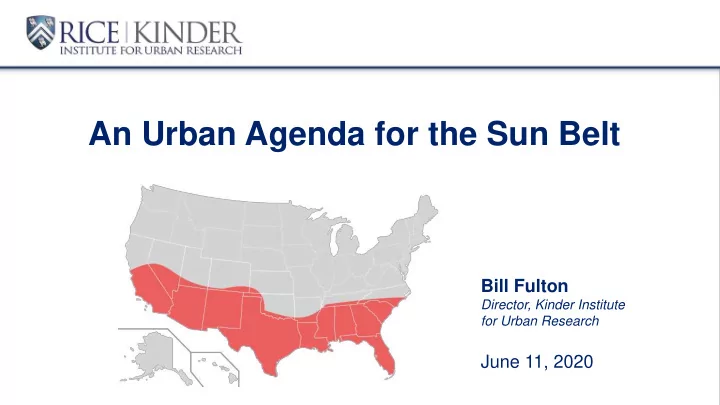
Defining the Sun Belt

  • 22 metro areas
  • f 1 million people or

more

  • Below the 36’30°

parallel

  • These metros

account for almost half of all U.S. population growth

slide-8
SLIDE 8

Growing much faster

slide-9
SLIDE 9

Adding more

  • ld and young
slide-10
SLIDE 10

Adding Latino and Asian residents quickly

slide-11
SLIDE 11

Shedding manufacturing jobs more slowly

slide-12
SLIDE 12

Adding service jobs more quickly

slide-13
SLIDE 13

Also shedding homeowners quickly

slide-14
SLIDE 14

And adding renters quickly

slide-15
SLIDE 15

Government Capacity

  • Government spending less

per capita than elsewhere in the U.S.

  • Many states have no

income tax, low property taxes, and high sales taxes

  • Local government

employment has been growing faster than elsewhere

slide-16
SLIDE 16
  • Philanthropies can

play a major role

  • Legacy cities have more

capacity than newer Sun Belt cities

  • Some Sun Belt business

centers are outliers

Philanthropic Capacity

slide-17
SLIDE 17

What Does An Urban Agenda For The Sun Belt Look Like?