
SLIDE 1
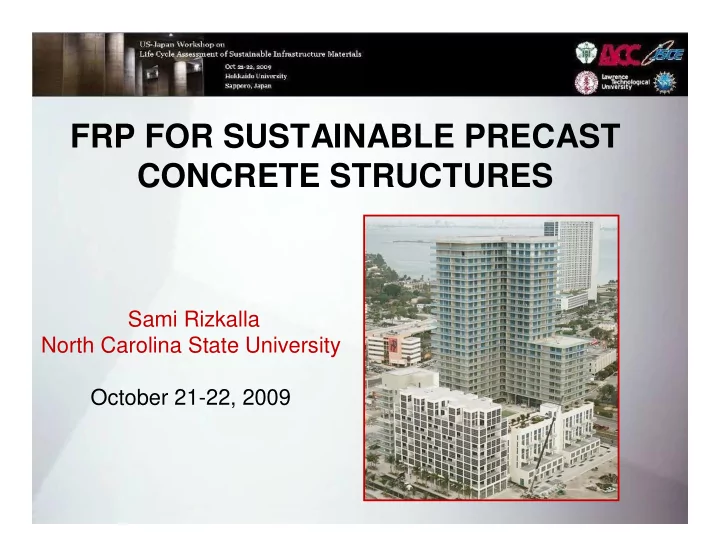
FRP FOR SUSTAINABLE PRECAST CONCRETE STRUCTURES
Sami Rizkalla North Carolina State University October 21-22, 2009
1
FRP FOR SUSTAINABLE PRECAST CONCRETE STRUCTURES Sami Rizkalla - - PowerPoint PPT Presentation
FRP FOR SUSTAINABLE PRECAST CONCRETE STRUCTURES Sami Rizkalla North Carolina State University October 21-22, 2009 1 Underground Precast Utility Tanks 2 1993 Beddington Trail Bridge First Bulb-Tee bridge girder pre- tensioned with CFRP
1
2
First Bulb-Tee bridge girder pre- tensioned with CFRP tendons
No signs of degradation when tested in July 2008, after 15 years of service
3
Instrumentation of the girder before casting First AASHTO Girder prestressed and Reinforced with CFRP CFRP stirrups
Route 40 Bridge, Virginia
4
Bending Resistance
Confinement effect
100 200 300 400 500 600 700 2 4 6 8 10 12 strain (µε) load (kN)
Axial Resistance
5
5.8 t 12 t
6
7
Thin flange susceptible to chloride penetration CFRP Grid replacement for WWF conventional steel
8
Carbon grids are manufactured in an automated process: – High production volume – High quality control
9
10
10
11
machine to place the grid
performance
for human error
12
Uniformly distributed applied load Experimental Program
13
14
15
16
Initial Cracking: DT1 DT2
17
Failure Mode DT1 2” thick flange
18
Failure Mode DT1 2” thick flange
19
“Failure” Mode DT2 3.5” thick flange
20
2” thick flange – Midspan
0.1 0.2 0.3 0.4 0.5 0.6 0.7 0.8 2 4 6 8 10 12 Distance along DT Profile (ft.) Measured Vertical Deflection (in.) Ultimate Service Factored 0.2 0.4 0.6 0.8 1 1.2 1.4 1.6 1.8 2 2 4 6 8 10 12 Distance along DT Profile (ft.) Measured Vertical Deflection (in.) Ultimate Service Factored
3.5” thick flange – Midspan
21
Failure load = 11,300 lbs
22
23
24
and a layer of rigid foam.
connectors
25
Discrete Continuous
26
– Orthogonal CFRP Grid – Cut at a 45-degree angle to develop truss action – Structurally and thermally efficient
27
28
Carbon fiber grid shear connectors:
between wythes
due to low thermal conductivity of the connector
Typical Cross Section
Exterior Interior Carbon Fiber Shear Connector Wythe Reinforcement Pilaster
28
29
5000 10000 15000 20000 25000 0.0 0.5 1.0 1.5 2.0 2.5 Lateral Deflection (in) Lateral Load (lbs) 22 44 67 89 111 0.00 1.27 2.54 3.81 5.08 6.35 Lateral Deflection (cm) Lateral Load (kN) Representative EPS Panel Service Load Ultimate Load Composite Non-composite
30
31
1.2D+0.5Lr+1.6W150 EPS 2
32
Flexural-shear failure
Panel Separation
33
34
composite load-deflection relationships were calculated following PCI guidelines.
exp x nc c nc
g cr a cr g a cr eff
I I M M I M M I ≤ − + =
3 3
1
g g cr a cr cr eff
I I I M M I I ≤ − − = 1 1
2
Valid only for Ig/Icr < 3.0
determined based on deflections as follows:
35
O I u
action compsoite full the At curvature given the At
36
CFRP grid 5.5 in. (140 mm) spacing
CFRP grid 3.5 in. (89 mm) spacing
8-Node solid elements for foam and concrete Truss elements for C-Grid
37
2 4 6 8
100 300 500 Strain x 106
Experimental Rational model FEA
Panel Thickness (mm) 50.8 101.6 152.4 203.2 Panel Thickness (in)
Inner wythe
Outer wythe
Tension Compression
Outer wythe
38
Fire testing
39
40
41
42
43
44
FRP Connector:
Composite Panel Non-composite Panel
45
NO thermal bridging Thermal bridging
46
47
Vertical Back Ribs Intermediate ribs attached to architectural façade with CFRP grid to avoid discoloration or ‘shadowing’
48
Intermediate ribs attached to architectural façade with CFRP grid to avoid discoloration or ‘shadowing’
49
Primary vertical rib Secondary vertical rib Carbon fiber grid in the panel face for crack control
6” Typical
50
Placement of CFRP grid reinforcement for architectural facade
51
Foam rib forms Steel reinforcing of structural frame
FRP shear grid between frame and facade
52
B3 B4 D C
DC-10 Line B Line C
53
Inward pressure (suction) Outward pressure
54
55