ST ST 13:Fiber ST ST 13:Fiber 13:Fiber Reinforced Concrete - - PowerPoint PPT Presentation

st st 13 fiber st st 13 fiber 13 fiber reinforced
SMART_READER_LITE
LIVE PREVIEW

ST ST 13:Fiber ST ST 13:Fiber 13:Fiber Reinforced Concrete - - PowerPoint PPT Presentation

ST ST 13:Fiber ST ST 13:Fiber 13:Fiber Reinforced Concrete 13:Fiber Reinforced Concrete Reinforced Concrete Reinforced Concrete Incorporating Recycled Concrete Fines Incorporating Recycled Concrete Fines ST ST 14: Green Concrete


slide-1
SLIDE 1

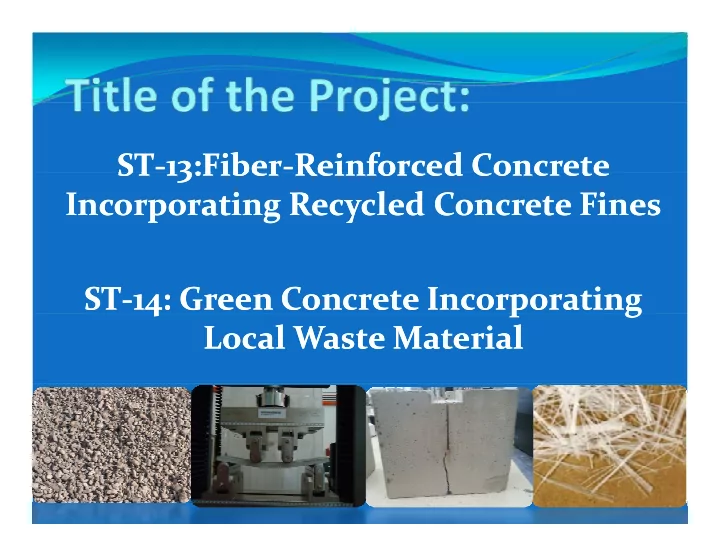
ST ST‐13:Fiber 13:Fiber‐Reinforced Concrete Reinforced Concrete ST ST 13:Fiber 13:Fiber Reinforced Concrete Reinforced Concrete Incorporating Recycled Concrete Fines Incorporating Recycled Concrete Fines ST ST‐14: Green Concrete Incorporating 14: Green Concrete Incorporating 4 p g 4 p g Local Waste Material Local Waste Material

slide-2
SLIDE 2

Recycled Concrete Fines & Engineered Cementitious

g Composities

Enhanced greenness of ECC Effect of RCF on ECC mechanical properties

ff f

Effect of RCF on ECC on mirco structure aspect using

Micromechanics Model

slide-3
SLIDE 3
slide-4
SLIDE 4
  • Importance of the reuse construction and

d li i demolition waste

  • Property of RCF

High water absorption

slide-5
SLIDE 5
  • A class of ultra ductile fiber

reinforced cementitious composites

Normal ECC Composites Water, Cement, Fiber, S d Additi Sand, Additives Mitaka Dam near Hiroshima

slide-6
SLIDE 6

N l C t Engineered Cementitious Normal Concrete Engineered Cementitious Composities (ECC)

Taken from: https://www.youtube.com/watch?v=tsGfCCY4_Gw

slide-7
SLIDE 7

Hi h E i t l b d Hi h E i t l b d High Environmental burden High Environmental burden

Vi C Li D l f G E i d C i Victor C. Li, Development of Green Engineered Cementitous Composites For Sustainable Infrasture Systems

Due to high cement content and introduction of PVA fib fibers

slide-8
SLIDE 8

S l i f C S l i f C Supplementation of Cement Supplementation of Cement

C3S + H2O C‐S‐H + CH CH + SiO SiO2 C‐S‐H

Present in Ground Granulated Blast Furnace Slag (GGBS) GGBS content Compressive Strength Ductility % I D 10 – 30% Increase Decrease 55 – 59 % Increase Decrease > 69% Decrease Increase

slide-9
SLIDE 9

Supplementation of Supplementation of A Aggregates ggregates

Lack of aggregates Lack of aggregates

  • Normal ECC

Composites RCF‐ECC Composites Water, Cement, Fiber, Sand, Additives Water, Cement, Slag, Fiber, Recycled Concrete Fines(RCF), Additi Additives

slide-10
SLIDE 10

S lf S lf i C t i C t Self Self‐sensing Concrete sensing Concrete

slide-11
SLIDE 11

Obj ti Obj ti Objective Objective

Enhanced the Enhanced the Green Greenness of ECC ness of ECC

Investigate the effect of RCF on GGBS‐ECC of its

mechanical properties p p

Self‐sensing measurement setup for future research

slide-12
SLIDE 12

S Scope Scope

Compressive Strength Flexural Strength & Deflection Self‐sensing measurement setup stability

slide-13
SLIDE 13
slide-14
SLIDE 14

Mix Design Mix Design Mix Design Mix Design

Natural aggregates RCF Cement Cement + GGBS

RCF PVA

RCF Cement + GGBS

Group 1 Cement Slag Water/B1 RCF/B size/mm fiber2 SP3/ B RS‐1 1 0.8 0.25 0~0.6 2% 0.5% RS‐2 1 0.8 0.25 0.2 0~0.6 2% 0.8% RS‐3 1 0.8 0.25 0.5 0~0.6 2% 0.8% RS‐7 1 0.8 0.25 0.2 0~0.3 2% 0.8% 7 5 3 RS‐8 1 0.8 0.25 0.2 0~1.18 2% 0.8% RS‐9 1 0.8 0.25 0.2 0~2.36 2% 0.8%

1.B=cement+slag; 2. Percentage by volume; 3.SP=superplasticizer.

slide-15
SLIDE 15

Mi D i Mi D i Mix Design Mix Design

Group 1 RCF Content Group 2 RCF size/µm

RS‐1 RS‐7 0‐300 RS‐2 0.2 RS‐3 0.5 RS‐2 0‐600 RS‐8 0‐1180 RS‐9 0‐2360

slide-16
SLIDE 16

C b C i T t C b C i T t

Experimental Procedures

Cube Compression Test Cube Compression Test

Load Cell Concrete Specimen

slide-17
SLIDE 17

Cylinder Compression Test Cylinder Compression Test

Experimental Procedures

Cylinder Compression Test Cylinder Compression Test

Load Cell 10mm LVDT Concrete Specimen p Magnetic Stand

slide-18
SLIDE 18

4 i t B di T t 4 i t B di T t

Experimental Procedures Loading Pins

4 point Bending Test 4 point Bending Test

  • ad

g s Concrete Specimen Supporting Pins

slide-19
SLIDE 19

S lf S i M t S lf S i M t

Experimental Procedures

Self Sensing Measurement Self Sensing Measurement

Pl i Sh Plastic Sheet Copper Wire

slide-20
SLIDE 20

S lf S i M t S lf S i M t

Experimental Procedures

Self Sensing Measurement Self Sensing Measurement

AC current source Digital Multimeter

slide-21
SLIDE 21
slide-22
SLIDE 22

D it D it Density Density (g/cm3) (g/cm3)

The degree of compactness of a substance

slide-23
SLIDE 23

Compressive Compressive Compressive Compressive Strength Strength (28 days) (28 days) (28 days) (28 days)

The resistance of the concrete to break under compression

slide-24
SLIDE 24

Compressive Compressive Compressive Compressive Strength Strength (90 days) (90 days) (90 days) (90 days)

The resistance of the concrete to break under compression

slide-25
SLIDE 25

Compressive Compressive

Group 2- RCF sizes

Compressive Compressive Strength Strength Comparison Comparison Comparison Comparison

slide-26
SLIDE 26

Fl l S h C l l i Fl l S h C l l i Flexural Strength Calculation Flexural Strength Calculation

slide-27
SLIDE 27

Flexural Strength V Deflection Flexural Strength V Deflection

Group 1- RCF content

(28 days) (28 days)

slide-28
SLIDE 28

Flexural Flexural

Group 1- RCF content

Flexural Flexural Strength Strength & & Deflection Deflection Deflection Deflection (28 days) (28 days)

Flexural strength is a l' b l material's ability to resist deformation under load

slide-29
SLIDE 29

Flexural Strength V Deflection Flexural Strength V Deflection

Group 2- RCF sizes

(28 days) (28 days)

slide-30
SLIDE 30

Flexural Flexural

Group 2- RCF sizes

Flexural Flexural Strength Strength & & Deflection Deflection Deflection Deflection (28 days) (28 days)

slide-31
SLIDE 31

Flexural Strength V Deflection Flexural Strength V Deflection

Group 2- RCF sizes

(90 days) (90 days)

slide-32
SLIDE 32

Flexural Flexural

Group 2- RCF sizes

Flexural Flexural Strength Strength & & Deflection Deflection Deflection Deflection (90days) (90days)

slide-33
SLIDE 33

Flexural Flexural

Group 2- RCF sizes

Flexural Flexural Strength Strength Comparison Comparison Comparison Comparison (90days) (90days)

slide-34
SLIDE 34

Group 2- RCF sizes

Deflection Deflection Comparison Comparison Comparison Comparison (90days) (90days)

slide-35
SLIDE 35

Self Self‐sensing sensing Measurement Measurement Measurement Measurement

Change in resistivity under compression

1

2 3

slide-36
SLIDE 36

1.

Compressive Strength drop as RCF content increase

2.

A slight drop then rise in compressive strength as RCF i i RCF size increase D i f i i RCF d i

3.

Decreasing σ for increasing RCF content and size with RS9 as exceptional

4

Decreasing deflection for increasing RCF and size

4.

Decreasing deflection for increasing RCF and size

slide-37
SLIDE 37

Future studies on RS 9 as it display a higher

flexural strength which is contract to the g trend in flexural strength and deflection.

To develop a more accurate tensile behavior

  • f the ECC uniaxial tensile test which pull
  • f the ECC, uniaxial tensile test which pull

the specimen could be used.

slide-38
SLIDE 38
slide-39
SLIDE 39

C it T il Composite Tensile Ductility

Steady‐state crack analysis

Fiber Bridging Property (σ‐δ) across cracks

crack analysis Micromechanics

Fiber, Matrix, Interface

slide-40
SLIDE 40

Aim: Achieve the tensile strain hardening behavior Aim: Achieve the tensile strain‐hardening behavior Energy Criteria: Energy Criteria:

σ0 Jb σss Jtip

Crack Tip l

δss δ0

tip

Crack Tip Toughness Complementary Energy

ss

slide-41
SLIDE 41

Chemical Bond Strength Constant friction bond strength g Slip Hardening Coefficient

Complementary Energy

slide-42
SLIDE 42

Fracture Toughness

slide-43
SLIDE 43

Li, V C., On Engineered Cementitious Composites (ECC) A review of the Material and Its Applications. Journal of Advanced Concrete Technology Vol 1 No 3 2003 pp215‐230 Technology Vol 1, No 3, 2003, pp215‐230

slide-44
SLIDE 44

Determine the interfacial properties and matrix toughness properties Evaluation of the effects of RCF content and particle size on ECC tensile properties based on micromechanics model

slide-45
SLIDE 45
slide-46
SLIDE 46

Single Fiber Pullout Test

slide-47
SLIDE 47

Matrix Toughness Test

Particle Size: 0 0 6mm Particle Size: 0‐0.6mm

slide-48
SLIDE 48
slide-49
SLIDE 49
slide-50
SLIDE 50

Actuator Aluminum Plate Specimen Mount 10 N Load Cell X‐Y table

slide-51
SLIDE 51

Free Length Specimen Thickness=1 1mm Thickness 1.1mm

slide-52
SLIDE 52

A t t Actuator Clip Gauge Wedging Device Steel loading d i i h ll Clip Gauge Wedging Device device with roller bearings Specimen

slide-53
SLIDE 53
slide-54
SLIDE 54

RCF Size RCF Size (0 (0‐0.6 0.6μm) m) Gd Gd (J/m^2) (J/m^2) Ʈ (Mpa Mpa) ) β Jb Jb’ ’ (J/m^2) (J/m^2) RS1 RCF/B=0 1.0162 2.4300 0.5196

10.14

RS2 RCF/B=0.2 0.5475 2.4041 0.2504

11.25

RS3 RCF/B=0.5 0.2623 2.6177 0.1956

11.47

slide-55
SLIDE 55
slide-56
SLIDE 56

RCF RCF Content Content (0.2) (0.2) Gd Gd (J/m^2) (J/m^2) Ʈ (Mpa Mpa) ) β Jb Jb’ ’ (J/m^2) (J/m^2) RS7 RS7 (0‐0.3mm)

1.4241 2.1450 0.4582 9.75

RS2 (0‐0.6mm)

0.5475 2.4041 0.2504 11.25

RS8

0 5697 1 8858 0 1760 12 72

(0‐1.18mm)

0.5697 1.8858 0.1760 12.72

RS9 (0‐2.36mm)

0.2438 2.1604 0.3180 13.37

slide-57
SLIDE 57
slide-58
SLIDE 58
slide-59
SLIDE 59

Graph of Km Graph of Km vs vs RCF Content RCF Content

Li, V C., On Engineered Cementitious Composites (ECC) A review of the Material and Its Applications , 2003

slide-60
SLIDE 60
slide-61
SLIDE 61

To evaluate the effect on the RCF content

slide-62
SLIDE 62

To evaluate the effect on the RCF size

slide-63
SLIDE 63
slide-64
SLIDE 64

1

Jtip and Jb’ increases with both RCF

1.

Jtip and Jb increases with both RCF content and size.

2

Jb’/Jtip shows both decreasing trend for

2.

Jb /Jtip shows both decreasing trend for increasing RCF content and size which is not desirable to achieve the strain‐ not desirable to achieve the strain hardening behavior.

3

RCF is not desirable material to replace

3.

RCF is not desirable material to replace sand in the ECC

slide-65
SLIDE 65
  • 1. To determine a more accurate experimental

work the Young modules for every mix should work, the Young modules for every mix should be determined as the RCF-ECC is different from the conventional concrete.

  • 2. Further research could be done to determine

the optimal amount of RCF content and size that achieve the maximum strain hardening effect which is beneficial to the construction effect which is beneficial to the construction industry.

slide-66
SLIDE 66
slide-67
SLIDE 67