
SLIDE 1
18TH INTERNATIONAL CONFERENCE ON COMPOSITE MATERIALS
1 Introduction With the development of processing technology of high performance thermoplastic polymers, light- weight structural applications for fiber reinforced thermoplastic composites are expanding rapidly in a number of sectors because thermoplastic composites have potential to achieve high-cycle and low-cost manufacturing and high recyclability in contrast to thermosetting composites [1][2]. Above all, polypropylene (PP), by itself or with other polymers, has been widely applied to automotive structural members such as bumper faces and interior parts because of high toughness and simple fabrication techniques [3][4]. The wide practical use of such polymer components has been supported by the advanced vehicle body design with use of various computer simulation techniques. Complying with this trend, Japanese METI-NEDO project has been developing a new type of advanced thermoplastic composite materials, carbon fiber reinforced thermoplastic composites (CFRTP), which are composed of surface treated carbon fiber (Mitsubishi Rayon) and maleic-acid modified polypropylene (TOYOBO), aiming to apply to the automobile main frame structures for the purpose of significant reduction of vehicle weight [2][5]. In particular, the main frame structural members of automobiles are required high energy absorption for collision safety. With increasing expectation of wide applications for the developed CFRTP, it is getting more important to predict the impact energy absorption by crash simulation. For this, it is essential to evaluate the mechanical properties and
- btain the fracture behavior of the materials applied
to the vehicle structure. This study focused on the fracture behavior of the thermoplastic composites, observing the fracture phenomenon and investigating the yield stress dependent on the strain-rate. 2 Observation of Impact flexural behavior in high-speed three-point bending test 2.1 Experimental setup In tensile test for carbon fiber reinforced plastics (CFRP), a high-speed photography has great effect in explanation of the fracture behavior of high- strength CFRP [6]. At first in this study, a high- speed camera (Hyper Vision HPV-1 by SHIMADZU)
- bserved
the dynamic flexural behaviors of the CFRP in high velocity three point bending test by using the impact tower (Dynatup by Instron), which has a recording system of load and
- deflection. A specimen with rectangular cross
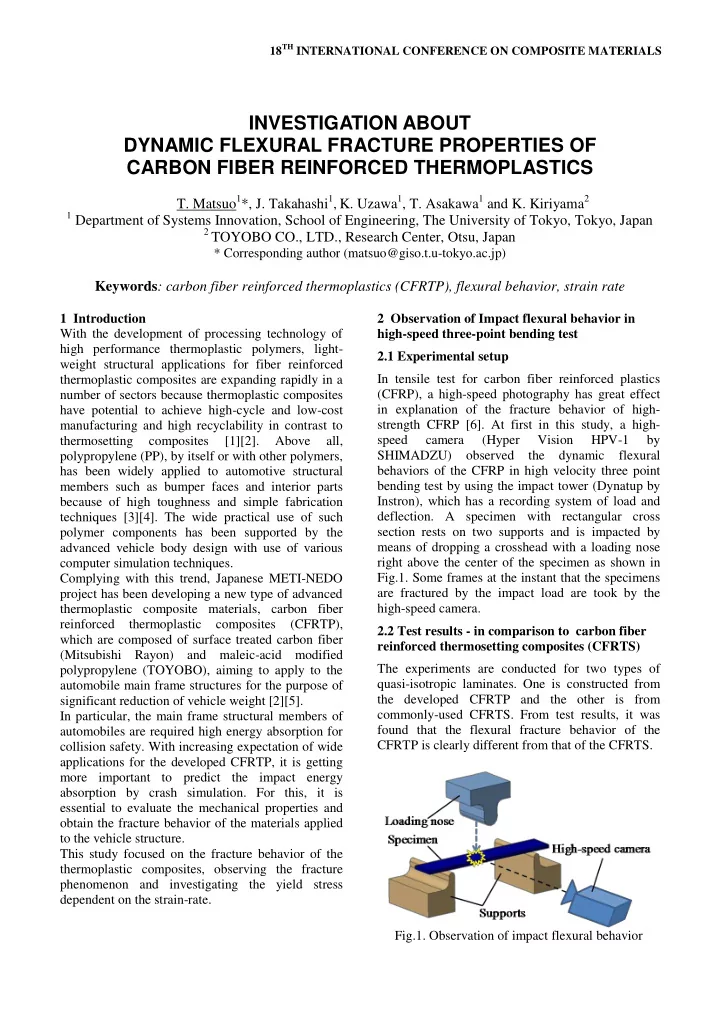
section rests on two supports and is impacted by means of dropping a crosshead with a loading nose right above the center of the specimen as shown in Fig.1. Some frames at the instant that the specimens are fractured by the impact load are took by the high-speed camera. 2.2 Test results - in comparison to carbon fiber reinforced thermosetting composites (CFRTS) The experiments are conducted for two types of quasi-isotropic laminates. One is constructed from the developed CFRTP and the other is from commonly-used CFRTS. From test results, it was found that the flexural fracture behavior of the CFRTP is clearly different from that of the CFRTS. Fig.1. Observation of impact flexural behavior
INVESTIGATION ABOUT DYNAMIC FLEXURAL FRACTURE PROPERTIES OF CARBON FIBER REINFORCED THERMOPLASTICS
- T. Matsuo1*, J. Takahashi1, K. Uzawa1, T. Asakawa1 and K. Kiriyama2