for offshore trawl vessels CSP Project MIT2013/05 J Cleal & J - - PowerPoint PPT Presentation

for offshore trawl vessels
SMART_READER_LITE
LIVE PREVIEW

for offshore trawl vessels CSP Project MIT2013/05 J Cleal & J - - PowerPoint PPT Presentation

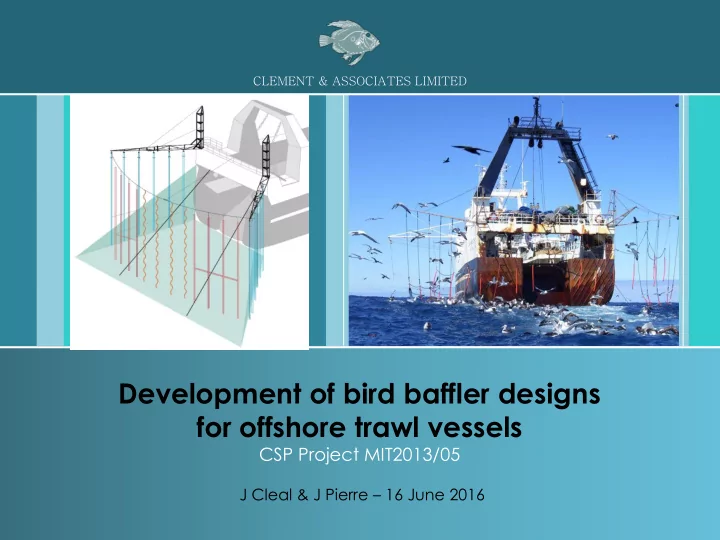
CLEMENT & ASSOCIATES LIMITED Development of bird baffler designs for offshore trawl vessels CSP Project MIT2013/05 J Cleal & J Pierre 16 June 2016 Introduction Seabirds foraging on trawler fish waste discharge can strike trawl


slide-1
SLIDE 1

CLEMENT & ASSOCIATES LIMITED

Development of bird baffler designs for offshore trawl vessels

CSP Project MIT2013/05

J Cleal & J Pierre – 16 June 2016
slide-2
SLIDE 2

Clement & Associates Ltd | www.fishinfo.co.nz

Introduction

  • Seabirds foraging on trawler fish waste discharge can strike trawl

warps

  • Managing fish waste discharge to reduce the amount and time that
  • ffal is around the trawl warps reduces the risk of warp strikes
  • A secondary mitigation approach is to provide a barrier protecting the

trawl warps to reduce seabird access

slide-3
SLIDE 3

Clement & Associates Ltd | www.fishinfo.co.nz

Baffler Mitigation Devices

Example – Four-boom baffler

slide-4
SLIDE 4

Clement & Associates Ltd | www.fishinfo.co.nz

Project Objectives: MIT2013-05

The specific objectives:

  • 1. To design and construct one or more improved bird baffler design(s).
  • 2. To conduct at sea trials of the improved baffler(s) in order to assess

efficacy and utility of the design.

  • 3. To produce recommendations on the construction of bird baffler designs

in a variety of media in order to maximise uptake in commercial fisheries.

slide-5
SLIDE 5

Clement & Associates Ltd | www.fishinfo.co.nz

Current Warp Mitigation Devices

  • Three mandatory devices for deepwater trawlers over 28 m:

1. Tori lines – all carry these 2. Warp deflector (clips onto warp) – not used 3. 2 or 4 boom bafflers – almost all use as their primary device. 30% use a 4-boom system.

  • 2 or 4 boom bafflers are of varying designs:
  • generally 4 to 5 m long booms, droppers spaced 1.5 to 2 m apart
  • ften droppers are ropes hanging down to water, with approx 1 m
  • f orange plastic cone fitted at the end of each dropper
  • most 4-boom bafflers have aft droppers removed, or very short aft

droppers to avoid tangling with trawl warps

  • most baffler designs don’t enclose the warp
slide-6
SLIDE 6

Clement & Associates Ltd | www.fishinfo.co.nz

Baffler Mitigation Devices

Two Boom Four boom - San Waitaki

  • FV. San Waitaki: first vessel to run aft droppers between the

aft booms to endeavour to get droppers over the full WDZ

slide-7
SLIDE 7

Clement & Associates Ltd | www.fishinfo.co.nz

Prototype – I (Pole System)

  • Design developed with input from experts, skippers, observers (Dec

2013)

  • Warp more enclosed
  • Main operational improvement:
  • adjustable boom angle (wider angle so boom/droppers still provide

‘cover’ when warps move outboard of the hull

  • position aft booms outside warps
  • droppers wont tangle around the warp
  • New configuration: rope between the two aft booms and droppers

hanging astern, providing ‘curtin around the warp

  • Design failed due to unresolvable engineering challenges with

supporting and securing the pole astern the vessel

slide-8
SLIDE 8

Clement & Associates Ltd | www.fishinfo.co.nz

Prototype – I (Pole System)

slide-9
SLIDE 9

Clement & Associates Ltd | www.fishinfo.co.nz

Prototype – II (Gate System)

  • Lighter construction and lower cost than Prototype I
  • One set of 10 m gates
  • Retained the concept of adjustable booms to optimise warp protection
  • Multiple design attempts
  • Naval architects couldn't find a safe and practical way to secure the gates

in place once deployed

slide-10
SLIDE 10

Clement & Associates Ltd | www.fishinfo.co.nz

Prototype – II (Gate System)

Below: port gate deployed, note side-bracket to give more angle of attack for stay-wires (like ‘stays’

  • n a yacht mast)

Lines astern show angles the warp moves outboard of the hull

slide-11
SLIDE 11

Clement & Associates Ltd | www.fishinfo.co.nz

Prototype – III (Tower & Boom System)

  • Final testing design, built and fitted to the vessel
  • 6 m support-tower
  • 8.4 m boom weighing 1 ton per side
  • Load meant decks required strengthening before installation
slide-12
SLIDE 12

Clement & Associates Ltd | www.fishinfo.co.nz

Prototype – III (Tower & Boom System)

Starboard view: Old 2 boom-pole and New tower & boom baffler

slide-13
SLIDE 13

Clement & Associates Ltd | www.fishinfo.co.nz

Prototype – III (Tower & Boom System)

  • To maximise warp protection, target boom

length was 10 m

  • Engineering loads and safety issues

required shorter boom: 10 m to 8.4 m

  • Booms would otherwise dip and roll in

heavy seas

  • Booms are lifted and deployed using a ‘lazy-

wire’ and vessel existing winches

  • A safety chain fixed between the boom &

tower holds booms at 10 degrees above horizontal

  • Locking pins on the towers fix booms

upright when not in use

  • Boom and tower install: Nov 2015
slide-14
SLIDE 14

Clement & Associates Ltd | www.fishinfo.co.nz

Prototype – III (Dropper System)

  • Load testing at Hampidjan NZ Ltd to determine load on booms
  • Port side: ‘conventional’ dropper system of rope and plastic pipe
  • Stern curtain: red 25 mm diameter hose
  • Weak link in stern curtain to release if one boom was lost at sea
  • Starboard side: new dropper design of 38 mm diameter hose
slide-15
SLIDE 15

Clement & Associates Ltd | www.fishinfo.co.nz

Prototype – III (Dropper System)

  • 11 mm diameter ‘Kraton’ streamer material in centre of stern curtain
slide-16
SLIDE 16

Clement & Associates Ltd | www.fishinfo.co.nz

At sea testing - baffler trials

  • Preliminary testing:
  • One day transit trip
  • Crew tested boom

deployment and retrieval

  • Made changes to locking-pins
  • Added extra droppers to stern

curtain to reduce bird access

slide-17
SLIDE 17

Clement & Associates Ltd | www.fishinfo.co.nz

At sea testing - baffler trials

  • Preliminary testing:
  • One day transit trip
  • Company observer
  • Tested dropper system
  • Considered booms too high and dangerous for crew to access
  • New sliding rail system fitted
  • each dropper loaded on a roller within a track
  • all can be lifted or lowered into position like a curtain rail
slide-18
SLIDE 18

Clement & Associates Ltd | www.fishinfo.co.nz

At sea testing - data collection

  • Crew observations, 23 December 2015 – 13 January 2016
  • normal fishing trip
  • minor design modifications made after return to port e.g. addition of

rope cleats

  • Two government fisheries observers, 24 January – 28 February 2016
  • fishing trip targeting hoki
  • observations recorded on data collection form
  • photos and video
slide-19
SLIDE 19

Clement & Associates Ltd | www.fishinfo.co.nz

Final tested design

slide-20
SLIDE 20

Clement & Associates Ltd | www.fishinfo.co.nz

At sea testing - Results

  • Government fisheries observers: 47 forms, 06:00 – 20:00 NZST
  • Observation periods: 20 – 35 mins (mean = 24 mins)
  • Vessel tow speeds: 3.9 – 4.2 kn
  • Beaufort sea state: 1 – 6
  • Droppers and stern curtain: 0 – 1.0 m

from sea surface

  • Exposed warp:
  • 0.5 – 2 m in calm conditions,
  • 0 – 4 m in 5-m swells
  • 0 – 2 m during vessel turns
slide-21
SLIDE 21

Clement & Associates Ltd | www.fishinfo.co.nz

  • Kraton streamers in centre of stern curtain tangled
  • Hose droppers more effective than rope and pipe

system

  • Tangled less, more durable,

better warp coverage

  • Stern curtain broke in a gale

(40 – 45 kn)

  • Was readily repaired and

redeployed next morning

At sea testing - Results

slide-22
SLIDE 22

Clement & Associates Ltd | www.fishinfo.co.nz

  • Most birds remained outside the area enclosed by the

boom droppers and stern curtain

  • Birds inside during 26 obs periods with offal
  • Outside during 8 periods with
  • ffal
  • Outside during 13 periods

with no offal

  • Salvin’s, Buller’s albatross
  • White-chinned, Cape and giant

petrels

  • Birds sometimes caught up on

lowest rope for a few seconds

At sea testing - Results

slide-23
SLIDE 23

Clement & Associates Ltd | www.fishinfo.co.nz

At sea testing - Recommendations

  • Increase height of lowest ropes to approx. 2 m
  • Replace Kraton noodles in centre stern curtain

with hose

  • Extending the booms 1.5 – 2 m in length by

attaching a lighter-weight pipe could increase warp protection while not risking the loss of the main tower and boom structure

  • Address friction and strength of rope ties

(knots wearing out) at the top of the hose droppers on booms and stern curtain

slide-24
SLIDE 24

Clement & Associates Ltd | www.fishinfo.co.nz

Discussion

  • Design challenges exemplary of what must be considered for real-

world fishing operations

  • Prototype III baffler expensive at around ~$40,000
  • Twice the cost of a conventional 4-boom baffler
  • Five times the cost of a 2-boom device
  • Many times the cost of two tori lines!
  • Design challenges and vessel scheduling also caused time delays
  • Some warp still exposed with the final design
  • Vessel trawls 500 – 800 m depths
  • More warp would be exposed with shallower trawls
  • Govt observers reported baffler was the best-performing seen in NZ’s

deepwater trawl fleet

slide-25
SLIDE 25

Clement & Associates Ltd | www.fishinfo.co.nz

Acknowledgements

  • Talley’s Group Ltd
  • Sanford Ltd
  • Sealord Group Ltd
  • FV Ocean Dawn: vessel managers, engineers, skipper and crew
  • Observers: P. Fullerton, R. Guild, D. Murray
  • MPI Observer Services Unit
  • K. Ramm and CSP