
SLIDE 1
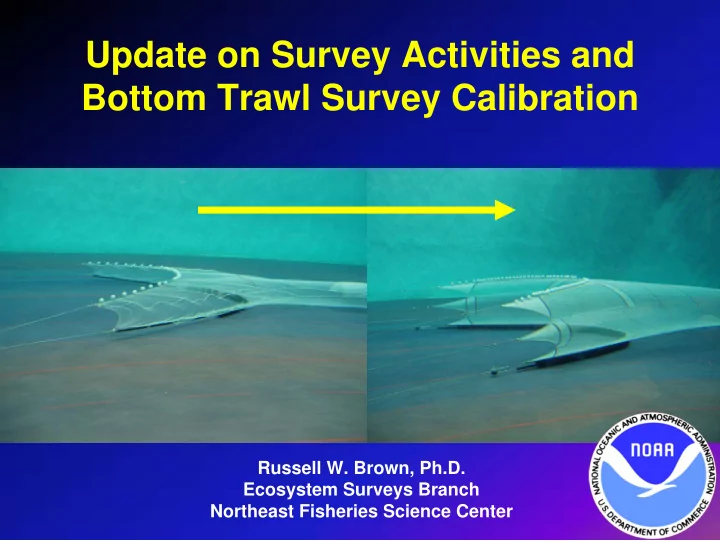
Update on Survey Activities and Bottom Trawl Survey Calibration
Russell W. Brown, Ph.D. Ecosystem Surveys Branch Northeast Fisheries Science Center
Update on Survey Activities and Bottom Trawl Survey Calibration - - PowerPoint PPT Presentation
Update on Survey Activities and Bottom Trawl Survey Calibration Russell W. Brown, Ph.D. Ecosystem Surveys Branch Northeast Fisheries Science Center Presentation Overview Current and Upcoming Survey Activities Review of New Trawl Survey
Russell W. Brown, Ph.D. Ecosystem Surveys Branch Northeast Fisheries Science Center
– RV Albatross IV and FSV Henry Bigelow – March 3, 2008 – May 16, 2008
– RV Hugh R. Sharp (University of Delaware) – June 21 – July 8, 2008 & July 28 – August 7, 2008 – Plan to use modified survey dredge redesigned cooperatively through the Scallop Survey Advisory Process
– RV Delaware II – June 30 – August 7, 2008 – Transition to Industry Vessel (Clam Advisory Process)
– RV Gloria Michelle (22 sea days) – July 20 – August 16, 2008
– RV Delaware II – September – October, 2008
– RV Albatross IV and FSV Henry Bigelow – September – November, 2008
Turtle Takes and a NEPA Environmental Assessment
sizes (multispecies survey)
minimum sampling between the wing ends and doors (minimal herding)
performance”
IV towing Yankee 36) to a higher efficiency sampling tool (Bigelow towing 400 X 12 Four Seam Trawl)
– Trends in abundance and biomass – Biological information including size and age composition, sex, maturity, diet composition
can meet these objectives
will meet these objectives, hopefully with lower variability
inspires confidence
27.7 cm 105.2 cm
Wingspread 12 - 13 m Overspread Wingspread ~ 12 – 14 m Not Overspread
Inconsistent Bottom Contact Consistent Bottom Contact
Headrope Height ~ 1.9 – 2.0 m Headrope Height 4.0 – 5.0 m
Larger Mesh further back in net Loss of smaller fish Fine Mesh for Small Fish Retention
12 cm – 6 cm – 3 cm
Flume Tank Testing 400 X 12 cm Four Seam Trawl
June 1-3, 2005 Marine Institute, Memorial University
1:7 scale model Changes to net design made after this modeling effort
– Winch lock to winch engage
water
water and with slow retrieval
– Delaware catches 10-40% more fish – Hypothesis: differences in winch speed translating in greater effective bottom time for Delaware
Bottom Winch Lock Winch Engage
Target Tow Time 30 minutes Actual Bottom Time 33 minutes
– Start Tow:
information (height sensor, depth sensor, changes in door spread)
– End Tow:
times are generally in seconds (not minutes)
– Standardization of effective tow time becomes more critical with shorter target tow times
Bottom Winch Lock Winch Engage
Actual Tow Time 20 minutes
Start Tow
– Albatross/Delaware: 30 minutes – Bigelow: 20 minutes
– Time savings is in the catch handling and processing
– Ability to occupy stations in areas limited by fixed gear, bad bottom – Avoid unnecessarily killing fish
– Balance tension between trawl warps – Optimize orientation of flow into the net using an acoustically reporting flow sensor in the mouth of the net
– Straight warps vs. Autotrawl (tension) vs. Autotrawl (Net sensor) – Autotrawl (tension) provided most consistent gear performance across a variety of conditions
– Apparent offset to one side much of the time – Did not correspond to equal tension on trawl warps – System less dynamic than observed on other vessels
– Rapp-Hydema tech rep on vessel to diagnose and solve system performance issues – Tech rep noted that warp tensions (averaging 1.8 tons) were low relative to system design capabilities – System adjustments seemed to solve performance issues
– Bigelow propulsion issues do not allow for adequate evaluation of Autotrawl system performance
– Autotrawl system performance issues are apparent again
– Removed one winch motor – Replaced a second winch motor with a larger motor to provide future flexibility relative to system sensitivity – Completed software modifications relative to different motor configuration
evaluation
– Changed the data “feed” to allow for simultaneous viewing and recording of both the calculated wire out based on winch drum rotation and a separate instrumented wire counter
System at one second intervals during tows
– Port= 546.5kg (1205lbs) – Starboard= 546.5kg (1205lbs)
10 20 30 40 50 50 100 150 200 250 Depth (m) Door Spread (m)
Overspread Underspread
10 20 30 40 50 50 100 150 200 250 Depth (m) Door Spread (m)
10 20 30 40 50 50 100 150 200 250 Depth (m) Door Spread (m)
– FV Albatross IV & Delaware II – FSV Henry B. Bigelow
– Yankee 36 Bottom Trawl – Modern Trawl Gear Designed in Conjunction with Stakeholders
– Tow speed – Tow duration – Setting/Hauling
RV Albatross IV FRV Henry B. Bigelow
2 4 6 8 10 12 14 16 1960 1980 2000 2020 2040 Mean Catch / Tow Albatross
10 20 30 40 50 60 70 1960 1980 2000 2020 2040 Mean Catch / Tow Albatross Bigelow
Overlap of two boats
10 20 30 40 50 60 70 1960 1980 2000 2020 2040 Mean Catch / Tow Albatross Bigelow Bigelow Converted
10 20 30 40 50 60 70 1960 1980 2000 2020 2040 Mean Catch / Tow Albatross Bigelow Albatross Converted
– Paired towing at most stations where depth not limiting
– Paired towing targeting specific species and/or habitats of concern
– Paired towing at most stations where depth not limiting
– Paired towing targeting specific species and/or habitats of concern
– Lots of discussion about “vessel effects” – Presence of one vessel affecting the catch of the other
attempt to estimate the “vessel effects”
and spatially to reduce possibility of vessel effects
variability with increased distance and/or time
Albatross Tow (30 min @ 3.8 knots) Bigelow Tow (20 min @ 3.0 knots) } Average Distance = 1.9 nm Average Distance = 1.0 nm Spatial Offset Target = 0.4 nm Acceptable Range: 0.25 – 0.55 nm
Spatial Offset Target = 0.5 nm Acceptable Range: 0.25 – 0.75 nm
Albatross Tow (30 min @ 3.8 knots) Bigelow Tow (20 min @ 3.0 knots) Temporal Offset Bigelow Tows Starts 25 minutes later Acceptable Range: 20-45 minutes later Temporal Offset Bigelow Tow Finishes 15 minutes later Acceptable Range: 10-35 minutes later
England and most of Georges Bank
Albatross survey tows
reasons:
– Draft Issues / Too Shallow (Bigelow, 17.5%) – Mechanical Issues (either vessel, 7.5%) – Space limitations (towable bottom, fixed gear, 1.3%) – Tear Up or Gear Performance Issues during the tow (1.3%)
during the design phase of the experiment
Bank and into the Gulf of Maine
20 40 60 80 100 20 40 60 80 100 Albatross Catch (Numbers or Weight) Bigelow Catch (Numbers or Weight) Pelagics Strongly Demersal Flatfish/Skates Round fish e.g. spiny dogfish Albatross/Yankee Catch Higher Bigelow/Four Seam Catch Higher
February 6-8, 2007 NEFMC Meeting Portsmouth, NH “That the Trawl Survey Advisory Panel recommends as specified in technical addendum: a three bridle four seam 400 X 12 cm net; use of one of two sweeps (1 rockhopper or 1 cookie); 66” type IV thyboron door (or doors with equivalent performance, i.e. 4.5 to 5.5 meter head rope height, 12.5 to 14.5 meter wing spread, and 30 to 35 meter door spread at 3.2 knots) to be utilized for future bottom trawl surveys on the FSV Henry B. Bigelow.”
process
efficient sampling tool
to ensure consistency
Albatross survey with the new Bigelow survey