
SLIDE 1
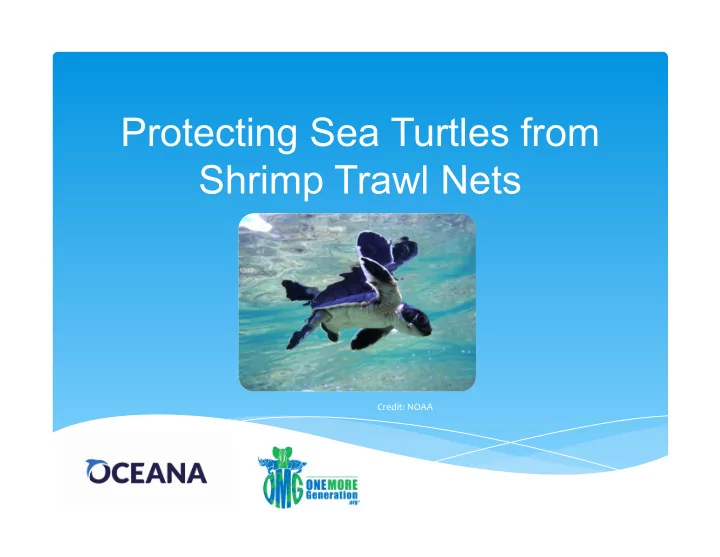
Protecting Sea Turtles from Shrimp Trawl Nets
Credit: ¡NOAA ¡
Protecting Sea Turtles from Shrimp Trawl Nets Credit: NOAA - - PowerPoint PPT Presentation
Protecting Sea Turtles from Shrimp Trawl Nets Credit: NOAA Whats the Problem? Not all shrimp boats are required to use Turtle Excluder Devices (TEDs) * The government estimates that 50,000 sea turtles drown every year in shrimp
Credit: ¡NOAA ¡
* The government estimates that 50,000 sea turtles drown every year in shrimp trawl nets in the South Atlantic and Gulf of Mexico. * While federal regulations require that certain types of nets use Turtle Excluder Devices (TEDs), not all types are required to do so.
Not all shrimp boats are required to use Turtle Excluder Devices (TEDs)
Credit: ¡Oceana/Mar ¡Mas ¡
* Bycatch is the catch of non- target fish and ocean wildlife. * The southeast shrimp trawl fishery throws back 64% of what it catches, exceeding 229 million pounds of wasted fish and
* This is as much as 4 times the weight of the State of Liberty!
Credit: ¡NOAA ¡
* TEDs are metal grates inserted in trawl nets that allow captured sea turtles to escape.
Mandate that all shrimp boats are required to use Turtle Excluder Devices (TEDs)
* When used properly, they are 97% effective at preventing sea turtle deaths in shrimp trawls! * They also allow other large critters such as rays, sharks and larger fish to escape
Credit: ¡NOAA ¡
* Require all shrimp trawls to use TEDs. * Research by the U.S. Fishery Service suggests that reducing the space between a TED’s bars by just 1 inch can reduce fish Bycatch by 25%,
pounds! It would also allow smaller turtles to escape.
* Sea turtles help maintain healthy sea grass beds and coral reefs that provide key habitats for other marine life and help balance marine food webs.
Credit: ¡NMFS ¡ Credit: ¡USGS ¡
… and all are already listed as endangered or threatened.
Green Loggerhead Leatherback Kemp’s ridley Hawksbill
Credit: ¡Oceana/Eduardo ¡Sorensen; ¡Carlos ¡Minguell; ¡David ¡Plange; ¡Melissa ¡Forsyth; ¡Carlos ¡Suárez ¡
* Smallest of the sea turtles * Only about 1,000 breeding females exist worldwide * Nest in mass synchronized groups called arribadas (Spanish for “arrival”)
Credit: ¡National ¡Park ¡Service ¡ Credit: ¡USEPA ¡
* Largest of the sea turtles (up to 8 feet and 1,300 lbs) * Instead of a bony shell, they have leathery connective tissue * Can swim more than 10,000 miles every year
Credit: ¡USFWS ¡ Credit: ¡Oceana/David ¡Plange ¡ ¡
* Eggs in a loggerhead nest that is below 82˚F will produce more males, while a nest above 85˚F will produce mostly females * Have callus-like traction scales that allow them to walk on the ocean floor
Credit: ¡NOAA ¡ Credit: ¡USFWS ¡
* Name comes from their fat and
green because of a herbivorous diet of sea grass and algae * Can live for over 80 years * Can lay 200 eggs at a time
Credits: ¡NOAA ¡
* Females return to their natal beaches every 2-3 years to nest * Have been hunted for hundreds of years for their beautiful shell, known as “tortoise shell” * Feed almost exclusively
Credit: ¡NIST ¡
* Visit OneMoreGeneration.org for more information * You can also scan and email your letters and pictures to us at info@onemoregeneration.org or usa.oceana.org/turtles to learn more! Please send by May 23, 2016.
¡Oceana ¡ ¡
Attn: ¡Save ¡Sea ¡Turtles ¡ ¡ 1350 ¡Connecticut ¡Ave. ¡NW ¡ 5th ¡Floor ¡ ¡ Washington, ¡DC ¡20036 ¡ ¡
¡One ¡More ¡Generation ¡ ¡
Attn: ¡Save ¡Sea ¡Turtles ¡ ¡ P.O. ¡Box ¡143627 ¡ Fayetteville, ¡GA ¡30214 ¡