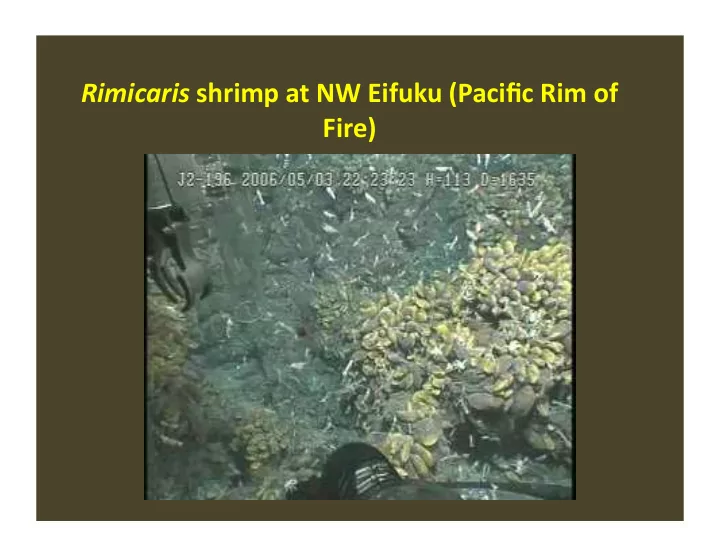
Rimicaris shrimp at NW Eifuku (Pacific Rim of Fire) Shrimp ( - - PowerPoint PPT Presentation
Rimicaris shrimp at NW Eifuku (Pacific Rim of Fire) Shrimp ( Cypridina hilgendorfii ) uses bioluminescent vomit to avoid preda6on 41 st SaasFee course from Planets to Life 39 April 2011 Lecture 5 Origin of Life and its Early Evolu6on on
Shrimp (Cypridina hilgendorfii) uses bioluminescent vomit to avoid preda6on
41st Saas‐Fee course from Planets to Life 3‐9 April 2011 Lecture 5 ‐ Origin of Life and its Early Evolu6on on Earth
Abbreviated history of origin of life ideas: metabolism versus replica6on
- Darwin’s warm liKle pond (LeKer to Joseph Hooker, 1 Feb.
1871)
- Oparin‐Haldane ‐ Life started in a prebio6c soup
- RNA world (Gilbert, 1986)
- RNA catalysis preceded and led to metabolism (Eigen, Orgel
etc, 1980’s)
- Dyson (1985) ‐ ATP produced and consumed by protein‐based
- rganisms led to RNA from accumulated AMP; Kauffman, 1998
broadened Dyson’s idea so as to include other polymers and metabolites (autocataly6c sets)
- Metabolic reac6ons catalyzed by pyrites under hydrothermal
vent condi6ons (Wächtershäuser, 1988); Experimental evidence provided by Cody and others (2001‐2004); Eschemosser (2006), autocataly6c metabolic systems may be possible.
Outline
- BoKom‐up approach to the origin of life
– Sources of organic compounds – Chemical reac6ons to make biologically relevant
- rganic compounds
- Replicator first
– RNA as both the “Chicken and egg”
- Metabolism‐first
– “sparseness” of organic compounds favor metabolism – Metabolism needed to synthesize RNA
Bottom Up Approaches
Top Down Approaches
(Infer from extant life)
a) Settings for the origin of life b) Ancient physiologies (T°C, ±O2 etc) c) “Ancient” metabolisms (autotrophy vs heterotrophy) d) Ribozymes and the RNA world and models for the origin of the code e) Early replicators: ribozymes, ancient viruses, minerals, etc f) Origin of catalytic proteins
Organic precursors
(multiple sources) Metabolic circuits
RNA world
Genetic code and protein synthesis
Encapsulation?
DNA life
From Shen & Buick 2005
CO2, CO
The pathway leading to life (Earth)
- 1. Forma6on and concentra6on of organic precursor
compounds and organic catalysts
- 2. Condensa6on and polymeriza6on
- 3. ??? RNA, protein, protometabolism
- 4. ??? The gene6c code, ribosomes etc
- 5. “Unity of biochemistry”: selec6on of the fiKest genes,
biochemistry etc before the separa6on of the three domains of life
- 6. Transi6on from RNA to DNA
- 7. The three domains of life
– The origin of eukaryotes
A living en>ty?
Loca>on, loca>on, loca>on
Linked?
BoKom‐up approaches to origin of life studies: Five broad topics
1) Sources or organic precursors to life and chirality selection of d- and l-isomers 2) Synthesis of biopolymers 3) Metabolism versus “replicator” as the first step leading to cells 4) The origin of nucleic acids, the genetic code, and the evolution of the “central dogma” and the first evolving entity 5) Settings for the different steps (still unknown) in the origin of life and how settings can affect the
- utcomes in 1, 2 and 3
SPACE ATMOSPHERE
LIGHTNING IDP’S, COMETS, METEORITES, SHOCK SYNTHESIS UV CATALYSIS
OCEAN CRUST PHOTOREDUCTION OF CARBON
HYDROTHERMAL ORGANIC SYNTHESIS
REDUCED INORGANIC SPECIES
SOURCES OF ORGANIC CARBON ON THE PREBIOTIC EARTH ‐ Includes many of the organic building blocks of life
Peridotite-hosted hydrothermal vent
magma
From Schopf,2002
The Building Blocks – The first experiment
Urey, Miller 1953 – from Schopf, 2002 & Smith, Szathmary,1995
Organic Chemistry of Carbonaceous Meteorites
COMPOUNDS CM OCCURRENCE BIOLOGY
Biochemical Building Blocks
Amino acids
Fatty acids Glycerol Phosphate Purines Pyrimidines Ribose Phosphate + + + +
Others
Alcohols
Aldehydes Amides Amines Carboxylic acids Hydrocarbons Ketones Phosphonic acids Sulfonic acids Sulfides
Membranes Nucleic acids
+ + ‐ +
Proteins
+ + + + + + + + + +
Synthe6c organic reac6ons poten6ally occurring
- n the early Earth
- Gas phase reac6ons
– Reduced gases (H2, CH4, NH3, H2) + energy (heat, electric discharge, UV etc) → Cyanide (HCN) and formaldehyde
- Reac6ons producing water‐soluble products
– HCN → purines (e.g. adenine) – HCHO → simple sugars (glyceraldehyde, glucose) – HCN + HCHO → amino acids (Strecker synthesis)
- Reac6ons producing water insoluble products (hydrocarbon
deriva6ves)
– CO, H2 + heat, iron catalyst → hydrocarbons and amphiphiles (long‐chain faKy acids, alcohols) (Fisher‐Tropsch reac6ons)
- Polymeriza6on reac6ons (least undestood)
– Amino acids + dry heat → pep6de bonds (protein‐like polymers) – Glyceraldehyde → polyglyceric acid – Purines, pyrimidines, sugar, phosphate → nucleic acids
The BIG gap
- We know how to synthesize many of the
- rganic compounds required by life but we
know liKle about how to incorporate these compounds into “useful” macromolecules
- While it is generally believed that RNA
preceded DNA, we don’t know if it can be synthesized under “environmental condi6ons” in contrast to how we synthesize in a laboratory
The two compe6ng models for the
- rigin of life: “Replicator first”,
“Metabolism first”
Both models involve encapsula6on into small cell like structures usually formed by lipids
(From Shapiro, 2007)
Shapiro favors a “metabolism first” model; his model also starts in an organic soup except that organic compounds are incorporated into compartments that have a beKer chance of developing into a network of autocataly6c cycles and eventually into an informa6on macromolecule.
The Shapiro builds on an idea first discussed by Freeman Dyson (1999) and summarized in one of his famous quotes: “Life began with liKle bags, the precursors of the cell, enclosing small volumes of dirty water containing miscellaneous garbage.”
The “Central Dogma” (left) and the RNA world (right). The transition from the RNA world to the DNA world is thought to have required “reverse transcription”. There are reverse transcriptase enzymes in some RNA viruses including the AID’s virus (Figure from De Duve, 1995)
The “Replicator first” model predicts that RNA preceded DNA, protein and metabolism
The RNA world – a compelling model
- RNA ‐ The all purpose molecule
– Templates in chemical systems – Informa6on storage and retrieval – Catalysis
- Self‐splicing
- Self‐reproducing (self‐cleaving)
- Pep6de forma6on
- RNA combines genotype and phenotype: self‐
replica>on permits Darwinian evolu>on
- The goal is to understand how a protein‐free RNA
world became established on the primi6ve Earth ‐ led to the “Molecular Biologists Dream”
RNA and DNA
RNA with its nitrogenase bases to the llen and DNA with its nitrogenase bases to the right
The Ribosome: brown is RNA and blue is proteins. The ribosome contains 4 RNA molecules >50
- proteins. The ribosome
is the site where mRNA’s code is translated so as to form specific proteins
A ribozyme that func6ons as an RNA‐dependent RNA polymerase
RNA molecule that can make copies of RNA from an RNA template Requires an RNA template and RNA primer (like in the PCR reac>on) and a mixture
- f the 4 nucleo>des.
It can make an RNA molecule that is only 14 bases long ‐ more work on this is needed
Some progress on the RNA world
Recent research results on the RNA world
- Ribose and nucleo>des have been synthesized
abio>cally (in some cases under unrealis>c early earth condi>ons)
- Polymeriza>on of nucleo>des (oligonucleo>des
20‐50 mers)
– Clays (Huang and Ferris 2006) – Eutec6c phase of water‐ice (Monnard et al., 2003) – Lipid‐bilayer lapces (Rajamani et al., 2007)
- S>ll needed:
– RNA polymerase ribozyme capable of self replica6on – Insight on the emergence of the RNA code (not dependent on the RNA polymerase ribozyme) – The origin and evolu6on of the ribosome – Linking metabolism and replica6on in a “compartment” (the emergence of a “cell”)
The “Molecular Biologists Dream” ‐ a scenario for the origin of the RNA world (from Orgel, no date)
The Scenario:
First, forma>on of precursors to nucleic acids on Earth or elsewhere and accumula>on on Earth Next, nucleo6des were formed from prebio6c bases, sugars and phosphates and accumulated in some “special” environment. Next, a mineral catalyst such as a mineral like clays then catalyzed the forma>on of long single‐stranded polynucleo>des some of which were converted to complementary double strands by template‐directed synthesis ‐ this resulted in a “library” of double‐stranded RNA on the primi>ve Earth Next, among the double‐stranded RNAs there is at least one that on mel6ng yields a single‐stranded ribozyme capable of copying itself and its complementary RNA ‐ this would eventually lead to an exponen6ally growing popula6on subjected to Darwinian evolu6on
Summary of outstanding problems with the RNA world
- Sources (source reac6ons) of the precursors to
RNA (nucleo6des, ribose* and phosphate)
- Abio6c synthesis of RNA from precursors
- The transi6on RNA to self‐replica6ng RNA (RNA
catalysis)
- The transi6on from a self‐replica6ng RNA to the
“gene6c code”, transla6on and transcrip6on
- The origin of the ribosome
- The transi6on from RNA to DNA
*Ribose demonstrated to be synthesized in the presence of boron
minerals (Ricardo et al., Science 2004)
Encapsula6on and the emergence of “cell‐ like” structures
(From Deamer 2007)
Encapsula6on of macromolecules during a drying‐wepng cycle. (A) If liposomes are mixed with soluble proteins or nucleic acids and dried, the liposomes produce a mul6lamellar structure in which the macromolecules are “sandwiched” between lipid layers. Upon rehydra6on, vesicles form that encapsulate up to half of the soluble macromolecules. (B) Electron micrograph of a 2:1 (wt/wt) mixture of mixture of dioleoytlphospha6dylcholine‐salmon tes6s DNA aner drying, showing the fused mul6lamellar structure. (C) Fluorescence micrograph of the lipid‐DNA mixture following rehydra6on. Acridine orange was used to stain the DNA captured in large vesicles (From Deamer, 1998, 2004)
Encapsula6on of RNA and protein by lipid membranes
Lipid bilayer showing the hydrophilic polar head (a`ract H2O) on the outside and the hydrophilic tails inside. These lipid compounds (amphiphiles) self‐ assemble into biolayer structures
(From Deamer 2007)
Forma6on of membrane vescles from mixtures of meteoric amphiphilic compounds (lipid vesicles, monolayers etc) Transmission electron micrograph showing that almost all of the vescles have a membrane surrounding an internal mass of non‐membraneous material. At higher magnifica6on (insert) the membrane shows the trilaminar structure typical of bilayer membranes
From Deamer, 1998
The protocell model from Mansy and Szostak,
PNAS 2008; Cold Spring Harbor Press 2009
Schema6c model of a protocell. A replica6ng vesicle enables spa6al localiza6on, and a replica6ng genome encodes heritable informa6on. A complex environment provides nucleo6des, lipids, and various sources of energy, including mechanical energy for division, chemical energy for nucleo6de ac6va6on, and phase transfer and osmo6c gradient energy for growth.
Cold Spring Harbor Press 2009
Cycles of vesicle growth and division. A spherical mul6cellular vesicle grows aner the addi6on of faKy acid micelles by the forma6on of a thin
- protuberance. This grows over 6me un6l the ini6ally spherical vesicle
transforms into a filamentous vesicle. Gentle agita6on leads to division into daughter vesicles, which in turn can grow and repeat the cycle.
DNA strand separa6on and reanealing in vesicles (Mansy and Szostak, PNAS 2008)
Strand separa6on inside vesicles (Black lines) DNA strands labeled with donor and quencher dyes. When annealed to each other, fluorescence is low. (Open lines) Unlabeled DNA strands. Following strand separa6on and reannealing, the donor and quencher oligonucleo6des are separated, resul6ng in a high fluorescence signal.
Conclusion from Mansy and Szostak
The requirement for cycling between low and high temperature for nucleic acid copying and strand separa6on strongly suggests that freshwater ponds or springs in a generally cold environment, locally heated by geothermal ac6vity as a volcanic region, would be an ideal incuba6on of life.
What did Earth look like at the 6me life
- riginated?
Summary of encapsula6on models
- Small lipid‐membrane structures were an early
stage in the origin of life
– These structures some6mes call “micells” form spontaneously when the lipids are accumulate
- The lipid‐membrane structures can self‐replicate
- The lipid‐membrane structures, when exposed to
wet‐and‐dry cycles can entrap macromolecules (nucleic acids and proteins)
- The nucleic acids entrapped in lipid‐membranes
can divide if exposed to a high‐ and low‐ temperature cycle (like the Polymerase Chain Reac6on)
“Protometabolism”
- The need for high concentra6ons of organic
compounds that are the core of macromolecules (purines, pyrimidines, amino acids, faKy acids etc)
- Generate cataly6c organic compounds (CN,
CO, formate, formaldehyde, etc)
- Chemical energy (thioesters?) to drive more
complex organic reac6ons Can you get “protometabolism” from a soup?
“Sparseness” is a hallmark characteris6c of metabolism (from Shelly Copley)
Aquifex aeolicus Metabolism uses a very limited (sparse) set of
- rganic molecules. Aquifex aeolicus grows on CO2,
H2, O2 and NH3 and at 95°C The total organic compounds in the metabolome is 162 small organic compounds (<160 daltons)
Photo: SteKer and Rachel
All possible small organic molecules (C, N, H, O) with a MW of <160 daltons = >14
million (does not include
many aroma6c and heterocyclic compounds) (Fink et al., 2005)
Metabolism versus Replica6on, cont.
A “Protometabolic” network is necessary for the con6nuous
synthesis of organic precursor compounds to proteins and nucleic acids; The “thioester world” (De Duve, 1991).
The key to protometabolism is the thioester bond, a high energy bond that supports energy‐requiring reacNons (DeDuve, 1995)
“The requirements for both life and protometabolism are essen6ally the same: (1) a sustained source of energy driven by chemical disequilibrium origina6ng from either geological processes or sunlight, and (2) the presence of certain elements, in par>cular transi>on metals, to provide cataly>c poten>al for synthesis of
- rganics” Cody and ScoS, 2007
Ini6al stages of the acety‐CoA pathway, highligh6ng the extensive use of transi6on metals and sulfur. Migra6on and inser6on of the CO between the methyl group and the Ni atom yields the acetyl group. The acetyl group is transferred to a biochemical co‐factor yielding acetyl‐CoA providing the ini6a6on point to the acetyl‐CoA metabolic pathway. (Cody and ScoK, 2007)
CH3 transferred to a cobalt atom than to nickel atom (Ni‐X‐Fe4S4) “A” CO2 reduced to CO and transferred to an iron atom in the Fe4S4 cluster
Environmental sources of CO2, H2 and metals.
The acetyl‐CoA pathway
“New findings from the enzymes at the heart of the acetyl‐CoA pathway, carbon monoxide dehydrogenase and acetyl‐CoA synthase, indicate that metals and metal sulfides do the biochemical work of CO2 fixaNon” (Russell and Mar6n, 2004)
Acetyl‐CoA is a thioester
The acetyl‐CoA pathway showing the posi6on of metals at various steps (This is a hydrogen dependent pathway)
The presence of a sustaining chemistry‐ genera6ng‐system preceded RNA instruc6on
- New evidence suppor6ng some kind of proto‐
metabolic system producing the precursors to RNA synthesis
PNAS 104:9358‐9363, 2007 along with other modeling papers 2010, 2011
The authors suggest that modern metabolism involving proteins originated in nucleo6de metabolism. “The first enzyma6c takeover of an ancient biochemistry or prebio6c chemistry involved processes related to the synthesis of nucleo6des for a world in which RNA was the only gene6cally encoded catalyst.” The authors also point
- ut how liKle we know about how the RNA
world transi6oned into modern biochemistry.
“Our findings suggest that modern metabolism developed early at the
- nset of protein discovery and had
- rigins that benefited the forma6on of
building blocks for the RNA world”.
Synthesis of nucleodides bases and ribose, and polymerase into RNA
A popular model for the development of the gene6c system (Goldman et al., 2010)
Goldman et al., 2010
Conclusion from Goldman et al., 2010
- A func6onal ribosome existed during the RNA
world
- All of the ribosome proteins tested had only
the ancient 9 protein folds
- Most of the proteins used by extant life
evolved during and aner the separa6on of the three domains of life
What is the origin of these metal dependent metabolic pathways?
1) Minerals, minerals, minerals 2) Some early ideas about minerals and the
- rigin of life
Cairns‐Smith Clay Model for the origin of life Clay crystals
Crystal growth and “muta6on”
Condense organic compounds (clays as templates and reac6ve surfaces)“organic takeover”
Macromolecules Cells Crystal growth occurs by addi6on of units
- f the kink edge of a con6nuous ramp
spiraling around the central core Informa6on stored in crystals as a group of crystal “defects” that can be replicated through cleavage and crystal growth
Examples of possible reac>ons involving pyrite based on pyrite having a ca>onic surface in which a variety of anionic reac>ons are possible. The example in (A) is the adsorp>on of glyceraldehyde‐3‐phoshate to the surface followed by polymeriza>on. (B) Par>cipa>on of pyrite in a reac>on that can drive and otherwise energe>cally unfavorable reac>on. For example, the reduc>on of CO2 by H2 has a posi>ve Gibbs free energy reac>on. However, if CO2 reduc>on is linked to the pyrite reac>on the synthesis of formic acid is energe>cally favorable
Organic reac>on on pyrite surfaces under hydrothermal condi>ons (Wächterhäuser, 1988, 1998)
Pyrite
Wächterhäuser Model 1980’s Pyrite Organic synthesis and condensa6on “surface metabolites” Informa6on Macromolecules CELLS Russell Model 1990’s FeS membranes (bubbles formed from a mix of acidic seawater and alkaline hydrothermal fluid) Organic synthesis (ΔEh across membrane) Metabolic pathway Condensa6on reac6ons Informa6on macromolecules CELLS
Models for the origin of life in vent environments
How to get high concentra6ons of useful organic compounds?
- Specific synthesis – requires catalysts
(minerals)
- Very limited data at the present 6me, but
preliminary data looks very promising
Keep in mind that the cataly6c reac6ons carried out by proteins in present‐day organisms was very likely carried out by minerals before the gene6c code and ribosomes were fully developed
Mineral surfaces that may be involved in the origin of life (Modified from Deamer, 2007)
Mineral Surface Properties Lava minerals Si, O, Fe Major mineral surface on early Earth Apatite Ca, PO4
2-
Primary phosphate mineral Clays Si, Al, O Can organize organics into films and catalyze polymerization reactions Pyrite FeS2 Source of reducing power Calcite CaCO3 Chiral surfaces; concentrate
- rganics such nucleotides from
models Quartz SiO2 Chiral surfaces Ultramafic minerals Fe, Mg Generate hydrogen and organic compounds from CO2 Borate minerals B Catalyze the synthesis of ribose Elemental composi6on
Mineral Needs
- Catalyze metabolic networks that involve
the reduc6on of CO2 to organic compounds.
- There is a need to iden6fy the cataly6c
ability of other minerals under different T/ pH condi6ons (minerals that mimic known enzyme groups: oxidoreductases, transferases, hydrolases, lyases, isomerases and ligases)
We can accomplish this by looking at minerals that contain the metals that are present in different minerals and examine their cataly>c ac>vity under the environmental condi>ons that they can form and remain stable
Are there realis6c early‐Earth sepngs that support the “metabolism first”, or the “replicator first” and the encapsula6on models? What about the source sites of cataly6c minerals?
- The answer is there is much we
don’t know
Billion years from human
Origin of Earth (4.5 Gya) Cyanobacteria (the rise of O2) Origin of life?
Thermophilic methanogens, S reducers (thermophilic N‐fixa6on) 4 3 2 1 Anoxygenic photosynthe>c bacteria?(anaerobic)
Accumula6on of O2 Single celled eukaryotes
(beginning of prey/predator associa6ons?)
Algal kingdoms Shelly invertebrates Vascular plants Mammals Humans Time of transi6on from anaerobic microbial ecosystems to aerobic microbial/eukaryo6c ecosystems
Early Earth temperature and O2 produc6on and accumula6on are controversial issues
4 3 2 1 0 1033 1031 1029 1027 1025 1023 1021
K/T Ty
3000 30 0.3 0.003
Time (Ga) Water evaporated (m) Impact energy (J)
- rigin of life
The largest bolide impacts on the Earth and the Moon. Light gray filled boxes are lunar, black filled boxes terrestrial. Red line is inferred earth impact history. Dashed blue line is depth of ocean vaporized by impact. K/T refers to the Cretaceous/Tertiary impact and Ty refers to the lunar crater Tycho (From Sleep et al., 1989)
Life may have started during the heavy bombardment period
- heavy bombardment, while rendering the
- cean water column and any landmass that
may have existed uninhabitable, would not have removed all water from the subsurface and thus would not have sterilized the Earth, but would have resulted in widespread impact‐volcanism (Abramov and Mojzsis, 2009). Did life originate in the subsurface and did volcanism play a role?
Geological sites relevant to the origin of life (Modified from Deamer, 2007)
(modified from Deamer 2007)(
SITE PROPERTIES
Inter-tidal zones, tide-pools, sand Fluctuating environment can concentrate organic solutes Fresh water ponds, lakes Moderate T°C ranges. Low mineral content can be conducive to self-assembly processes. Impacted by lightning, bolides etc. Ice fields Organics can be concentrated in eutectics within ice. Low T°C preserves organic compounds Subterranean geothermal regions T°C range from moderate (40-60°C) to boiling. Reducing power available Magma-hosted Hydrothermal vents T°C range from 2°C (present day) to >400°C with everything in between . Multiple gradients in physical and chemical
- conditions. Reducing power and catalytic minerals available
Peridotite-hosted Hydrothemal vents T°C to >90°C, pH up to 11; high concentrations of CH4, formate, acetate and low MW hydrocarbons; porous calcite for concentration of organic compounds Atmosphere, clouds Water droplets as “cell-like” enclosures for synthesis of complex
- rganic compounds using UV light
Radioactive Beaches (Adam, Astrobiology 2007) The possible role of Actinides (elements with atomic numbers between 89-103) in the abiotic synthesis of organic compounds, polmerization reactions; P release from minerals
The sepngs and metabolism of the earliest microbial communi6es
- All evidence points to hydrogen as the earliest
source of chemical energy (both non‐ photosynthe6c and photosynthe6c organisms)
- Hydrothermal vent environments would have
provided the hydrogen, other vola6les (CO2, sulfur compounds, nitrogen, etc) and key elements to support life
- Evolu6onary phylogeny of extant organisms
support the hypothesis of hydrogen u6lizing, high temperature microbes as ancient groups
Nisbet & Sleep, 2001
The earliest microbial ecosystems might have been biofilms that u>lized H2 as the primary energy source
The earliest evidence for life is found in 3.8 billion year old rocks from hydrothermal sepngs – the chemical and isotopic signatures point to microbial communi6es that used H2 as their energy source and formed “biofilms”
Electron donors, metabolism and vola>le metabolites on an anoxic Earth
(modified from Canfield et al 2006)
Electron donors Environmental settings Metabolism Metabolites in the atmosphere
H2 Submarine hydrothermal vents; subaerial volcanoes Methanogenesis, anoxygenic photosynthesis, SO4
2-, S°, FeIII
reduction, acetogenesis, denitrification CH4, H2S, N2O, N2, CO2 depletion? H2S Submarine hydrothermal vents; subaerial volcanoes anoxygenic photosynthesis NO3
- reduction
N2, decreasing H2S and H2, CO2 depletion? S° Submarine hydrothermal vents; subaerial volcanoes anoxygenic photosynthesis, NO3
- reduction, S disproportionation
N2, CO2 depletion? Fe(II) Submarine hydrothermal vents; subaerial volcanoes anoxygenic photosynthesis, NO3
- reduction
CO2 depletion? N2 CH4 Hydrothermal vents Anaerobic CH4 oxidation CO2 NH4
+
Hydrothermal vents Anammox N2, CO2 depletion? CH2O Hydrothermal vents heterotrophy CO2, H2
Timeline for Archean photosynthesis with proposed reductants (from Olson 2006)
Reductant Ga Marker
H2O 2.3 2.4 O2 level begins to rise H2O 2.5 Hamersley BIF H2O 2.6 Nauga cyanobacteria H2O 2.7 2.8; 2.9 Pilbara methylhopanes Tumbiana stromatolites Fe(OH)+ 3.0 3.1 Protocyanobacteria and Proteobacteria emerge? H2S 3.2 3.3 Swaziland barites H2 3.4 Buck Reef microbial mats (Tice and Lowe, 2006; Sleep 2010) H2S 3.5 3.6; 3.7 Warrawoona evaporites H2 3.8 Isua carbon isotope fractionation
Phototrophic Fe(II)‐oxidizing bacteria (Thodobacter ferrooxidans, Chrorobium ferrooxidans and Thiodictyon sp.) 4Fe2
+ + CO2 + 11H2O + hv → [CH2O] +
4Fe(OH)3 + 8H+ Purple sulfur bacteria (Chlorobiaceae, ChromaNaceae) 2HCO3
‐ + H2S → 2CH2O
+ SO4
2‐
Mul6ple groups of Bacteria and Archaea use H2 as energy source: methanogenesis, Phototrophic Bacteria; S reducers
Anoxygenic photosynthe6c bacteria
PNAS 102:9306‐9310, 2005 Morphology and ultrastructure
- f GSB1 cells. Bar, 300 nm
Chlorosomes
A Green‐sulfur photosynthe6c bacteria was isolated from a submarine hydrothermal vent smoker where the only source of light is geothermal radia6on that includes wavelengths absorbed by photosynthe6c pigments. This organisms is an
- bligate anaerobe and reduces CO2 coupled with oxida6on of
sulfur compounds
Photosynthe6c bacteria 2HCO3
‐ + H2S → 2CH2O + SO4 2‐
Summarizing the case for a subseafloor seong for the origin of life and early microbial ecosystems
- Extensive bolide impacts before 3.8 Ga including ocean
evapora6ng impacts (Maher & Stevenson, 1988; Sleep et al., 1989)
- LiKle con6nental mass before 3.8 GA (Lowe, 1994)
- Extensive hydrothermal ac6vity in the early Archaean
with ridge lengths >5X present (Bickle, 1978; Nisbet and Sleep, 2001)
- Abundant and diverse cataly6c minerals from geophysical
processes
- Extensive temperature, pH and chemical gradients
- Source of Fe/S, C compounds, C‐S compounds, P with
serpen6ne (alkaline hydrothermal systems) thio‐esters
- Sources of thio‐esters, ammonia and phosphate not well
understood
Extreme physical and chemical condi6ons at different vent systems
Magma hosted hydrothermal systems ‐ Most elements required for life
‐ Carbon sources, cataly6c minerals ‐ Temp to >400°C ‐ pH <3; sulfide chimneys
PeridoNte hosted hydrothermal systems ‐ High concentra6ons of H2, CH4 and
- ther hydrocarbons and organic acids
‐ Temp to >90°C ‐ pH to ~11 ‐ Carbonate chimneys
Kelley 2001
Hypotheses
– “Sparseness” , from soup to a few nuts (Morowitz, Smith and Copley) – “protometabolic networks” that produce high concentrations of “key” organic compounds and not an “organic soup”, is a necessary “first step” leading to life – The origin of the “RNA world” required a “protometabolic network” – The genetic code and protein synthesis evolved in the “RNA world” – DNA world: large genomes and free-living cells
The “Molecular Biologists Dream” ‐ a scenario for the origin of the RNA world
The Scenario:
First, forma>on of precursors to nucleic acids on Earth or elsewhere and accumula>on on Earth Next, nucleo6des were formed from prebio6c bases, sugars and phosphates and accumulated in some “special” environment. Next, a mineral catalyst such as a mineral like clays then catalyzed the forma>on of long single‐stranded polynucleo>des some of which were converted to complementary double strands by template‐directed synthesis ‐ this resulted in a “library” of double‐stranded RNA on the primi>ve Earth Next, among the double‐stranded RNAs there is at least one that on mel6ng yields a single‐stranded ribozyme capable of copying itself and its complementary RNA ‐ this would eventually lead to an exponen6ally growing popula6on subjected to Darwinian evolu6on
Condensa6on reac6ons and the forma6on of macromolecules
- Polymeriza6on on clays – proteins and nucleic acids
- Not known how to make a self‐replica6ng RNA
molecule or cataly6c proteins
- Lipids can self assemble into membrane‐like structures
– Very interes6ng studies
The big ques>on is how to get high concentra>ons
- f the precursor compounds (either formed in
situ or concentrated from dilute solu>ons)? This ques>on is crucial in the arguments for and against the “metabolism first” vs the “replicator first” ideas.
The two compe6ng models for the
- rigin of life: “Replicator first”,
“Metabolism first”
Both models involve encapsula6on into small cell like structures usually formed by lipids
(From Shapiro, 2007)
Shapiro favors a “metabolism first” model; his model also starts in an organic soup except that organic compounds are incorporated into compartments that have a beKer chance of developing into a network of autocataly6c cycles and eventually into an informa6on macromolecule.
The Shapiro builds on an idea first discussed by Freeman Dyson (1999) and summarized in one of his famous quotes: “Life began with liKle bags, the precursors of the cell, enclosing small volumes of dirty water containing miscellaneous garbage.”
The “Central Dogma” (left) and the RNA world (right). The transition from the RNA world to the DNA world is thought to have required “reverse transcription”. There are reverse transcriptase enzymes in some RNA viruses including the AID’s virus (Figure from De Duve, 1995)
The “Replicator first” model predicts that RNA preceded DNA, protein and metabolism
The “Molecular Biologists Dream” ‐ a scenario for the origin of the RNA world (from Orgel, no date)
The Scenario:
First, forma>on of precursors to nucleic acids on Earth or elsewhere and accumula>on on Earth Next, nucleo6des were formed from prebio6c bases, sugars and phosphates and accumulated in some “special” environment. Next, a mineral catalyst such as a mineral like clays then catalyzed the forma>on of long single‐stranded polynucleo>des some of which were converted to complementary double strands by template‐directed synthesis ‐ this resulted in a “library” of double‐stranded RNA on the primi>ve Earth Next, among the double‐stranded RNAs there is at least one that on mel6ng yields a single‐stranded ribozyme capable of copying itself and its complementary RNA ‐ this would eventually lead to an exponen6ally growing popula6on subjected to Darwinian evolu6on
A ribozyme that func6ons as an RNA‐dependent RNA polymerase
RNA molecule that can make copies of RNA from an RNA template Requires an RNA template and RNA primer (like in the PCR reac>on) and a mixture
- f the 4 nucleo>des.
It can make an RNA molecule that is only 14 bases long ‐ more work on this is needed
Some progress on the RNA world
Recent research results on the RNA world
- Ribose and nucleo>des have been synthesized
abio>cally (in some cases under unrealis>c early earth condi>ons)
- Polymeriza>on of nucleo>des (oligonucleo>des
20‐50 mers)
– Clays (Huang and Ferris 2006) – Eutec6c phase of water‐ice (Monnard et al., 2003) – Lipid‐bilayer lapces (Rajamani et al., 2007)
- S>ll needed:
– RNA polymerase ribozyme capable of self replica6on – Insight on the emergence of the RNA code (not dependent on the RNA polymerase ribozyme) – The origin and evolu6on of the ribosome – Linking metabolism and replica6on in a “compartment” (the emergence of a “cell”)
Summary of outstanding problems with the RNA world
- Sources (source reac6ons) of the precursors to
RNA (nucleo6des, ribose* and phosphate)
- Abio6c synthesis of RNA from precursors
- The transi6on RNA to self‐replica6ng RNA (RNA
catalysis)
- The transi6on from a self‐replica6ng RNA to the
“gene6c code”, transla6on and transcrip6on
- The origin of the ribosome
- The transi6on from RNA to DNA and the
synthesis of deoxyribose
*Ribose demonstrated to be synthesized in the presence of boron
minerals (Ricardo et al., Science 2004)
Condensa6on reac6ons and the forma6on of macromolecules
- Polymeriza6on on clays – proteins and nucleic
acids
- Not known how to make a self‐replica6ng RNA
molecule or cataly6c proteins
- Lipids can self assemble into membrane‐like