20.201 Mechanisms of Drug Action Introduction 4 Sept 2013 - - PowerPoint PPT Presentation

20 201 mechanisms of drug action
SMART_READER_LITE
LIVE PREVIEW

20.201 Mechanisms of Drug Action Introduction 4 Sept 2013 - - PowerPoint PPT Presentation

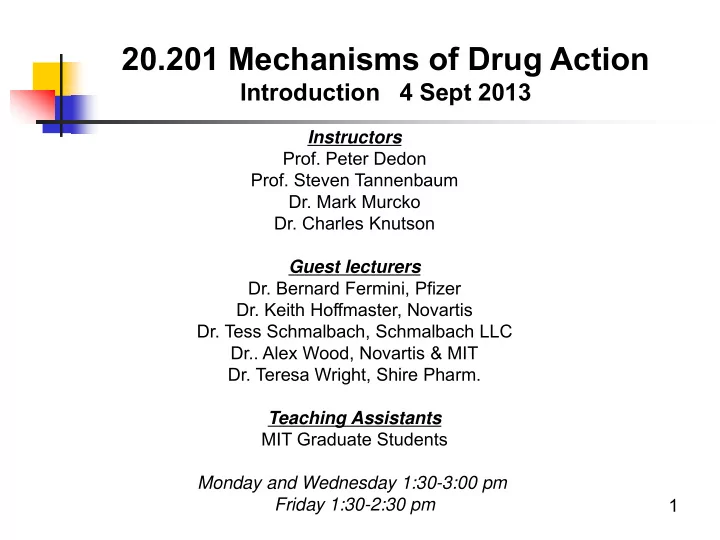
20.201 Mechanisms of Drug Action Introduction 4 Sept 2013 Instructors Prof. Peter Dedon Prof. Steven Tannenbaum Dr. Mark Murcko Dr. Charles Knutson Guest lecturers Dr. Bernard Fermini, Pfizer Dr. Keith Hoffmaster, Novartis Dr. Tess


slide-1
SLIDE 1

1

20.201 Mechanisms of Drug Action

Introduction 4 Sept 2013

Instructors

  • Prof. Peter Dedon
  • Prof. Steven Tannenbaum
  • Dr. Mark Murcko
  • Dr. Charles Knutson

Guest lecturers

  • Dr. Bernard Fermini, Pfizer
  • Dr. Keith Hoffmaster, Novartis
  • Dr. Tess Schmalbach, Schmalbach LLC

Dr.. Alex Wood, Novartis & MIT

  • Dr. Teresa Wright, Shire Pharm.

Teaching Assistants MIT Graduate Students Monday and Wednesday 1:30-3:00 pm Friday 1:30-2:30 pm

slide-2
SLIDE 2

2

Learning Objectives

  • Develop an understanding of the scientific basis

for drug development, drug mechanisms, drug disposition and drug safety

  • Develop an appreciation for the role of

pharmacokinetics, drug metabolism and drug interactions in the mechanisms of drug action

  • Understand the balance between environment

and pharmacogenetics in the toxicity and therapeutic outcome associated with a drug

  • Understand factors that lead to success and

failure in drug development

slide-3
SLIDE 3

3

  • 1. Identify a "target” in a disease

~ receptor, enzyme, mRNA

  • 2. Utilize cell lines with disease phenotypes
  • 3. Identify one or more drug candidates
  • 4. Test drug candidates in

~ cells, tissues, animals

  • 5. Test drug candidates in humans
  • 6. Apply to FDA for approval as a drug

Steps in drug development

slide-4
SLIDE 4

4

  • Discovering new drug targets

~ Example: screening 106-compound libraries ~ finding a new drug target is important… ~ …but only one part of drug development

  • A drug candidate becomes a drug when the FDA is

convinced that a candidate has been ~ proven safe ~ proven effective

  • Concepts relevant to the safety and efficacy of a

drug are as important as concepts of drug targets

Selection of a drug target is only step #1

slide-5
SLIDE 5

5

New/Old Approach is to Test Phenotypes

 Phenotypic screening (aka classical

pharmacology) has been historically used in drug discovery. While technological developments have made the prevalence

  • f target-based screening more popular,

statistical analysis shows that a disproportionate number of first-in-class drugs with novel mechanisms of action come from phenotypic screening.

slide-6
SLIDE 6

6

What will you get out of 20.201?

  • Framework for understanding "drugs"
  • Fundamental concepts of drug development

and pharmacology

  • Learn the language of the pharmaceutical and

biotechnology industries

  • Application areas for modern biological

engineering, chemistry, biology

  • Opportunities to meet scientists from drug

companies

slide-7
SLIDE 7

7

What is "drug action”

  • The mechanism of action of a drug is not

just limited to its interaction with one specific target and the response that ensues

  • This is “pharmacodynamics”: the study of how a drug acts on a

living organism, including the pharmacologic response and the duration and magnitude of response observed relative to the concentration of the drug at an active site in the organism.

  • We will use the term "drug action" broadly to encompass:

~ drug actions that lead to toxicity ~ features of uptake, distribution and metabolism that alter or limit a drug's action ("pharmacokinetics"; ADME)

slide-8
SLIDE 8

8

Mechanisms of drug action involve every aspect of a drug's fate

  • An often under-appreciated facet of a drug’s

mechanism of action is its “pharmacokinetics”

  • “Pharmacokinetics” (how/how much gets to the

target) and “pharmacodynamics” (what it does at the target) are the foundations of drug action

  • Pharmacokinetics, in its broadest definition, involves:

~ Uptake = absorption ~ Distribution ~ Metabolism ~ Elimination

A D M E

slide-9
SLIDE 9

9

Drug Safety

 Toxicology

 Drug causes or induces chemical/biological

damage to cells and organs

 Drug has off-target effects

 Lack of Efficacy

 Drug doesn’t have therapeutic effect

slide-10
SLIDE 10

10

Pharmacophores & Toxicophores

slide-11
SLIDE 11

11

Topics covered in 20.201

  • Mechanisms of action of drugs and drug classes
  • Role of drug structure and drug transport

proteins in uptake and distribution

  • Kinetics of drug behavior in the human body
  • Metabolism:

~ chemical alterations of drugs ~ generation of toxic metabolites ~ metabolic activation of drugs

  • Drug interactions leading to toxicity
  • Drug-receptor interactions
  • The role of pharmacogenetics in drug actions
slide-12
SLIDE 12

12

  • All sessions address a drug and its mechanism/use
  • All sessions use specific examples of drugs and drug

literature to illustrate the fundamentals of drug development, ADME, toxicity and pharmacodynamics

  • Some sessions develop fundamental concepts in

didactic format (i.e., straight lectures)

  • Some sessions involve discussion of literature
  • Many lectures use case study format to illustrate

fundamental concepts

  • Heavy emphasis on critical analysis of the primary

literature

Our approach

slide-13
SLIDE 13

13

Why so Many Drugs?

 Non-steroidal anti-inflammatory drugs (NSAIDS)  Statins  Antacids  Blood pressure

slide-14
SLIDE 14

14

Percentage contributions to final grade: 30% Quiz mid-term 30% Case study project 20% Evidence of reading assigned papers 20% Homework assignments

Grading Policy

slide-15
SLIDE 15

15

"Recitations"

  • Lecture and problem set review
  • ffered Fridays from 1:30-2:30
  • Several sessions will involve quiz

review, discussion of projects and tutoring as needed

slide-16
SLIDE 16

16

  • Homework assignments cover:

~ Problem sets relevant to lecture material ~ Problem sets associated with the reading

  • Readings

~ Book chapters ~ Review papers ~ Papers from the primary literature

  • Assignments available on course website
  • Homework due as noted in class

Homework assignments and readings

slide-17
SLIDE 17

17

  • There will be one take-home quiz at

approximately mid-term

  • The quiz will cover application of

fundamentals presented in the first series of lectures

  • There is no final examination

There is an individual project due at end of term

Quiz

slide-18
SLIDE 18

18

Critical analysis of the literature

  • The class emphasizes the primary literature of drug

mechanisms and toxicity

  • Students are responsible for thoroughly reading each

paper and should be prepared to make brief summary presentations of various facets of the paper: (1) What is the hypothesis driving the work? What is the point of the paper? Is this an important question? (2) What is the experimental plan here? (3) Are the methods chosen appropriate for testing the hypothesis? (4) Are the results substantive and credible? Statistical analyses performed properly? (5) Are the conclusions justified by the results?

slide-19
SLIDE 19

19

  • "Principles of Pharmacology: The

Pathophysiologic Basis of Drug Therapy," by David E. Golan et al., Lippincott Williams and Wilkins, 3nd Edition, 2012

  • Best bet? Amazon.com for pricing?
  • Available at Harvard Medical COOP:

333 Longwood Avenue Boston, MA 02115 (617)499-3300 Store Hours: M-F 9-6; Sa 11-5

Required Text

slide-20
SLIDE 20

20

  • 7th edition of "Casarett and Doull's Toxicology, the Basic Science
  • f Poisons, ed. Curtis Klassen, McGraw-Hill, NY, 2007
  • Other pharmacology text: “The Pharmacologic Basis of

Therapeutics” by Gilman, Rall, Nies and Taylor; Pergamon Press

  • Physiology texts:

~ “A Textbook of Medical Physiology” by Arthur Guyton (W.B. Saunders) ~ “Human Physiology: The Mechanisms of Body Function” by Vander, Sherman, and Luciano

  • Histology texts:

~ “Basic Histology” by Junqueira, Carneiro, and Kelley; Appleton/Lange ~ “A Textbook of Histology” by Bloom and Fawcet

Other recommended Texts

slide-21
SLIDE 21

21

Structures and Functional Groups

  • carboxylic acids
  • aldehydes
  • ketones
  • aromatic molecules/heterocycles
  • esters
  • amides
  • thiols (sulfhydryls)
  • epoxides

Nucleophiles/electrophiles Bonding

  • covalent bonds
  • coordinate covalent bonds
  • ionic bonds
  • hydrogen bonding
  • van der Waal's interactions

Reduction/oxidation Thermodynamics and Equilibria Acid/base chemistry Reaction kinetics and mechanisms:

  • zero-, first- and second-order reaction kinetics
  • SN1 and SN2 nucleophilic substitution mechanisms
  • Michael acceptors

The Chemistry/Biochemistry You Need to Know or Learn

slide-22
SLIDE 22

22 Enzymes

  • kinetics
  • cofactors: NAD+/NADH; FAD/FADH; FMN; acetyl CoA; UDP-

glucuronic acid; ATP; GTP; cAMP; cGMP; PAPS (3’=phosphoadenosine-5’-phosphosulfate); s-adenosylmethionine (SAM); glutathione Lipids

  • membrane structure
  • types: fatty acids; triglycerides; cholesterol; phospholipids

Mitochondrial structure and function Metabolism and ATP generation DNA structure

  • bases, nucleosides, nucleotides
  • primary, secondary structure

Proteins/peptides

  • amino acid structure and side chain chemistry
  • peptide bonds
  • glutathione

The Chemistry/Biochemistry You Need to Know or Learn

slide-23
SLIDE 23

23

Other Sources of Information

Google and Google Scholar

Pubmed

Wikipedia

FDA website

http://canreviews.aacrjournals.org/

https://dilin.dcri.duke.edu/ (drug liver injury)

NCTR

http://www.livertox.nih.gov/index.html

CDER

Nature Reviews Drug Discovery

slide-24
SLIDE 24

MIT OpenCourseWare http://ocw.mit.edu

20.201 Mechanisms of Drug Actions

Fall 2013 For information about citing these materials or our Terms of Use, visit: http://ocw.mit.edu/terms.