Footprint Training Connie Morella Library Bethesda, MD November - - PowerPoint PPT Presentation

footprint training
SMART_READER_LITE
LIVE PREVIEW

Footprint Training Connie Morella Library Bethesda, MD November - - PowerPoint PPT Presentation

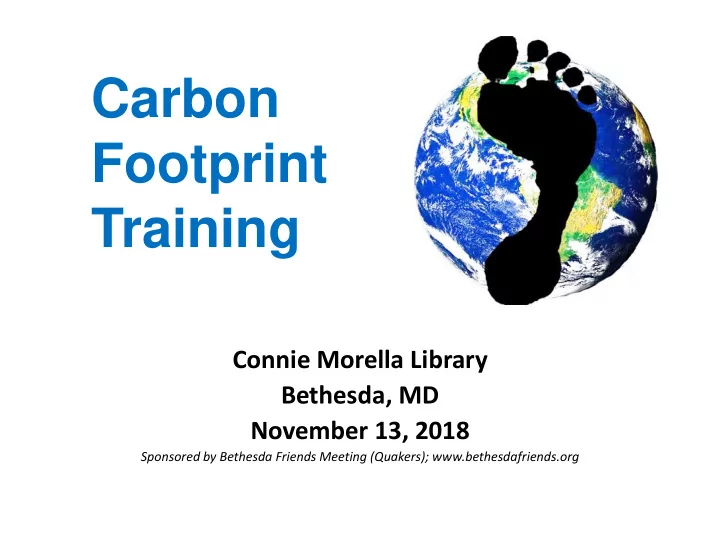
Carbon Footprint Training Connie Morella Library Bethesda, MD November 13, 2018 Sponsored by Bethesda Friends Meeting (Quakers); www.bethesdafriends.org Presenters Rick Morgan Keith Campbell Commissioner, DC Public Service Data

slide-1
SLIDE 1

Carbon Footprint Training

Connie Morella Library Bethesda, MD November 13, 2018

Sponsored by Bethesda Friends Meeting (Quakers); www.bethesdafriends.org

slide-2
SLIDE 2

Presenters

Rick Morgan

  • Commissioner, DC Public Service

Commission, 2003-2011 (retired)

  • Economist; Creator of EPA’s “eGRID”

database of US power plants

  • Member, Unity with Nature

Committee, Baltimore Yearly Meeting (Quakers)

Keith Campbell

  • Data scientist specializing in

transportation

  • Ph.D in Systems Engineering from
  • Univ. of Pennsylvania
  • Works for MITRE Corporation

2

slide-3
SLIDE 3

The context for carbon footprinting

  • 2015 Paris Climate Accords

– 196 nations signed

  • UN IPCC report warned

last month:

– Warming mustn’t exceed 1.5°C!

  • Atmospheric CO2 has

topped 400 ppm. →Many motivated to track carbon footprints for:

– Households, congregations, communities

3

slide-4
SLIDE 4

Comparing our carbon footprints worldwide

Annual U.S. per capita carbon emissions (~16 metric tons) are:

  • Nearly double most European

countries’.

  • 4 times worldwide average

(~4 metric tons per capita).

  • 8 times our fair share of carbon

the earth can sequester*.

*~2.0 metric tons per capita annually, per 2015 Paris Climate Accords

Source: Stanford Kay

4

slide-5
SLIDE 5

Climate queries posed by Friends

  • As a human community, do we need to limit our

human caused CO2 to equal or less than what can be sequestered?

  • Do we as individuals and nations need to share

the limits of emissions fairly to avoid further CO2 increases to the atmosphere?

  • -Unity with Nature Committee

Baltimore Yearly Meeting (Quakers)

5

slide-6
SLIDE 6

Reasons for footprinting

  • Tracking our carbon footprints is a form of

witness to our own actions that impact the earth.

  • Footprinting can motivate us to:

– make changes in our personal lifestyles. – work for cultural changes.

  • Results are eye-opening!

“When I can see my own footprint, I can’t be silent and complicit!”

6

slide-7
SLIDE 7

What makes a good carbon footprint calculator?

  • Key attributes of a good calculator

include:

– user-friendliness --accuracy – robustness

  • -usefulness of results
  • No single calculator ideal in all respects.

– Often tension between simplicity and accuracy.

  • Typical features:

– Organized by sector modules (travel, housing, diet, etc). – Scores generally reported by household, not per capita. – Scores expressed in metric tons of CO2 annually

  • 1 metric ton = ~1.1 “short” US ton.

7

slide-8
SLIDE 8

A leading on-line calculator:

UC-Berkeley’s CoolClimate*

  • Precise & easy to use
  • Choice of standard vs.

advanced inputs

  • Air travel module

accounts for high-altitude emissions

  • Documentation is

thorough, transparent

  • ‘Take Action’ list

* https://coolclimate.berkeley.edu/calculator Phone-friendly version: https://www.nature.org/en-us/get- involved/how-to-help/consider-your- impact/carbon-calculator/

8

slide-9
SLIDE 9

carbonfootprint.com (U.K.)

  • Versatile & easy to use
  • Optional high altitude adjustment for air travel
  • Score compared to your fair share of worldwide emissions target.
  • Hawking of “carbon offsets” may be objectionable to some.

9

slide-10
SLIDE 10

Cool Congregations*

(Interfaith Power & Light)

  • Calculates footprints for

religious congregations

  • Accounts for energy use,

staff travel

  • Estimates emissions

associated with food,

  • ffice products, cleaning

products

  • Credit for congregation

lands managed in their natural state

* http://www.coolcongregations.org/calculator/

10

slide-11
SLIDE 11

Takeaways re: carbon footprints

  • Our carbon footprints are

driven by our culture.

– Societal infrastructure reinforces consumptive lifestyles. – Modifying behavior alone won’t solve climate change. →Work for societal change!

  • Still plenty of things you can

control.

– energy

  • -travel

– diet

  • -purchases

11

slide-12
SLIDE 12

Take action, beginning today

  • Caring about this issue is not enough.
  • Your individual actions are one important part
  • f a larger solution.
  • Let’s look at some simple ways to cut your

household’s footprint by 1+, 5+ and 10+ tons per year.

12

slide-13
SLIDE 13

Cut your footprint at least 1 ton

Switch to LED bulbs

(30+ bulbs)

Switch to Low-Flow Shower Heads

Now less than $2 per bulb. Save money! More comfort in summer! Good models provide a nice shower. Much better than the 1980’s version.

  • Cut a round-trip flight to Atlanta , Chicago or Toronto.
  • Stop eating beef and pork in a 2-person household.
  • Switch to high-efficiency water heater or front-load washing machine.
  • Many more!

13

slide-14
SLIDE 14

Cut your footprint at least 5 tons

Change Electricity Provider Seal and Insulate

  • e.g. solar and wind plans
  • Easy to switch
  • Rates very close to PEPCO’s
  • 10+ tons for some households
  • Cut a 2-person flight to California or Europe.
  • Switch 2 vehicles to hybrid cars, or 1 car to transit.
  • Install solar panels.
  • Many more!
  • Improves comfort too!
  • Most effective for older, single

family homes.

14

slide-15
SLIDE 15

Cut your footprint at least 10 tons

Combine Actions

Switch 2 vehicles to transit, EV,

  • r bicycle
  • Electrify gas appliances.
  • Move to a smaller place.
  • Many more!

Cut a 4-person trip to Europe or 2-person trip to Asia.

15

slide-16
SLIDE 16

Sample Utility Bills for Footprint

16