Food security of Pakistan Prof. Dr. Javaid Akhtar Director, - - PowerPoint PPT Presentation

food security of pakistan
SMART_READER_LITE
LIVE PREVIEW

Food security of Pakistan Prof. Dr. Javaid Akhtar Director, - - PowerPoint PPT Presentation

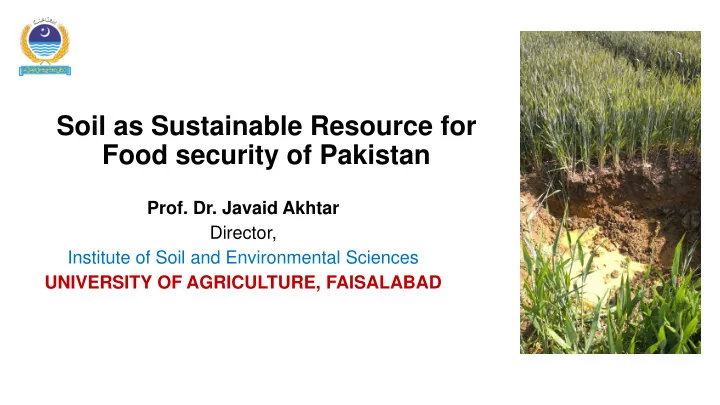
Soil as Sustainable Resource for Food security of Pakistan Prof. Dr. Javaid Akhtar Director, Institute of Soil and Environmental Sciences UNIVERSITY OF AGRICULTURE, FAISALABAD What is Food Security? There exists food security when all people


slide-1
SLIDE 1

Soil as Sustainable Resource for Food security of Pakistan

  • Prof. Dr. Javaid Akhtar

Director, Institute of Soil and Environmental Sciences UNIVERSITY OF AGRICULTURE, FAISALABAD

slide-2
SLIDE 2

What is Food Security?

There exists food security when all people at all times have access to sufficient, safe, nutritious food to maintain a healthy and active life”

This is a function of

Food availability: the amount of food physically available to a household or at the national level. Food access: the physical (e.g. road network, market) and economical (e.g. own production, purchase) ability of a household to acquire adequate amounts of food. Food utilization: the intra-household use of the food accessible and the individual’s ability to absorb and use nutrients.

(World Food Summit, 1996)

slide-3
SLIDE 3

Demographic outlook

The majority of these people will leave in Asia or Africa, where conditions do not favor agriculture

By 2050, UN predict a global population of 9.6 billions

94% of all food originates from terrestrial environments (FAOSTAT, 2011) Global food production must increase by 3% annually to 2050.

slide-4
SLIDE 4

The global food system is experiencing

Multiple challenges…. 1. Demand increasing: we need to boost production by about 650 m mt by now and 2023 (additional 540 million acres). Number of food-insecure people has fallen from 959 million to 780 million (37% to 17%) 2. Agriculture sector has to generate jobs and incomes to poverty eradication 3. It has a major role to play in ensuring the sustainability of natural resources for future and in combating climate change. 4. 1/3rd of the global land resources have already lost its potential due to various degradation problems. (Six million ha per year = UK)

slide-5
SLIDE 5
  • 60% of Population experiencing food insecurity

(78/109)

slide-6
SLIDE 6

Im Impact of f glo lobal warming and cli limate change

slide-7
SLIDE 7
slide-8
SLIDE 8

Projected change in agricultural production due to climate change

“Climate change affects agricultural production through its effects on the timing, intensity and variability of rainfall and shifts in temperatures and carbon dioxide concentrations”

(Guardian Apr 13 2013)

slide-9
SLIDE 9

In addition to that…..

Urbanization as a confounding factor

  • Urban sprawl around cities and regional centres

results in conversion of agricultural land into

  • ther uses
  • In Australia, this trend has already resulted in a

loss of 10 % of agricultural land over the last 10 years

slide-10
SLIDE 10

A case study: drought stress

“Pakistan’s water crisis has become increasingly visible in recent months: levels in the largest dams are low; parched irrigation canals mean farmers in the south planted less cotton; and the commercial capital Karachi has long queues at hydrants”

Pakistan

Per capita water availability dropped from 5,000 m3 in 1947 to 1,000 m3 in 2018

Australia

  • 2006 drought costed Australian

economy 1% of the GDP

  • In 2018 Australia experienced

the biggest drought in 800 years

slide-11
SLIDE 11

1950 1950 38 38 millio ion n people ple 2010 2010 174 174 millio ion n people ple 2050 2050 330 330 millio ion n people ple 1950 1950 One hectare tare to feed d 1.6 people ple 2050 2050 One hectare tare to feed ed 11.2 2 people ple 2010 2010 One hectare tare to feed d 5.3 people ple

slide-12
SLIDE 12

Implication for food security

Tester & Langridge (2010) Science

  • Annual crop production should increase

by 38% compared with historical trends

  • Not achievable with exiting practices
  • Crop production systems will need to

move into marginal lands to meet growing foods demand

This requires a major shift in a current paradigm of crop growing and breeding

slide-13
SLIDE 13

Most world water is saline

  • Agriculture accounts for ~70 % of the

freshwater

  • To

meet food demand water withdrawn by irrigated agriculture will need to increase by 11%

slide-14
SLIDE 14

Rain water EC 10-30 mg/L (add salt 10 kg/ha for 100 mm rainfall) Irrigation water (with EC 500 mg/L) (add 0.5 t of salt /1000 m3) since crops require 6000-10,000m3/ha/year water i.e. 3-5 t of salt adding each year in the soil Underground saline water Raising water tables of saline aquifers (with EC 2 - 45 dS/m) due to increased recharge & use of saline water Recycle water or drainage water from industry Discharge of saline effluents from drainage or industry (EC 2- 10 dS/m)

Land salinization is progressing

slide-15
SLIDE 15
slide-16
SLIDE 16

The th thin la layer of f soil covering th the earth's surface re represents th the dif ifference between surv rvival and ext xtinction for most terrestrial life.”

Foundation of food production Many essential ecosystem services Storing and supplying more clean water Maintaining biodiversity Sequestering carbon Increasing resilience in a changing climate

slide-17
SLIDE 17

Land is a finite resource……

Land Use in Pakistan

slide-18
SLIDE 18

Some Facts of our Soil/Land resources

  • More than 50% of agricultural Lands are moderately to

severely degraded.

  • Land Degradation directly affects 1,5 billion people

globally.

  • 75 billion tons of fertile soil disappear/year
  • 12 million ha/Year lost due to drought and

desertification.

  • Six million km2 of drylands bear a legacy of

desertification.

  • Biodiversity: 27,000 species lost each year due to LD

IT REQUIRES 1000 YEARS FOR CREATING 3 CM OF TOPSOIL

slide-19
SLIDE 19

Global status of human-induced soil degradation

Very high severity High severity Moderate severity Low severity Stable Land, Ice Caps or non-used wasteland

Soil is eroding faster than it is forming on more than one-third of the world’s cropland

slide-20
SLIDE 20

Green revolution and Soil Resources

  • Of the productivity increase, it has been estimated that about 70% is due

to the intensification of agriculture, 30% is a result of new land being brought into production.

  • It must be highlighted that the doubling of global food production during

the past decades has also led to the degradation and exhaustion of soil and land.

  • Over the past 50 years, the world’s net cultivated area has grown by 12%,

mostly at the expense of forest, wetlands and grassland habitats. At the same time, the global irrigated area has doubled.

  • FAO models estimate about 25% of land to be highly degraded.
  • The overall effects of soil degradation pose a major threat to food security

especially in poor regions.

slide-21
SLIDE 21

Soil Health: Deteriorating balance in NPK

slide-22
SLIDE 22

Breeding & Biotechnology

Where will the food come from?

Land

(-5%)

Reduced Losses

20% 50%

Farm Practices

80% 100% 250%

Current Crop Production Future Crop Production

slide-23
SLIDE 23

Future Outlook

By 2050, the demand for new agricultural land is expected to increase by about 50%. FAO suggest that, by 2030, an additional 81 to 147 million ha of cropland will be needed compared to the yr 2000 baseline.

It is very probable that tropical forests will account for that land; therefore, further deforestation is to be expected, together with an exacerbation of soil degradation.