Fixing the Lines Canarsie Tunnel 1 Agenda Welcome: Al - - PowerPoint PPT Presentation

fixing the line s canarsie tunnel
SMART_READER_LITE
LIVE PREVIEW

Fixing the Lines Canarsie Tunnel 1 Agenda Welcome: Al - - PowerPoint PPT Presentation

Fixing the Lines Canarsie Tunnel 1 Agenda Welcome: Al Silvestri (NYCDOT) Panel Introductions Town Hall Ground Rules Timeline Sandy Video Presentation by NYCT President Andy Byford and NYCDOT Commissioner Polly


slide-1
SLIDE 1

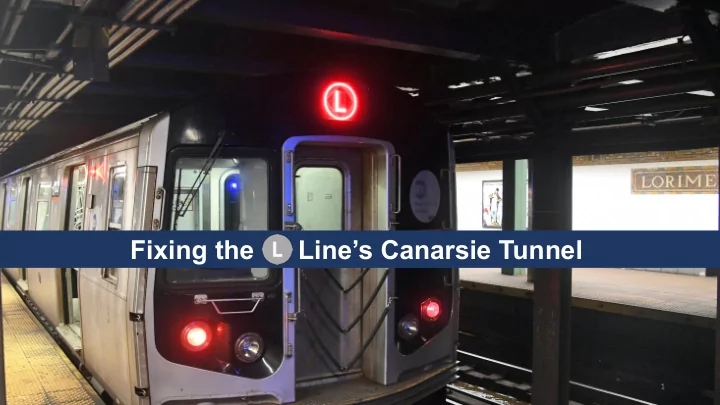
Fixing the Line’s Canarsie Tunnel

1
slide-2
SLIDE 2

Agenda

  • Welcome: Al Silvestri (NYCDOT)
  • Panel Introductions
  • Town Hall Ground Rules
  • Timeline
  • Sandy Video
  • Presentation by NYCT President Andy Byford and

NYCDOT Commissioner Polly Trottenberg

  • Questions & Answers

2

slide-3
SLIDE 3

Proposed Service Plan

3

slide-4
SLIDE 4

Challenge of Serving Customers

400,000 daily riders use the :

  • 225,000 use the Canarsie Tube under East River
  • Nearly as many inbound passengers during the AM peak hour as in

private vehicles on all six East River bridges and tunnels combined

  • 50,000 travel solely in Manhattan
  • Greater than busiest NYC Bus route (Bx12 - 48,000 riders/day)
  • 66% greater than current M14 ridership (30,000 riders/day)
  • 125,000 travel solely in Brooklyn

4

slide-5
SLIDE 5

Increased alternate subway service Temporary bus service Temporary ferry service Station access and capacity improvements Temporary bike and pedestrian infrastructure Temporary peak period traffic management strategies

Our Strategy

5

slide-6
SLIDE 6

Proposed Alternative Services

6

slide-7
SLIDE 7

Proposed Inter-Borough Bus Routing

7

slide-8
SLIDE 8

Proposed Transit Priority Treatments

8

slide-9
SLIDE 9

Maximize Connections Between Brooklyn and Manhattan

  • HOV 3+ on Williamsburg Bridge
  • Bus priority to accommodate

~30,000 daily riders

  • Additional bike facilities
  • New ferry service connecting

North Williamsburg to Manhattan

9

slide-10
SLIDE 10

Williamsburg Bridge Entrance Proposal

10

slide-11
SLIDE 11

HOV 3+ Manhattan Bound

11

slide-12
SLIDE 12

HOV 3+ on Williamsburg Bridge

  • HOV 3+ will accommodate ~80 buses

per hour over Williamsburg Bridge

  • Buses, trucks, & HOV 3+ all lanes,

both directions, peak hours

  • Peak hours still to be determined
  • Deliver Strict Enforcement
  • Automated HOV enforcement

cameras (legislation pending)

  • Consistent NYPD presence

12

slide-13
SLIDE 13

Making Grand St Work for All Users

Bus priority connecting to WBB

  • Reliability
  • High capacity stops

Safe, direct connection for cyclists

  • Upgrade existing facility on Grand St
  • Greater network connectivity

Maintain local access along Grand St

  • Allow local circulation along Grand St
  • Increased loading zones to support local

businesses

Grand St Existing

13

slide-14
SLIDE 14

Grand Street Bus and Local Access

  • Provide bus priority for

buses crossing the Williamsburg Bridge

  • Maintain local access

along Grand St

14

slide-15
SLIDE 15

Grand Street Traffic Diversions

  • Provide bus priority for

buses crossing the Williamsburg Bridge

  • Maintain local access

along Grand St

  • Through traffic

diversions

  • Metropolitan Av
  • S.5th Street
  • Broadway
  • Montrose Av

15

slide-16
SLIDE 16

Local Traffic Improvements: Metropolitan Ave, S 5th St, S 3rd St

  • HOV 3+ will reduce traffic to

the Williamsburg Bridge We are continuing to study:

  • Curb regulation changes
  • Rush hour lanes
  • Signal changes
  • Turn lanes
  • Turn restrictions

16

slide-17
SLIDE 17

Accommodate Expected Surge In Cycling

  • Cycling is an important option for

commuters from Brooklyn and across Manhattan

  • Williamsburg Bridge is already the

city’s busiest bike crossing; plan builds network connecting to bridge and across Manhattan Why Grand Street

  • Vision Zero Priority Area with a bicycle

fatality in August 2016

  • Numerous calls for safety

improvements

  • High existing cycling volumes (+1300

cyclists counted in a 12 hour period on the weekday and weekend) Additional Bike Facilities

  • Provides options for cyclists
  • Allows higher cycling volumes
  • Allows for greater network connectivity

17

slide-18
SLIDE 18

Minimize Disruption to the Extent Possible

  • Chosen shuttle routes provide a number of alternatives for commuters between

Brooklyn and Manhattan

  • Street design provides a safe option for the different users of Grand Street
  • Traffic analysis on the effect of bus priority on Grand St, Metropolitan Av, and

neighborhood streets is ongoing

  • MTA & NYCDOT will continue to work with the industrial business community on

traffic calming and alternate routes

  • Commitment to provide on-going monitoring of traffic and to make adjustments

as needed

18

slide-19
SLIDE 19

We’ve Heard You, We’re Still Listening

  • 75+ public meetings (with more coming)
  • 4,700+ comments received (and still counting)

Key Takeaways:

  • Competing public interest/priorities
  • Conflicts between citywide transportation

needs and neighbors’ block-level needs

  • Shared priorities of safety, enforcement,

minimizing congestion

19

slide-20
SLIDE 20

Outstanding Community Concerns & Challenges

  • Exact Hours of Williamsburg Bridge HOV3
  • Exact Hours and operational features of Grand Street bus lanes and 14th St Busway
  • Local traffic improvement plan

20

slide-21
SLIDE 21

Planned Next Steps

Ongoing Through 2020

  • Construction at street level to support

tunnel project Spring 2018

  • Stakeholder outreach, design and

service plan refinement Summer 2018 – March 2019

  • Multiple weekend and overnight L

closures to support tunnel project Winter 2019

  • Completion of temporary street and/or site

modifications for SBS service, bus terminal and parking, and ferry operations April 2019

  • Start of Canarsie Tunnel Closure,

alternative service plan begins

21

slide-22
SLIDE 22

Fixing the Line’s Canarsie Tunnel

22