First results and prospects of the IRSN DENOPI program devoted to - - PowerPoint PPT Presentation

first results and prospects of the
SMART_READER_LITE
LIVE PREVIEW

First results and prospects of the IRSN DENOPI program devoted to - - PowerPoint PPT Presentation

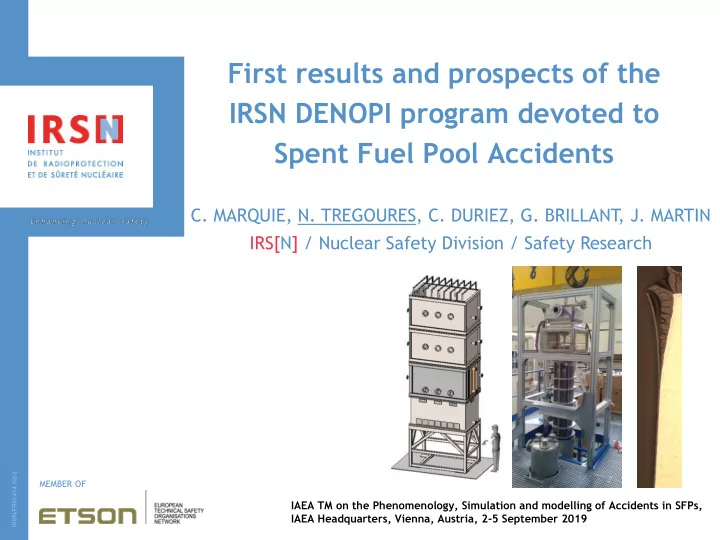
First results and prospects of the IRSN DENOPI program devoted to Spent Fuel Pool Accidents C. MARQUIE, N. TREGOURES, C. DURIEZ, G. BRILLANT , J. MARTIN IRS[N] / Nuclear Safety Division / Safety Research IRSN/FRM-414 ind 3 MEMBER OF IAEA TM


slide-1
SLIDE 1

MEMBER OF

IRSN/FRM-414 ind 3

IAEA TM on the Phenomenology, Simulation and modelling of Accidents in SFPs, IAEA Headquarters, Vienna, Austria, 2-5 September 2019

First results and prospects of the IRSN DENOPI program devoted to Spent Fuel Pool Accidents

  • C. MARQUIE, N. TREGOURES, C. DURIEZ, G. BRILLANT

, J. MARTIN IRS[N] / Nuclear Safety Division / Safety Research

slide-2
SLIDE 2

MEMBER OF

2

Outline

▪ Elements of context ▪ The DENOPI Project ▪ First results with MEDEA facility ▪ First results on Zy oxidation

IRSN DENOPI Program on SFP – September 2019

slide-3
SLIDE 3

MEMBER OF

3

Fukushima Daiichi Unit 4 SFP-LOCA

▪ On 2011/03/11: 1331 spent fuels - decay heat: 2.26 MWth ▪ Time estimation before fuel assembly dry out without counter- measures: end of March 2011 (0D energy balance) ▪ No clear evidence for boiling, no fuel uncovery ▪ Water temp. ~ 80-90 °C during ~4.5 months ▪ Recovery of active heat removal on 2011/07/31 @ water ~ 75 °C

ELEMENTS OF CONTEXT

IRSN DENOPI Program on SFP – September 2019

slide-4
SLIDE 4

MEMBER OF

4

International effort on SFP accidents

▪ OECD: ▪ Status Report on Spent Fuel Pools under Loss-

  • f-Cooling and Loss-of-Coolant Accident

Conditions NEA/CSNI/R(2015) ▪ PIRT on SFP (2016/2017): NEA/CSNI/R(2018) ▪ …

ELEMENTS OF CONTEXT

▪ IAEA: ▪ International Experts Meeting on Strengthening Research and Development Effectiveness in the Light of the Accident at the Fukushima Daiichi NPP , 2015 ▪ …

IRSN DENOPI Program on SFP – September 2019

slide-5
SLIDE 5

MEMBER OF

5

International effort on SFP accidents

▪ European Community – NUGENIA+: Air-SFP Project (IRSN lead) ▪ WP1: Benchmark of SFP transients with SA codes (PSI coordination) ▪ Task 1.1 Analysis of SFP transients carried out in the frame

  • f a benchmark on SFP geometry similar to Fukushima one

▪ Task 1.2 Investigation of criticality phenomena ▪ WP 2: Roadmap for further R&D on SFP accidents (NRG coordination)

ELEMENTS OF CONTEXT

IRSN DENOPI Program on SFP – September 2019

slide-6
SLIDE 6

MEMBER OF

6

Overview

▪ Framework: Post-Fukushima project, supported by the French government (ANR 11 – RSNR 006) – 2014/2020 ▪ Participants: IRSN and French academic labs ▪ 3 axis representing three scale of interest and 3 different time frames ▪ Axis 1: Pool scale - Before fuel uncovery ▪ Validation of TH models (convection loops, power distribution effect...) ▪ Axis 2: Assembly scale - Partial or total uncovery of fuel assembly ▪ Spray cooling efficiency as a mitigation measure ▪ Axis 3: Fuel clad scale - Degradation of fuel assembly ▪ Clad oxidation under mix air-vapor atmosphere

THE DENOPI PROJECT

IRSN DENOPI Program on SFP – September 2019

slide-7
SLIDE 7

MEMBER OF

7

Axis 1 – Pool scale

▪ MIDI facility: A 1/6th scale pool (except in height 1/3rd) - Design based on a similarity approach ▪ 21 heating elements for a max total power of 300 kW – possibility to test different power distributions i.e. different loading patterns ▪ Instrumentation: progressive approach ▪ At first: “classical” instrumentation (TC, pressure sensors, flowmeters...) ▪ Progressively: evolution with innovative measurements in the upper volume depending of development and qualification ▪ Construction undergoing

THE DENOPI PROJECT

IRSN DENOPI Program on SFP – September 2019

slide-8
SLIDE 8

MEMBER OF

8

Axis 2 – Assembly scale

▪ MEDEA facility: A full-scale upper part of a fuel assembly (top meter) in its storage cell ▪ 17x17 unheated rods ▪ Air or steam (up to 200°C) injection from the bottom ▪ Modular water spray at the top (flow, shape and temperature) ▪ Measurement of water progression in the assembly / ejected at the top ▪ Two configurations ▪ Water-air tests ▪ Steam-air tests ▪ All tests performed

THE DENOPI PROJECT

IRSN DENOPI Program on SFP – September 2019

slide-9
SLIDE 9

MEMBER OF

9

Axis 2 – Assembly scale

▪ ASPIC facility: A full-scale assembly in its storage cell ▪ 17x17 electrically heated rods (T

clad <

600°C) ▪ Versatile configurations: no, partial

  • r total uncovering

▪ Water spray at the top ▪ Measurements: Temp., pressure, flowrates and levels ▪ Design studies finalized mid-2017 ▪ Construction undergoing: → 2019 ▪ Tests: 2020-2021

THE DENOPI PROJECT

IRSN DENOPI Program on SFP – September 2019

slide-10
SLIDE 10

MEMBER OF

10

Axis 3 – Clad scale

▪ Zy 4 oxidation tests under mixed steam/air atmosphere ▪ Effect of pre-oxide layer ▪ Effect of O2/H2O/N2 partial pressures ▪ TGA testing ▪

18O/Raman tests

▪ In-situ DRX ▪ Mechanical test ▪ In collaboration with Mines Saint-Etienne, LEPMI and LVEEM

THE DENOPI PROJECT

IRSN DENOPI Program on SFP – September 2019

slide-11
SLIDE 11

MEMBER OF

11

Air/water flooding test on MEDEA

FIRST RESULTS – AXIS 2 – ASSEMBLY SCALE

Qspray Qair Qup Qdown

Parameters: ▪ Air inlet and spray flowrates ▪ Spray shape ▪ Distance spray / top of assembly ▪ Cross-section of top nozzle Measures (flooding curves): ▪ Water going through the assembly (Qdown) ▪ Overflow water at the top (Qupo) ▪ Temperatures (RT), pressures

IRSN DENOPI Program on SFP – September 2019

slide-12
SLIDE 12

MEMBER OF

12

Conclusion of MEDEA first tests

FIRST RESULTS – AXIS 2 – ASSEMBLY SCALE

▪ For typical SFP configuration (low spray / gaz flows), the risk of CCFL is unlikely ▪ But with debris on top of the top nozzle, CCFL is observed even with low flowrates. ▪ Steam tests are under analyses

IRSN DENOPI Program on SFP – September 2019

slide-13
SLIDE 13

MEMBER OF

13

Pre-oxidation effect

▪ Pre-oxidation: Objective to simulate oxide layer formed during operation in reactor

FIRST RESULTS – AXIS 3 – CLAD SCALE

▪ Protective effect from oxide formed at low temperature ▪ Strongly depend on oxidation conditions: positive effect of steam

0.01 0.02 0.03 0.04 0.05 0.06 0.07 60 120 180 240 300

d(Dm/S)/dt (g m-2 s-1) time (min) Bare Zy4

850°C

PO ~ 30 µm

IRSN DENOPI Program on SFP – September 2019

slide-14
SLIDE 14

MEMBER OF

14

Effect of steam

▪ Air + steam tests with variation of steam partial pressure

FIRST RESULTS – AXIS 3 – CLAD SCALE

▪ No effect of steam (vs. O2) on oxidation kinetic ▪ But steam contributes to the oxidation: H incorporation in the sample

50 100 150 200 60 120 180 240

Prise de masse (g.m-2) Temps (min)

air sec 30hPa H2O 50hPa H2O 80hPa H2O 100hPa H2O 280hPa H2O

  • 100

400 900 1400 1900 200 400 600 800 1000

D[H] (ppm mass.) PH2O (mb)

ECRHT 44-54% ECRHT 14-17%

850°C

ECRHT 35-41%

(wt ppm)

time (min) mass gain (g.m-2)

IRSN DENOPI Program on SFP – September 2019

slide-15
SLIDE 15

MEMBER OF

15

Edge effect

FIRST RESULTS – AXIS 3 – CLAD SCALE

▪ HT oxidation is initiated from edges or defects on the oxide layer (with nitrogen)

IRSN DENOPI Program on SFP – September 2019

slide-16
SLIDE 16

MEMBER OF

16

Conclusions

▪ Following the Fukushima Daiichi accident, IRSN launched the DENOPI project with support from French Government (ANR) ▪ First results of the DENOPI projects are available concerning clad

  • xidation and spray tests (CCFL)

▪ The design studies for the last two devices (ASPIC/MIDI) are finalized ▪ ASPIC and MIDI tests are planned in 2020-2021 ▪ International collaborations with Bel V and US-NRC ▪ Collaboration with EDF

THE DENOPI PROJECT

IRSN DENOPI Program on SFP – September 2019