Fire Safety Solutions for Oklahomans with Disabilities NANCY TRENCH - - PDF document

fire safety solutions for oklahomans with disabilities
SMART_READER_LITE
LIVE PREVIEW

Fire Safety Solutions for Oklahomans with Disabilities NANCY TRENCH - - PDF document

8/30/2016 Fire Safety Solutions for Oklahomans with Disabilities NANCY TRENCH MILISSA GOFOURTH https://www.youtube.com/watch?v=MN5C8taVqqI 1 8/30/2016 Facts More people die in home fires than in tornadoes in Oklahoma More people die in

slide-1
SLIDE 1

8/30/2016 1

Fire Safety Solutions for Oklahomans with Disabilities

NANCY TRENCH MILISSA GOFOURTH

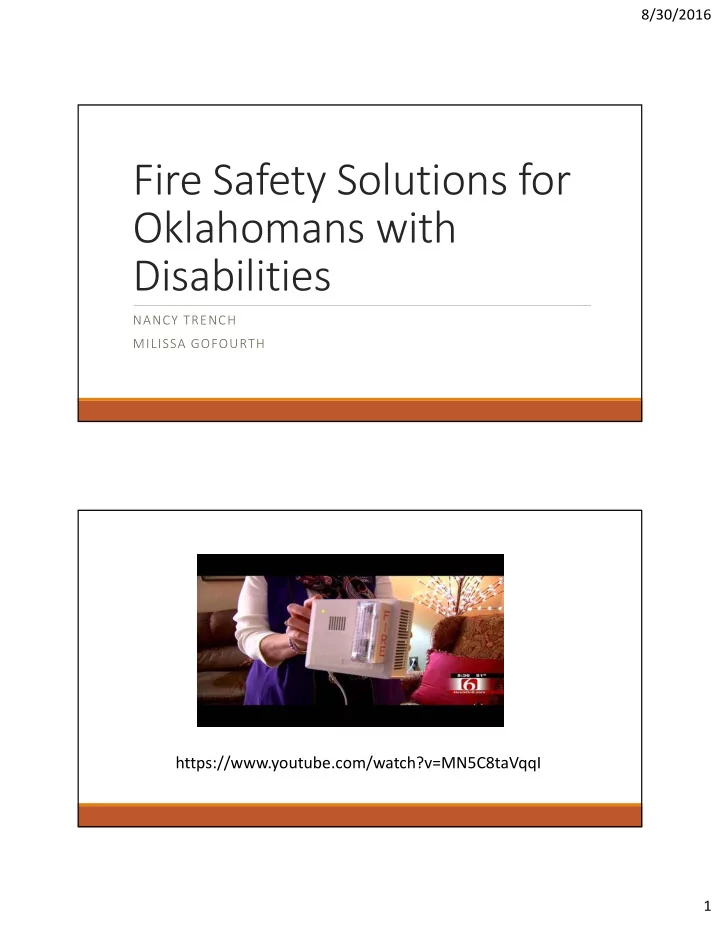
https://www.youtube.com/watch?v=MN5C8taVqqI

slide-2
SLIDE 2

8/30/2016 2

Facts

  • More people die in home fires than in tornadoes in Oklahoma
  • More people die in home fires across the United States than in all
  • ther disasters combined
  • Physical disabilities are a factor in 14% of fire deaths in U.S.
  • Death rate is 15 per million population for people with disabilities
  • Death rate is 9 per million population

The Oklahoma Program

  • FEMA Funded (Assistance to Firefighter Grants)
  • Statewide
  • No income requirement
  • No cost to the consumer
  • $400 worth of equipment per household
  • Pay trained installers
  • Program does not install in licensed facilities
  • Program Contact Information should the equipment malfunction
slide-3
SLIDE 3

8/30/2016 3

Serving People with Disabilities with Smoke Alarm Installations

  • Engage people with disabilities – what do you want to know about

home fires and HOW?

  • It takes time to develop a true partnership in trustworthiness
  • Once ASL Interpreters began to recommend the program
  • All materials in alternate formats, Braille, Audio, Large Print, ASL

DVD, HTML, etc.

  • If requested always provided paid ASL interpreters

Partnerships

  • Home Fire Safety Technical Partner(s)
  • Always inform the local fire department, the level of engagement varies

community to community

  • State Fire Marshall
  • State Fire Training Services
  • Disability Advocates/Organization
  • Assistive Technology Act program in your state
  • Rehabilitation agency
  • Center for Independent Living
  • Community‐based organizations
slide-4
SLIDE 4

8/30/2016 4

Building a Partnership for Success

  • Research Funding Sources – know the requirements
  • Federal and State Agency
  • Local Programs
  • Foundations and Insurance Providers
  • Red Cross
  • Create a Compelling Story – Why do People with Disabilities need

appropriate equipment

  • Plan the Doable

Involve People with Disabilities

  • Nothing about Us Without Us – the Disability Partner formed Focus

Groups

  • Deaf/Hearing Loss
  • Blind/Low Vision
  • Mobility
  • Cognitive
  • Lessons Learned
  • Modify common home fire safety messages ‐ not all messages work for all
  • Created a DVD in ASL
slide-5
SLIDE 5

8/30/2016 5

Marketing

  • News Release
  • Television/Radio Interview
  • Websites
  • Social Media
  • Events
  • Silent Dinners
  • Health Fairs
  • Conference Presentations/Booths
  • Satisfied Consumers

Program Components

  • Traditional canvassing door‐to‐door smoke alarm installation does

not work to serve people with disabilities

  • Application based program
  • It provides programmatic information as to who is served
  • Eligibility determines proof of disability
  • Arrange for home installation appointment
  • Formal Agreements with paid trained installers
slide-6
SLIDE 6

8/30/2016 6

Trained Installers

  • Serving people with disabilities (4 hours)
  • Social Etiquette
  • People First Language
  • Working with ASL Interpreters & service animals
  • Smoke Alarm & Alert Equipment Installation (3 hours)
  • The right alarm in the right place makes a difference
  • Bedside alert device set‐up and sync
  • Home Safety Messages

Program Evaluation

  • Critical to collect both qualitative and quantitative data
  • Change in behavior
  • Satisfaction level
  • Respond to feedback – especially if an alarm malfunctions
  • Regular Partner meetings
  • Evaluate timeliness and effectiveness
  • Outreach
  • Installations
  • Changes and improvements
slide-7
SLIDE 7

8/30/2016 7

Quality Assurance

  • Install Alarms – Giving Away is NOT effective
  • One is Not Enough – NFPA Standards
  • Install 2 Types of Alarms
  • Photoelectric – smoldering or dense smoke fires
  • Ionization – fast flaming fires
  • Prevent Nuisance Alarms – location, location, location
  • Replace Old Alarms ‐ Smoke alarms are only functional for 10 years

Fire Deaths Occur at Night

  • Smoke alarms save lives because they alert people to a fire
  • Smoke alarms are on duty detecting smoke 24/7
  • Deadly home fires occur while people are sleeping, so the primary

emphasis is: Smoke alarms need to intercept smoke from a fire before the smoke reaches sleeping people

  • The smoke alarm must wake people. The standard smoke alarm

sound does not wake some people. They need to be alerted with a low frequency sound and a bed shaker (tactile alert)

slide-8
SLIDE 8

8/30/2016 8

Install Bedside Alert Devices

  • People who are deaf and people who are hard of hearing need an

alert device to awake them

  • Alert devices are NOT smoke alarms, they listen for the smoke

alarm alert sound to activate

  • The alert device makes a low frequency sound and a shakes the bed
  • Check for the UL or ETL listing

Lifetone & SafeAwake

slide-9
SLIDE 9

8/30/2016 9

Smoke Alarm for People Who are Deaf In the Home

  • Installers need to take the time to train the resident(s) on how to
  • perate and test the alarm and alert device
  • Discuss and plan to practice the family fire escape
  • Provide additional Fire Safety information – How to Prevent a Home

Fire

slide-10
SLIDE 10

8/30/2016 10

Replicate the Oklahoma Program

  • Application
  • Home Fire Safety Materials
  • 2 Training Program Curriculums
  • Follow‐up Survey
  • 2 DVDs
  • Home Fire Safety for YOU – Presented in American Sign Language
  • Meet Natalea – Retrofit Home Fire Sprinkler System

https://www.ok.gov/abletech/Fire_Safety/index.html

Contact

Nancy Trench ntrench@osufpp.org Milissa Gofourth milissa.gofourth@okstate.edu