A Novel Compact Compliant Actuator Design for Rehabilitation Robots - - PowerPoint PPT Presentation

a novel compact compliant actuator design for
SMART_READER_LITE
LIVE PREVIEW

A Novel Compact Compliant Actuator Design for Rehabilitation Robots - - PowerPoint PPT Presentation

A Novel Compact Compliant Actuator Design for Rehabilitation Robots H.Yu, S. Huang,N. Thakor, G.Chen, S.L. Toh: National University of Singapore (NUS) M. STA Cruz, HOPE Technik Pte.Ltd, Singapore Y. Ghorbel, University of Stuttgart, Germany C.


slide-1
SLIDE 1

A Novel Compact Compliant Actuator Design for Rehabilitation Robots

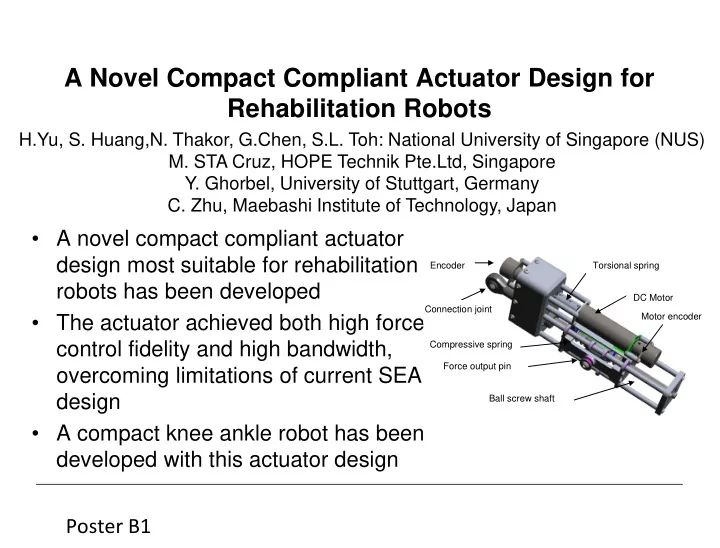
  • A novel compact compliant actuator

design most suitable for rehabilitation robots has been developed

  • The actuator achieved both high force

control fidelity and high bandwidth,

  • vercoming limitations of current SEA

design

  • A compact knee ankle robot has been

developed with this actuator design

H.Yu, S. Huang,N. Thakor, G.Chen, S.L. Toh: National University of Singapore (NUS)

  • M. STA Cruz, HOPE Technik Pte.Ltd, Singapore
  • Y. Ghorbel, University of Stuttgart, Germany
  • C. Zhu, Maebashi Institute of Technology, Japan

Ball screw shaft DC Motor Torsional spring Force output pin Compressive spring Connection joint Encoder Motor encoder

Poster B1

slide-2
SLIDE 2

Poster B2

slide-3
SLIDE 3

Poster B3

slide-4
SLIDE 4

Poster B4

Development and Control of a Lower Extremity Assistive Device (LEAD) for Gait Rehabilitation

slide-5
SLIDE 5

Non-Contact Capacitance Sensing for Continuous Locomotion Mode Recognition: Design Specifications and Experiments with An Amputee

Enhao Zheng, Long Wang, Yimin Luo, Kunlin Wei and Qining Wang Intelligent Control Laboratory, College of Engineering, Peking University, China qiningwang@pku.edu.cn

  • This paper presents a non-contact capacitance sensing system (C-Sens) to

measure the interfacial signals between the residual limb and the prosthetic socket.

  • With the continuous phase dependent classification method and the quadratic

discriminant analysis (QDA) classifier, the average recognition accuracies are 93.8% and 95.0% for the stance phase and the swing phase respectively.

  • The results show the potential of the proposed system for the control of powered

lower-limb prostheses.

Poster B5

slide-6
SLIDE 6

Poster B6

Muscle Force Estimation Method with Surface EMG for a Lower Extremities Rehabilitation Device

slide-7
SLIDE 7

A Quasi-Passive Compliant Stance Control Knee-Ankle-Foot Orthosis

Poster B7

slide-8
SLIDE 8

Poster B8

slide-9
SLIDE 9

Poster B9

slide-10
SLIDE 10

Poster B10

slide-11
SLIDE 11

Poster B11

A Novel Body Weight Support System Extension: Initial Concept and Simulation Study

slide-12
SLIDE 12

Poster B12

slide-13
SLIDE 13

Poster B13 Poster B13

slide-14
SLIDE 14

Towards ¡Extended ¡Virtual ¡Presence ¡of ¡ the ¡Therapist ¡in ¡Stroke ¡Rehabilita;on ¡

  • The ¡concept ¡of ¡‘extended ¡virtual ¡presence’ ¡is ¡

proposed ¡to ¡extend ¡the ¡therapists’ ¡service ¡to ¡ remotely ¡located ¡pa;ents. ¡

  • A ¡single ¡subject ¡case ¡study ¡is ¡performed ¡to ¡study ¡

the ¡feasibility ¡of ¡the ¡concept. ¡

  • Results ¡indicate ¡that ¡the ¡therapist ¡is ¡able ¡to ¡gain ¡

sufficient ¡proficiency ¡in ¡teleopera;ng ¡a ¡robot, ¡ prescribing ¡well-­‑balanced ¡and ¡challenging ¡tasks/ targets, ¡which ¡is ¡well ¡accepted ¡by ¡the ¡pa;ent ¡and ¡ the ¡spouse. ¡

Poster B14

slide-15
SLIDE 15

Poster B15

slide-16
SLIDE 16

Poster B16

slide-17
SLIDE 17

Poster B17

slide-18
SLIDE 18

A feasibility study of the effect of multichannel electrical stimulation and gravity compensation on hand function in stroke patients: a pilot study

  • A new therapeutic device for post stroke

arm/hand training is being developed.

  • Effect of gravity compensation (GC) and

electrical stimulation (ES) on dexterity was evaluated with Box and Blocks Test.

  • Possible to induce sufficient hand opening

but no instantaneous improvement of dexterity due to GC and ES.

  • More specific and sophisticated control

algorithms are needed.

  • T. Krabben, MSc; J.H. Buurke, PhD; G.B. Prange, PhD; J.S Rietman, PhD, MD

Poster B18

slide-19
SLIDE 19

Poster B19

slide-20
SLIDE 20

Poster B20

slide-21
SLIDE 21

Design of a self-aligning 3-DOF actuated exoskeleton for diagnosis and training of wrist and forearm after stroke

  • A novel exoskeleton for wrist and forearm to help post-

stroke survivors recover hand function has been developed

  • Decoupling of rotations and translations makes the

device self-aligning to the wrist’s axes

  • The device can provide training and diagnostics in the

full ROM of Flexion/Extension, Radial/Ulnar-deviation and Pronation/Supination while hand and fingers remain free

  • CAD design has been completed and a prototype will

provide real-world validation of mechanical and functional properties

  • J. Houdijn Beekhuis*, Ard J. Westerveld*, Herman van der Kooij*†, and Arno H.A. Stienen*‡

*Laboratory of Biomechanical Engineering, University of Twente, Enschede, NL †Biomechanical Engineering, TU Delft, NL ‡Physical Therapy and Human Movement Sciences, Northwestern University, Chicago (IL), USA Corresponding author: arnostienen@gmail.com

Poster B21

slide-22
SLIDE 22

Poster B22

slide-23
SLIDE 23

Poster B23

slide-24
SLIDE 24

Poster B24

slide-25
SLIDE 25
  • Avoiding contact through safety margins

significantly reduces the reachable workspace of an assistive robot.

  • Whole-arm tactile sensing can improve

task performance and limit contact forces during assistive tasks.

  • Able-bodied users controlling an

assistive robot to perform a task around their bodies find physical contact by the robot acceptable.

Phillip M. Grice1, Marc D. Killpack1, Advait Jain2, Sarvagya Vaish1, Jeffrey Hawke1, Charles C. Kemp1

  • 1. Healthcare Robotics Lab, Georgia Institute of Technology
  • 2. Redwood Robotics

Whole-arm Tactile Sensing for Beneficial and Acceptable Contact During Robotic Assistance Poster B25

slide-26
SLIDE 26

Poster B26

slide-27
SLIDE 27

Design of a Robotic Mobility System to Promote Socialization in Children

  • A robotic mobility system has been

developed to track multiple moving targets and plan a path to the goal while avoiding moving obstacles.

  • Use force-feedback to train children to

join the peers in a ball chasing game.

  • Results show that all modules functioned

well and the system is promising in promoting socialization in children.

Xi Chen, Christina Ragonesi, James C. Galloway, University of Delaware, USA Sunil K. Agrawal, Columbia University, USA

Poster B27

slide-28
SLIDE 28

A Haptically Enhanced Painting as a Tool for Neurorehabilitation

  • A new form of interaction combining

haptic and sonic exploration with static visual information from a real painting

  • Preliminary results suggest approach

might be of value to neurorehabilitation by exploring concepts of augmented art works with technology (haptics + sound), promoting social integration and potential use in public spaces.

HH Le, RCV Loureiro, A Zivanovic, MJ Loomes: Middlesex University, UK F Dussopt: Florian Dussopt Design Studio, UK N Phillips : Nick Phillips Design Studio, UK

Poster B28