
SLIDE 1
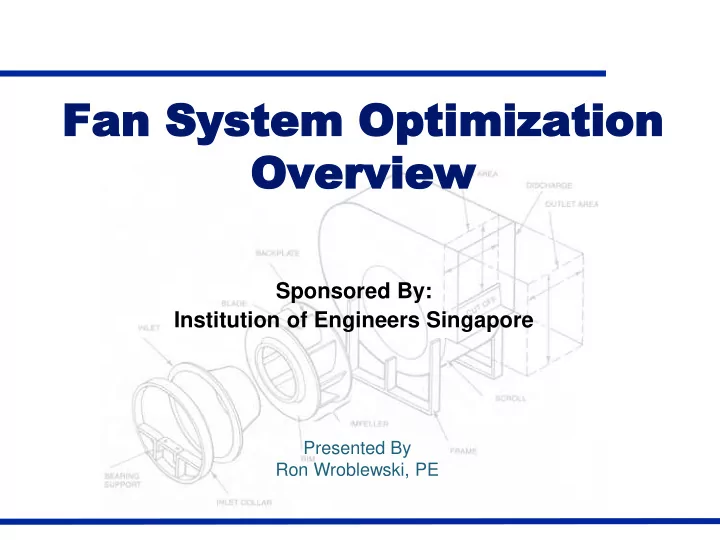
Fan Fan System Optimization System Optimization Overview Overview
Sponsored By: Institution of Engineers Singapore
Presented By Ron Wroblewski, PE
Fan Fan System Optimization System Optimization Overview Overview - - PowerPoint PPT Presentation
Fan Fan System Optimization System Optimization Overview Overview Sponsored By: Institution of Engineers Singapore Presented By Ron Wroblewski, PE What is Efficiency? output Useful Output or input Energy Input
Sponsored By: Institution of Engineers Singapore
Presented By Ron Wroblewski, PE
What is Efficiency?
Efficiency is the portion of energy you paid for that is actually doing the work
What is Deficiency?
Deficiency is the energy working against you.
Damper Locations
Rolling Mill Reheat Furnace Example
Optimization Benefits
Financial Corporate Production Maintenance Safety Environmental Societal
Time Magazine April 5, 2004
To the untrained eye, the inefficient fan and the efficient fan look the same. The conditions that cause them to work inefficiently are everyday occurrences.
Characteristics of Fan Systems
Tough Enduring They will suffer years of abuse quietly, because of their resilient nature.
Measuring Fan Systems ISO 5802
needed to measure the performance of a fan system draw from —Calculus —Fluid dynamics —Thermodynamics and —Psychrometrics
Measuring Fan Systems ISO 5802
measure.
has mass and momentum, the flow is: —Unsteady —Pulsing —Uneven
contractions and expansions in the ductwork
Variable Frequency Drives
maintenance
quality problems
Other Optimization Strategies
slow down the fan
more efficient model
efficient model
reduce friction at key choke points
Other FSO Strategies
Advantages:
rooted in the system Disadvantages
knowledge and hard work
fan performance
FSO study
FSO Tools and Training – US DOE
—Efficiency guides —Tip sheets —Case studies
FSO tools and training - Productive Energy
In-Person Training
advanced level
FSO online training – productiveenergy.com
—Motors intro —Psychrometrics —Heat Recovery* —Simplified affinity laws —Fan controls —Measuring fan performance
Case Study – Malting
Expansion of a malthouse
4 fans serve the kiln
system, ~11 in/wg
Malting – Proposal Options
Proposal #19107 730 SWSI = $30,030 Proposal #19108 670 DWDI = $39,835 Proposal #19207 660 DWDI = $40,955 Q 150,000 ACFM Q 150,000 ACFM Q 150,000 ACFM Ps 11 in/wg Ps 11 in/wg Ps 11 in/wg ρ .072 lbs/ft3 ρ .072 lbs/ft3 ρ .072 lbs/ft3 N 875 RPM N 890 RPM N 890 RPM HP 387 BHP HP 379 BHP HP 359 BHP Ps(Max) 14 in/wg Ps(Max) 11.8 in/wg Ps(Max) 14.2 in/wg ŋ 67% ŋ 68% ŋ 72%
Malting – Analyses
Malting – Simple Payback
Proposal #19107 Proposal #19207 BHP 387 359 Cumulative BHP 1,548 1,436 Difference kW 1,154.8 1,071.3 83.6 kWh/yr, @8000 Hours 9,238,464 8,570,048 668,416 $/yr, @ $0.05/kWh 461,923 428,502 33,421 First Cost $ 30,030 $ 40,955 $ 10,925 Cumulative First Cost $ 120,120 $ 163,820 $ 43,700 Simple Payback
16 months
Case Study – Coke Oven
Steel Mill – Coke Oven Baghouse Fan
670-683 Type R37A DIDW
Steel Mill – Coke Battery
Summary
cycles
2.5 year
Steel Mill
Hot Dip Plating Line
Savings $883 000 /year Cost $751 000 Simple payback 0.9 Years
Ronald G. Wroblewski, P.E. Madison, WI 53726 1 (608) 232-1861 www.productiveenergy.com ron@productiveenergy.com Thank You!