Family Foodways Evaluation Results CECILIA GARIBAY PRINCIPAL - - PowerPoint PPT Presentation

family foodways
SMART_READER_LITE
LIVE PREVIEW

Family Foodways Evaluation Results CECILIA GARIBAY PRINCIPAL - - PowerPoint PPT Presentation

CHILDRENS DISCOVERY MUSEUM OF SAN JOSE October 15, 2015 Family Foodways Evaluation Results CECILIA GARIBAY PRINCIPAL Perceptions of the Caf as Healthy The Caf was universally perceived as providing a healthy, appealing food options


slide-1
SLIDE 1

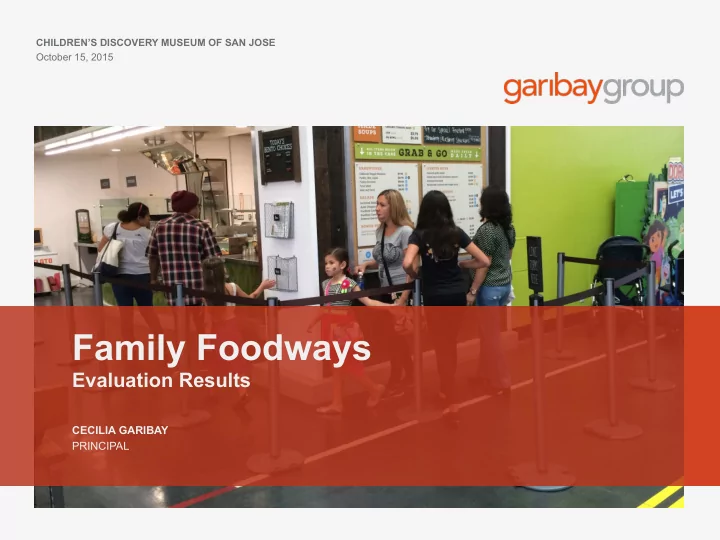
Family Foodways

Evaluation Results

CHILDREN’S DISCOVERY MUSEUM OF SAN JOSE October 15, 2015

CECILIA GARIBAY PRINCIPAL
slide-2
SLIDE 2

Perceptions of the Café as Healthy

  • The Café was universally perceived as providing a healthy, appealing

food options for families. 26 (96%) of the 27 families who participated in the word association activity selected healthy. The other most common terms selection were good for me (78%) and foods I like (74%).

  • When asked what made the Café healthy, they discussed the

emphasis on whole grains and fresh fruit and vegetables. Other terms such as “organic” and “local” were mentioned, but not as universally as “whole” and “fresh”.

  • Respondents who were familiar with the previous Café recognized

the FoodShed Café as a significant change towards promoting healthy eating. There was, however, a vocal minority who wanted the former options, especially soft drinks.

slide-3
SLIDE 3

Supporting Families’ Healthy Food Choices

  • Caregivers agreed that the Café supports their families in making

good food choices when eating at CDM.

  • Children felt positive about the variety of choices and their ability to
  • choose. When asked to pick phrases that described the Café from a

set of options, more than half the children selected the phrases “lots

  • f choices” or “I get to pick foods.”
  • While caregivers appreciated that children could choose their options

(e.g., their own side dishes), the current design of the counter makes it difficult for children to see the options and make their own choices. Even adults had difficulty figuring out the process.

  • Some families wanted a greater variety of hot meal options for both

children and adults.

slide-4
SLIDE 4

Facilitating Families’ Conversations about Healthy Eating

  • While we documented a number of conversations families had about

healthy eating, the Café was not necessarily sparking these discussions consistently. In other words, nothing in the Café was intentionally prompting discussions of healthy eating among the families.

  • When discussions took place, some of the most promising aspects of

the Café that prompted conversations were: ‒ The FoodShed Map ‒ The labeling of Gluten Free and Vegetarian items on the menu ‒ The absence of soft drinks (made apparent by the Sparklers) ‒ The “energy ball” ‒ The non-ketchup chicken finger dipping sauce ‒ The chicken finger breading and how the chicken fingers differed from McDonald’s chicken nuggets

slide-5
SLIDE 5

Accessibility and Affordability

The perception that the Café was accessible and affordable for ethnically and economically diverse families was mixed.

  • When asked to pick phrases that described the Café from a set of options

containing the words “affordable” and “expensive”, respondents were on the

  • fence. Ultimately, about a third chose “expensive” and another choose

“affordable.” The remaining respondents did not make a choice between the two.

  • Of the families who described the Café as expensive, some agreed that it was

affordable and fairly priced when they realized the food was local and organic. Families for whom organic and local foods were not a priority felt the food prices were high. Portion sizes seemed to be the main issue with these families.

  • When asked directly if the Café seemed like a space for all families, respondents

unanimously said “yes.” A small number specifically mentioned appreciating the rotating hot special, which reflected food from cultural groups in the San Jose area.

  • Respondents who brought food with them specifically mentioned that they felt

comfortable and welcomed sitting in the Café with the food they brought from

  • home. They compared this to other museums and public places with on-site

dining where they felt judged by staff for bringing their own food.

slide-6
SLIDE 6

Reasons Families Bring Food From Home

  • Some families packed lunches and snacks to bring to CDM in order to

save money, which allows them to go on more family outings.

  • Other families brought their own food from home because they knew

that their children would eat the food they bring as opposed to what may be available in the Café.

  • Finally, some families brought their own food from home because they

were not familiar with the options available in the new Café.

slide-7
SLIDE 7

Usability and Customer Service

  • Crowding is a challenge in the Café. The number of people, particularly

when ordering, makes it difficult for visitors to understand all the options and make choices without feeling rushed.

  • At peak hours, tables are at a premium, and it can feel chaotic in the

Café.

  • At peak hours, there were also not enough high chairs. As a result,

visitors brought strollers into the Café area, making it difficult for people to move around.

  • Staff knowledge, especially about allergens and dietary needs, was not

as high as it should have been. This lack of knowledge frustrated and caused stress for caregivers.

  • We received a number of customer service complaints. These visitors

perceived staff as not being especially friendly or helpful.

slide-8
SLIDE 8

The Café Model

The following are insights from interviews with key players about the Café model:

  • The need for values clarification and mission alignment in order to

inform all decisions

  • The importance of bringing in outside expertise
  • The need for board support
  • The importance of clear communication throughout the process with

everyone including floor staff

slide-9
SLIDE 9