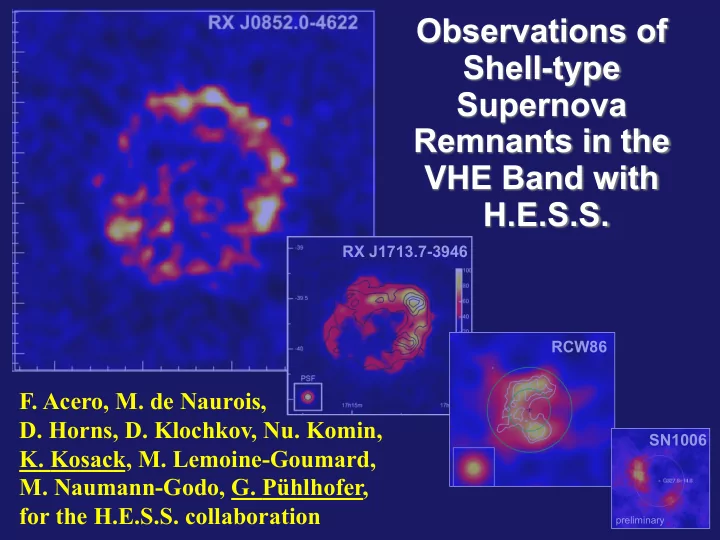
SLIDE 1 RX J1713.7-3946 RCW86 SN1006
preliminary
- F. Acero, M. de Naurois,
- D. Horns, D. Klochkov, Nu. Komin,
- K. Kosack, M. Lemoine-Goumard,
- M. Naumann-Godo, G. Pühlhofer,
for the H.E.S.S. collaboration
SLIDE 2 RX J1713.7-3946
H.E.S.S. 2004 H.E.S.S. 2005
Probable scenario:
- Shock interacts with high density wind blown shell
(probably inside molecular cloud)
- Dominant leptonic VHE gamma-ray emission scenario
would require low B-field (magnetic field damping after shock to explain X-ray synchrotron morphology ?)
- Dominant hadronic VHE scenario fits nicely, but low
level of thermal X-ray emission needs to be explained!
RX J1713.7-3946 Berezhko & Völk (2006)
Shock speed 1840 m/s e/p ~ 10-4, B = 126 µG asymptotically 50%
synchrotron radiation o decay
SLIDE 3 smoothed X-ray contours Flux: 1% Crab
2 – 4.5 keV X-rays VHE -rays
H.E.S.S. prelim.
HESS VHE excess map XMM map (2-4.5 keV)
B ?
preliminary
SN 1006
SLIDE 4
smoothed X-ray contours Flux: 1% Crab
2 – 4.5 keV X-rays VHE -rays
H.E.S.S. prelim.
HESS VHE excess map XMM map (2-4.5 keV) smoothed to HESS PSF preliminary
SLIDE 5 smoothed X-ray contours Flux: 1% Crab
H.E.S.S. prelim.
- Mixed model (superposition of leptonic and hadronic VHE emission)
gives good description of data, reasonable Wp ~ 12% WSN
- Pure leptonic model may also work (reasonable B-field of 45µG)
smoothed X-ray contours
preliminary o decay IC on CMB preliminary
SLIDE 6 Chandra & XMM H.E.S.S .
PSF
RCW 86 Age 2 kyr (?)
- Dist. 2.5 kpc (?)
- SNR expands in wind-blown bubble (cf. RX J1713.7-3946 + Vela Jr.), but:
distinct regions of thermal (high ρ) and non-thermal (low ρ) X-rays
- In NE, measured post-shock temperature (2.3±0.3 keV, from Hα line width) is much
smaller than expected (40..70 keV, from shock velocity measured with Chandra) (Helder et al., Science 2009) >50% of energy in non-thermal component or in turn, efficient CR acceleration “cools” thermal X-ray temperature
- But: morphological comparisons not yet possible due to lack of VHE statistics
SLIDE 7
Galactic Plane, H.E.S.S., E>100 GeV
SLIDE 8
Galactic Plane, H.E.S.S., E>100 GeV There’s at least one !
SLIDE 9
HESS collaboration, A&A 2008: ~14 hours lifetime
Color map: H.E.S.S. γ-ray excess Contours: H.E.S.S. significance
HESS J1731-347
SLIDE 10
HESS collaboration, A&A 2008: ~14 hours lifetime
B&W map: ATCA 1.4 GHz
Tian et al., ApJ 2008
Color map: H.E.S.S. γ-ray excess Contours: H.E.S.S. significance
HESS J1731-347
SLIDE 11
Color map: H.E.S.S. γ-ray excess Contours: H.E.S.S. significance
HESS collaboration: ~30 hours lifetime
Shell model preferred at the 2.1σ level more H.E.S.S. data under way
HESS J1731-347
HESS collaboration, A&A 2008: ~14 hours lifetime
HESS J1731-347
SLIDE 12
All X-ray observations (Suzaku, XMM-Newton, Chandra) focused so far on the (X-ray-) bright Eastern part of the source Color map: XMM-Newton
Technical details: MOS1+MOS2, 0.5-4.5 keV, 23 ksec
Red contours: ATCA 1.4 GHz
HESS J1731-347
SLIDE 13
Color map: XMM-Newton
Technical details: MOS1+MOS2, 0.5-4.5 keV, 23 ksec
Red contours: ATCA 1.4 GHz
Technical details: absorbed power-law spectra, MOS2 example spectrum from white dashed box region
HESS J1731-347
SLIDE 14 Significant gradient of absorption column NH = 1.0 .. 1.7 × 1022cm-2
Technical details: assumption of a pure power law, „wabs“ absorption model
x kpc ? SNR
a distance estimate!
HESS J1731-347
blue contours: XMM-Newton
SLIDE 15
Significant gradient of absorption column NH = 1.0 .. 1.7 × 1022cm-2
Technical details: assumption of a pure power law, „wabs“ absorption model
Matching increase in absorption derived from 12CO observations
Technical details: CfA CO survey data; map integrated from LSR velocities between 0 and -17 kms-1, where first peak towards the SNR appears; CO-to-H2 mass conversion factor 2.5×1020cm-2K-1km-1s
Object is at least 3.5 kpc away!
Technical details: Galactic rotation model from Fich et al. 1989
[NH] = 1022cm-2
HESS J1731-347
blue contours: XMM-Newton blue contours: XMM-Newton
SLIDE 16
- The class of VHE-emitting SNR shells is slowly
growing; latest addition is SN 1006
- Hadronic vs. leptonic VHE emission scenarios (so far)
usually employ spectral and morphological comparisons to X-ray emission
- HESS J1731-347: If association of VHE emission with
the SNR (radio) shell will be confirmed, then HESS J1731-347 is the most distant spatially resolved VHE SNR shell detected so far
- With the same caveat, HESS J1731-347 could be the
- ldest yet identified shell-type VHE SNR; from a simple
Sedov solution:
tSNR 4800 n0 0.1 cm3
1 2 years (if E 1051erg)